Building Bridges Through Travel and Dialogue
The future Sarah believed in
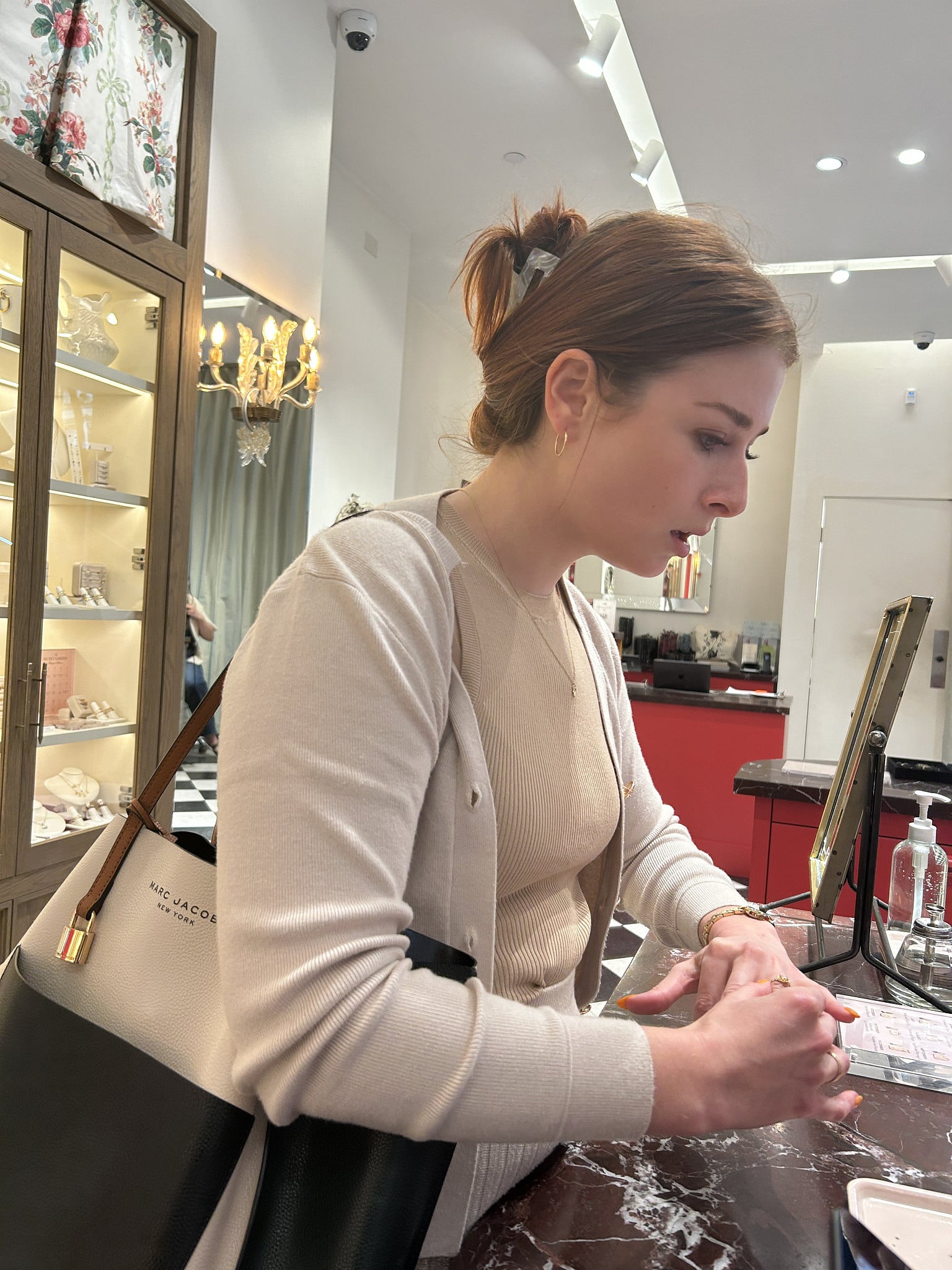
A glimpse into Sarah's future, trying on engagement rings at the AJC Global Forum in April 2025. Photo credit: Mayan Chin Jacobi.
Last week, I returned to the AJC Global Forum carrying two very different emotions: gratitude and grief.
The American Jewish Committee’s Global Forum brings together thousands of Jewish leaders, diplomats, policymakers, students, and advocates from around the world. It is built on a simple idea: the Jewish people are strongest when we show up for one another. This year, that idea felt more personal than ever.
The last time I attended Global Forum, Sarah Milgrim was there.
We were together in New York, surrounded by friends and colleagues committed to the Jewish people, Israel, and the work of repairing the world. Like so many friendships formed through AJC and the Michael Sachs Fellowship, ours was rooted in a shared belief that relationships matter- that even in moments of tension and disagreement, people can still choose connection over division.
One of my clearest memories from that week has nothing to do with a stage or a session. It is walking with Sarah as she looked at engagement rings. She invited me into one of the most joyful and intimate chapters of her life, allowing me to witness the future she was building with Yaron.
That memory has stayed with me- not only because it captures Sarah’s joy, but because it captures her way of being in the world. She lived with openness. She believed in what was possible.
Sarah and Yaron believed deeply in building a better future. In fact, just before their lives were taken in a horrific antisemitic attack in Washington, they had attended an event at the Capital Jewish Museum titled “Turning Pain into Purpose,” which explored how dialogue, humanitarian cooperation, and cross-cultural partnership can help shape a more peaceful future in the Middle East.
The hatred that ended their lives stood in direct opposition to everything they stood for.
This year at Global Forum, many of the same friends gathered again. The conversations continued. The work continued. But Sarah was not there.
Her absence was not announced. It was felt- in the pauses between sentences, in the stories told about her, in the quiet recognition that someone who should have been in the room was missing.
Returning to Global Forum felt like completing a circle- not because grief resolves itself, and not because there is closure when someone is murdered, but because I returned to a community she deeply loved, in a city now inseparable from her story.
Washington was where Sarah and Yaron met. Where they fell in love. Where they imagined a shared future. And it is where that future was stolen.
And yet, what stayed with me most from this year’s gathering was not only what was lost. It was what remained.
It was the resilience of a community that refuses to disappear. It was the determination of people who continue to show up even when it hurts. It was the choice, made again and again, not to surrender meaning to violence.
In one of the sessions, someone said that the Jewish people have never been sustained by safety alone, but by responsibility- to one another, and to the world beyond us. That idea echoed differently this year. It felt less theoretical and more urgent.
Because responsibility now looks like continuity. It looks like refusing to let fear define Jewish life. It looks like continuing to build relationships across communities, across borders, across difference- even when that work feels fragile.
Sarah believed in that work. She lived it. And in that sense, her presence at Global Forum this year was still real, not in absence but in impact- in the way people spoke her name, in the way her values surfaced in conversations, in the way her commitment to justice and connection still shaped the room.
Grief does not ask to be resolved. But it does ask what we will do with what remains.
So the question I left Global Forum with is not only how we remember Sarah, but how we continue what she began. How we keep choosing dialogue over division. How we keep building relationships that outlast fear. How we ensure that hatred does not get the final word.
If there is a call to action in this moment, it is simple: show up. Stay engaged. Build something with others, even when it is hard. Especially when it is hard.
Because the opposite of what was taken from Sarah and Yaron is not silence. It is presence.
And presence- choosing to be in the room, to listen, to connect, to continue- is how we honor them now.
Related Topics