
The genocide argument before the genocide argument

TL;DR: The Gaza genocide debate often begins after the crucial question has already been skipped. Death, deprivation and destruction can be evidence of genocide, but only if they also establish the specific intent to destroy a protected group. A failed refutation does not prove the accusation, and showing that genocidal intent could be inferred does not show that it has been. Once that threshold is crossed too early, the accusation starts organizing the evidence around itself and acquires force far beyond the legal debate. The real question is not how much evidence there is, but what the evidence actually proves.
*
Bret Stephens recently called the claim that Israel committed genocide in Gaza “farcical.” Mehdi Hasan responded by dismantling several of the examples Stephens offered in support of that conclusion. Stephens asks why a state intent on destroying Palestinians would permit vaccination campaigns, allow food into Gaza, issue evacuation warnings, and leave unused vastly greater destructive capacity. Hasan replies that food entered under pressure, warnings were inconsistent, vaccinations were not an Israeli humanitarian initiative, and genocide does not require killing every member of a protected group.
Their disagreement begins after a more consequential agreement has already been reached. Genocide has entered as the category within which deaths, destruction, deprivation, political statements and military conduct are to be sorted. Stephens searches for facts inconsistent with it, while Hasan weakens those facts and treats the accusation as correspondingly strengthened. The sequence matters. Conditional refutation does more than test an accusation. It assumes that the accusation has already crossed the threshold for a genocide claim. If the defining element of genocide has not been established, the refutation quietly grants the accusation a status the evidence has not earned.
The gate
The Convention on the Prevention and Punishment of the Crime of Genocide makes that earlier step unavoidable. Article II combines specified acts with an intent to destroy, in whole or in part, a national, ethnical, racial or religious group as such. The International Court of Justice describes this specific intent as the “essential characteristic” of genocide and the feature that distinguishes it from other serious crimes. Intent need not arrive in a written extermination order. In Bosnia and Herzegovina v. Serbia and Montenegro, the Court accepted that genocidal intent can be established circumstantially and recognized genocide at Srebrenica against a geographically concentrated substantial part of the protected group. Croatia v. Serbia supplies the other half of the rule: the Court found killings and serious bodily or mental harm falling within Article II, then separately examined whether the required genocidal intent existed and concluded that it did not. The classification therefore occurs at a precise point: evidence that members of a protected group were destroyed must become evidence that destruction of the group was itself intended.
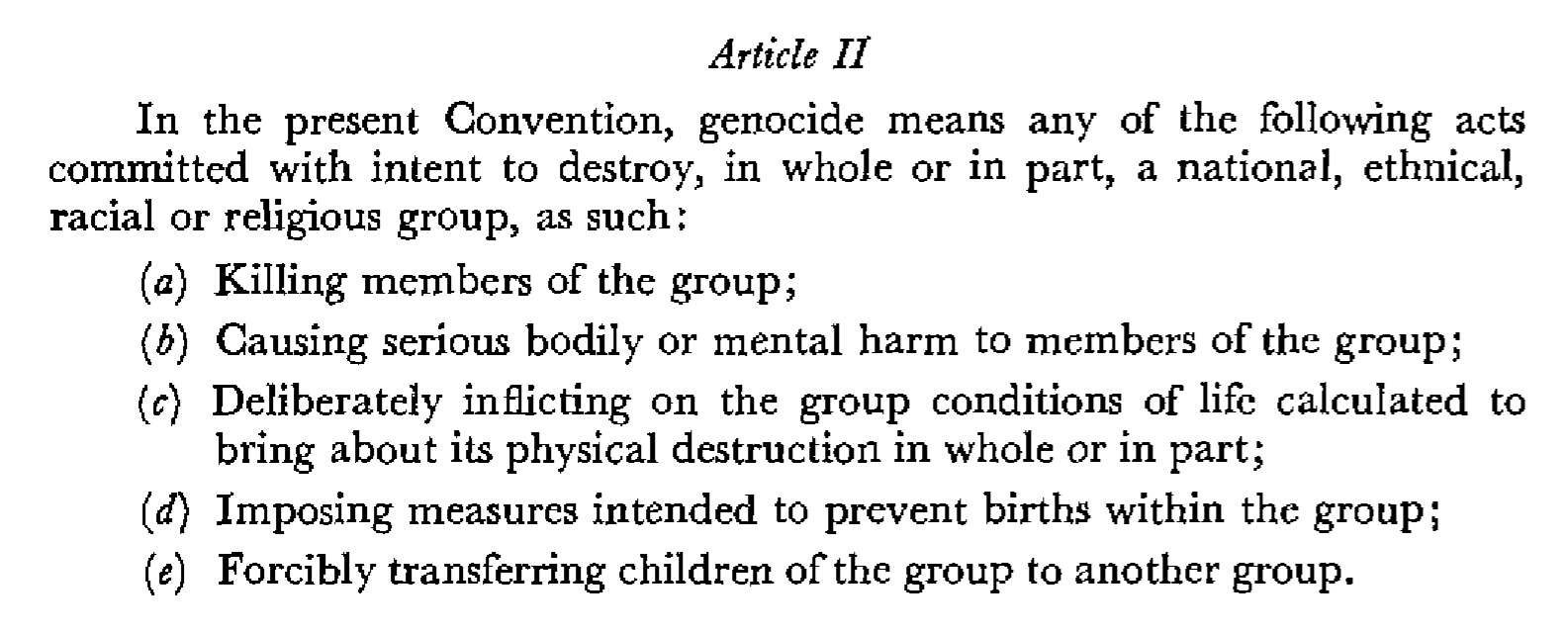
That boundary is the gate, and the Stephens-Hasan exchange shows what happens when it is bypassed. Stephens accepts genocide as the proposition to be refuted; Hasan dismantles parts of his refutation, and this is treated as strengthening the accusation. It does not. Showing that an argument against genocide fails is not evidence that genocide occurred. But the distortion goes further. Once genocide is admitted before its defining intent has been established, the accusation begins to organize the evidence around it: destructive acts become evidence of genocide, contrary evidence becomes something to explain away, and the failure of those explanations becomes further support for the accusation. The accusation can then become progressively harder to dislodge without ever having established the intent required to put it there.
The UN Independent International Commission of Inquiry and Amnesty International attempt to supply that inference. Amnesty combines deaths, destruction, displacement, deprivation and statements by Israeli officials into a finding of specific intent, while the Commission concludes that official statements and the pattern of conduct establish genocidal intent. These are affirmative arguments for genocidal intent, not merely assertions of it. The question is whether the evidence establishes the inference they draw.
What the evidence proves
Statements appear to offer the shortest route to genocidal intent: instead of inferring purpose from conduct, one appears to hear it from the actors themselves. But a statement does not establish its own evidentiary meaning. A senior minister may reveal a personal preference, articulate government policy, influence policy without formal authority, direct implementation or describe an objective already visible in operations. The words alone cannot tell us which of these they are. Their evidentiary meaning depends on who spoke, what was being referred to, the speaker’s authority, the institutional setting, the decisions that followed and the relationship between the statement and subsequent conduct.
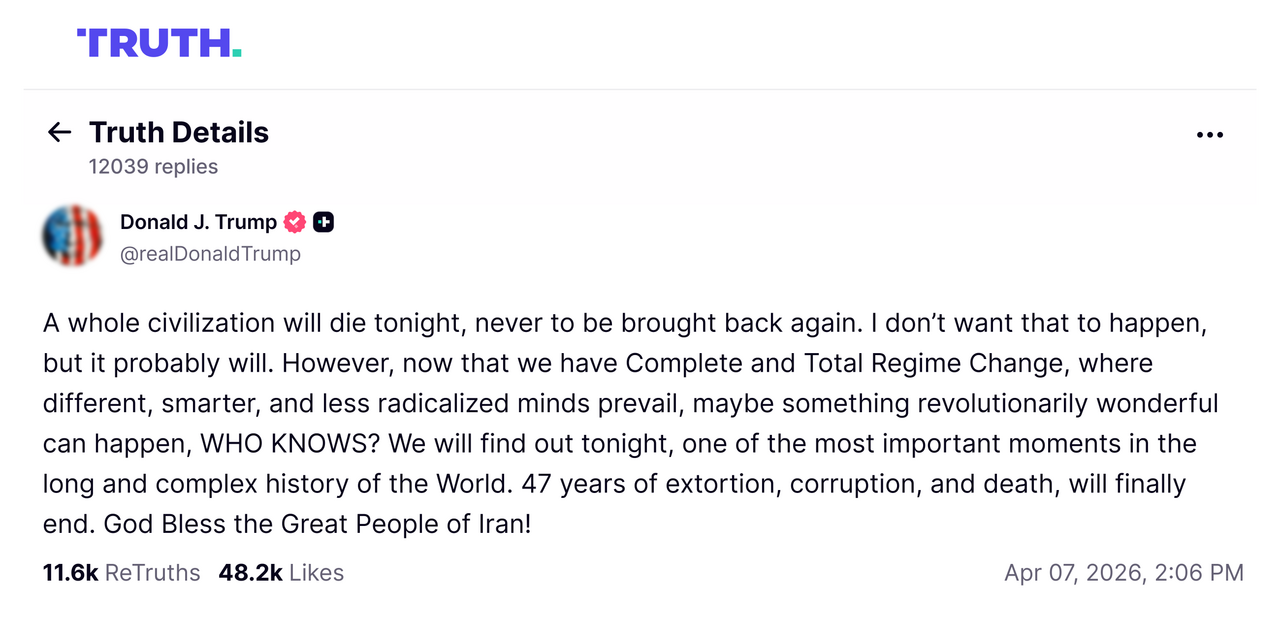
The same rule becomes clearer when Israel is removed from the example. During an active U.S. war with Iran, after American forces had already struck Iranian targets, President Trump warned that “a whole civilization will die tonight” if Iran did not make a deal. The combination is striking: the head of state invokes the destruction of a “civilization” while his country is already using military force against Iran. Even this combination does not establish American genocidal intent toward Iranians. The relevant questions are whether the statement expresses a purpose to physically destroy Iranians as a national group, whether that purpose can be attributed to the state, and whether policy and conduct provide evidence of that purpose. The meaning of “civilization,” the surrounding political objectives and the operations that followed matter because they bear on those questions. The evidentiary rule is the same when the speaker is Israeli.
Deprivation presents the same problem in a more difficult form. Article II(c) covers deliberately inflicted conditions of life “calculated to bring about” the physical destruction of the group. Here the conduct itself can provide evidence of intent, but the two cannot simply be collapsed: creating conditions that are destructive to a population is not the same proposition as creating those conditions in order to destroy the group. A policy intended to bring about physical group destruction and a policy intended to coerce an adversary while knowingly causing deprivation may produce the same deaths, hunger, and suffering. The consequences establish what the policy did. They do not, by themselves, establish what it was for. That is precisely the work performed by “calculated to bring about.” Without that distinction, the consequences would prove the intent simply by being consequences, and the defining element of genocide would disappear into the act itself.
Knowledge strengthens the inference, but it does not erase the distinction between consequence and purpose. Continuing a policy after its destructive effects are known can provide evidence of the purpose for which it is maintained. Gaza, however, presents a changing rather than a fixed pattern: humanitarian access was negotiated, restricted, expanded and adjusted over time, under external pressure and alongside changing military operations. Those changes belong to the evidence from which intent must be inferred. A claim of a single continuing purpose to physically destroy the group must therefore explain them, rather than treat every restriction as evidence of that purpose and every relaxation as irrelevant to it. Otherwise the evidentiary rule runs in only one direction: whatever increases suffering counts toward genocidal intent, while whatever reduces suffering is denied the capacity to count against it.
Operational conduct makes the problem still clearer. Gaza has suffered catastrophic destruction, civilian death, displacement and damage to life-sustaining infrastructure. Observable Israeli conduct has repeatedly been directed toward Hamas personnel and infrastructure, hostage recovery, territorial control and the degradation of Hamas’s military and governing capacity. The existence of these objectives cannot establish the absence of an additional genocidal purpose. Equally, demonstrating that an additional purpose could coexist with them supplies no evidence that it did.
This asymmetry is important. Evidence that conduct serves a military purpose does not by itself exclude an additional purpose to destroy the protected group: the two could coexist. But establishing the military purpose does nothing to establish the genocidal one. That second purpose must be demonstrated from the evidence, not inferred merely from the fact that coexistence is possible. Otherwise, destructive consequences can be attributed to an additional genocidal purpose, and then used as evidence that this additional purpose existed.
The problem becomes decisive when the claim is that genocidal intent is the only reasonable inference. Such a claim fails if another explanation of the evidence remains reasonable; that alternative need not itself be proved correct. The pursuit of identifiable Hamas targets, hostage negotiations, evacuations, changing operational geography, tactical pauses and shifting humanitarian arrangements therefore matter without individually disproving genocide. Taken together, they sustain a reasonable account in which military and coercive objectives explain substantial portions of the observed conduct. A claim that genocidal intent is nevertheless the only reasonable inference must show why that account is no longer reasonable. It cannot become the only reasonable inference while another reasonable inference remains.
Possibility is not demonstration
The preceding arguments expose a distinction that becomes easy to lose as examples accumulate. Genocidal intent may be established circumstantially, including from conduct and statements; it may coexist with military purposes; and genocide may be directed at a geographically concentrated substantial part of a protected group. Political officials may influence policy without formal authority, while knowledge of practically certain destruction may contribute to an inference of purpose. All of this tells us how genocidal intent could, in principle, be established. It does not tell us that it has been established in Gaza. That distance between legal possibility and evidentiary demonstration is precisely what the gate preserves.
Seen from that perspective, the Stephens-Hasan exchange becomes simpler. Stephens points to food deliveries, vaccinations, and warnings as evidence against genocidal intent. Hasan correctly shows that none of them makes genocidal intent impossible. But showing that genocide remains possible is not evidence that it occurred. The institutional arguments are more substantial: they attempt to establish genocidal intent affirmatively from statements, deprivation, and the pattern of conduct. Yet here too, showing that such evidence can establish genocidal intent does not show that it does establish it in Gaza. In both cases, possibility is being asked to do work that only evidence can do.
The cost of getting the sequence wrong
The sequence would matter less if the genocide accusation remained confined to legal argument. It does not. Once the accusation is institutionally absorbed, it begins reorganizing relationships around it: cooperation becomes complicity, professional association becomes normalization, and disagreement becomes genocide denial. Jews and Israelis can consequently be made answerable for a crime whose classification remains contested. The wider environment in which this occurs is measurable. The European Union Agency for Fundamental Rights reports that 76 percent of Jewish respondents conceal their Jewish identity at least occasionally, 34 percent avoid Jewish events or sites because they feel unsafe, and 41 percent frequently conceal their identity at school or university. Concealment, avoidance, withdrawal, and heightened attention to personal safety are behavioral adaptations to an environment experienced as hostile. The genocide accusation need not explain these patterns by itself for its institutional circulation to become one mechanism through which that environment reaches Jews and Israelis.
That gives the category boundary a consequence often missing from the genocide debate. A false or conceptually defective accusation does not remain suspended harmlessly while scholarship waits for clarification. It can affect employment, social relations, institutional participation, mental well-being and the willingness to appear publicly as Jewish or Israeli. These consequences do not determine whether genocide occurred. They do remove the assumption that only premature exclusion carries a cost. Premature admission carries one as well.
The International Court of Justice itself demonstrates why these stages must remain separate. In the provisional-measures proceedings in South Africa v. Israel, the Court did not find that it was plausible that Israel was committing genocide. Joan Donoghue, who presided over the Court when the order was issued, later corrected that widespread interpretation explicitly: the Court found plausible the Palestinians’ right to protection from genocide and South Africa’s right to seek protection of that right; it “did not decide that the claim of genocide was plausible.” The distinction is fundamental. Provisional measures allow a court to protect rights before the underlying allegation has been adjudicated. Turning that precautionary threshold into evidence that genocide itself was plausible reverses the function of the ruling: a mechanism designed to preserve rights under uncertainty becomes evidence that the central uncertainty had already been resolved.
The gate matters especially for genocide because few accusations carry comparable moral and institutional force. Once the word is accepted, that force travels ahead of adjudication: it shapes institutions, relationships and the interpretation of subsequent evidence. This is precisely why the sequence cannot be reversed. The gravity of the accusation cannot supply the element required to establish it.
The argument over Gaza has spent extraordinary energy asking whether there is enough evidence for genocide. That question comes too late. The prior question is what the evidence establishes: catastrophic destruction, however extensive, becomes evidence of genocide only when it establishes the specific purpose to destroy the protected group. Until that inference is made, the evidence may establish many terrible things. It has not yet established genocide.