

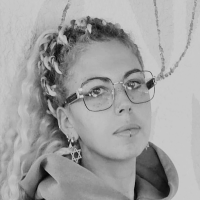
French-Israeli Visual Artist and Writer
The Geography of Belonging – Lech Lecha 5787

Credit photo: @YiddishFeminist / Morgane Koresh
I approach the weekly Torah portion not as a religious scholar or someone seeking to offer an authoritative interpretation, but as a secular Jew for whom Jewish texts remain a source of curiosity, questioning, and spiritual reflection. My reading is shaped by commentaries, personal experience, and the circumstances of my life at the moment I encounter the text. As a visual artist and writer, I am particularly interested in what happens when these encounters become part of a creative process. This is an attempt to enter into conversation with the parasha, rather than to explain it.
The Geography of Belonging – Lech Lecha 5787
This week, I left Tel Aviv for Budapest to take part in a gathering of Voice of the People. During the conference, Rachel Goldberg-Polin spoke about the journeys that had brought us there. She said she did not believe it was a coincidence that her feet had taken her to Budapest, or that ours had brought us into the same room. I have been carrying those words with me while reading Lech Lecha.
Voice of the People, an initiative launched by Israeli President Isaac Herzog, brings together Jews from around the world to work towards a flourishing future for global Jewry. The conference offered opportunities to meet, listen, debate, and think together about our collective future. I had also chosen to stay in Budapest for several days beyond the conference, dedicating that time to exploring its Jewish history, culture, and contemporary life.
At the beginning of Lech Lecha, God tells Abram to leave his land, his birthplace, and his father’s house, and go to a land God will show him (Genesis 12:1). This is not a general invitation to travel. It is a call that demands faith: Abram must leave the familiar and trust God without knowing where he will be led. My journey to Budapest was very different. I knew where I was going and why. But I couldn’t know what I would encounter there, how those encounters might affect me, or what I might make of them.
In his commentary on Lech Lecha, Rabbi Jonathan Sacks explores several interpretations of its opening words. One is go to yourself: a journey towards discovering who we are. But another spoke to me more directly: go with yourself. Drawing on Midrash, Rabbi Sacks describes Abram carrying his beliefs, his faith, and his way of life into the world, extending their influence beyond the place from which he departed. Movement is not only about what we leave behind. It can also be about what we take with us.
I went with myself. I brought my family history, my Jewish identity, and my existing relationships. Yet Budapest made me consider how much of who we are exists beyond what we personally know, remember, or have experienced.
During the days I stayed beyond the conference, I visited synagogues, a Jewish museum, Jewish cemeteries, a medieval Jewish prayer room, and memorial sites. The devastation of the Shoah was undeniably part of this history, but I also encountered the extraordinarily rich religious, intellectual, artistic, and civic worlds Hungarian Jews had created before it, as well as the Jewish life and creativity that continue today. Their contributions shaped Jewish communal life and the wider society, often at the same time. Some histories were familiar in outline, but many people and stories were new to me. They belonged to the particular history of Hungarian Jewry, with its own traditions, experiences, and achievements.
The encounters at Voice of the People added another dimension, through the people I met. Jews from different countries brought their perspectives, practices, memories, and hopes into our conversations. We did not always share the same experiences or understandings of Jewish life, even as we reflected together on our collective future. Those differences did not diminish our shared belonging. They made the collective to which we belonged more tangible in its variety.
Together, these encounters connected me to Jewish lives across geography and generations. I didn’t need to know those particular histories or meet those particular people to belong to the Jewish people. Belonging and familiarity are not the same thing. We can belong to a collective history while knowing only fragments of it. Learning about lives and traditions beyond my own, and forming new relationships in the present, deepened and sharpened my understanding of my Jewish identity and the wider collective to which it connects me.
I returned to the different readings of Lech Lecha. Perhaps the journey towards ourselves does not always lead us further inward. Sometimes it takes us out into the world, where we discover how much of who we are exists beyond ourselves. Going with ourselves need not mean carrying something fixed and fully understood. What we encounter can deepen and reshape our understanding of it.
As an artist, part of my practice involves placing works exploring Jewish identity in shared public spaces. Where I place them matters: the surroundings influence who might encounter them and how they might be understood. For me, creating is not separate from learning and engaging with Jewish life. It is part of how I explore, understand, and participate in it.
After visiting several Jewish sites, I began creating stickers in response to the richness of what I was discovering. The messages included “Jewish joy looks good on Budapest,” “Budapest, you’ve got Jewish stories written all over you,” and “Jewish life runs deep in Budapest.” They grew out of the pleasure of encountering Jewish Budapest and my desire to express something of that experience in the city itself.
Later that week, while shopping for souvenirs outside the Jewish quarter, I noticed the familiar images of Budapest: Parliament, bridges, trams, churches, and other landmarks, repeated on postcards, magnets, and small objects. I couldn’t find anything referring to Jewish Budapest. After that first shop, I looked specifically in four others, also outside the Jewish quarter, and found nothing there either.
What surprised me particularly was the absence of the Great Dohány Street Synagogue. It is not an obscure Jewish site, but one of Budapest’s most recognisable architectural landmarks. I had expected to see it represented alongside the city’s other famous buildings.
Five shops cannot represent an entire city. But souvenirs are not insignificant. They offer visitors portable images of a place, and through repetition help shape and reinforce what we recognise as representative of its identity and culture. I had spent my days discovering a Jewish history woven into Budapest’s life, yet in these representations of the city, I couldn’t find it.
That absence influenced where I decided to paste up six portraits of Hungarian Jewish historical figures, each accompanied by a short text about their lives and contributions. I had brought them to Budapest intending to install them in the streets, and initially considered the Jewish quarter, where visitors interested in Jewish history would be more likely to encounter them. Instead, I chose a central tourist area beyond it. Jewish visitors, like everyone else, move through the whole city. Others might encounter the portraits without having set out to discover Jewish history at all.
Jewish history belongs in the main text of Budapest’s story, not in a separate appendix. My intention was not to demonstrate that Jewish people deserve recognition because of what they contributed, but to make some of their stories visible as part of a shared history.
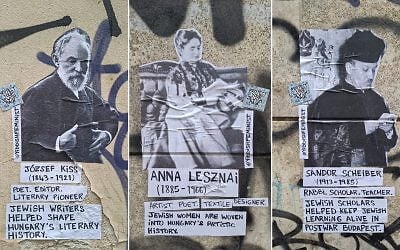
The placement of the portraits and the creation of the stickers emerged from different encounters with Budapest. One was influenced by noticing what was missing from familiar representations of the city; the other grew out of the pleasure of discovering what was there. Both were ways of participating in the Jewish life and history I was encountering. I had not travelled only to learn, observe, and return home with new knowledge. As an artist, what I encounter also enters what I create, and what I create can become something someone else encounters in turn.
In the verses following God’s command, Abram receives promises concerning not only his own future but also generations to come and people beyond himself (Genesis 12:2–3). The biblical promise is of an entirely different nature from my journey or my artistic work. Yet it invites me to consider how the significance of a journey may extend beyond the person undertaking it. What we learn can become something we share. What we create may offer someone else an encounter whose outcome we cannot predict.
I cannot know who will notice the portraits or stickers, or what they might take from them. Just as I could not anticipate everything Budapest would bring into my own experience, I cannot determine what someone else might encounter through what I have left there.
Rachel Goldberg-Polin’s words return to me as I think about the journey home. I cannot say whether the paths that brought us to Budapest were coincidence or something beyond our understanding. But I know that I arrived already belonging, and leave with a deeper, sharper understanding of how far that belonging extends across geography and generations.
Abram was called to leave what was familiar. I travelled with an identity and relationships I did not need to leave behind. These remain very different journeys. Yet Lech Lecha has left me thinking about how movement can bring us into a deeper relationship with who we are and where we belong. Perhaps go with yourself is not only about remaining connected to what we already know of ourselves, but about discovering more of what that belonging encompasses, and participating in what it continues to become.