

Middle East Forum Fellow/North Africa Risk Consultant
The Ghannouchi Verdict and the Trap of Choosing between Tyrants in Tunisia
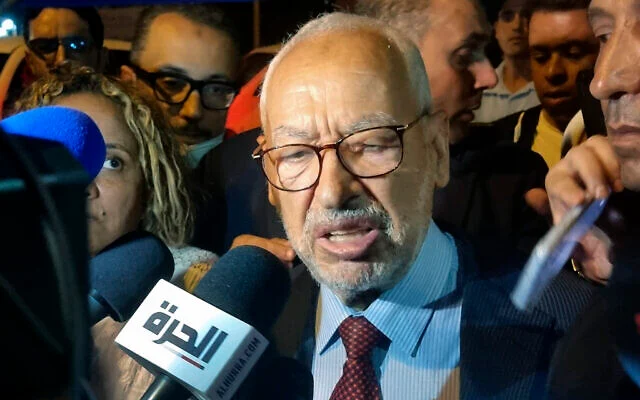
Leader of the Ennahdha party, Rached Ghannouchi, speaks to the media after he was freed by the Tunisia's anti-terrorism unit in Tunis, Tunisia, July 19, 2022. (AP Photo/Hassene Dridi, File)
A Tunisian court sentenced Rachid Ghannouchi, the 84-year-old leader of the Islamist Ennahda movement, to life in prison this week. Former Prime Minister Ali Larayedh received 42 years. Retired officer Kamal Badawi got life plus 32 years. The charges: terrorism, running a secret security apparatus, and conspiring against the state.
The Western press will spend the next week debating whether this is justice or political persecution. That is the wrong debate. The right question is this: how did Tunisia, the Arab world’s one genuine democratic experiment, arrive at a moment where the only available choices are an Islamist movement that spent a decade undermining the republic it pretended to serve, and a one-man government that has abolished the very institutions democracy requires to survive?
Tunisia is not choosing between democracy and authoritarianism. It already lost democracy. It is now choosing which kind of authoritarian project gets to write the obituary.
Ghannouchi’s Record Deserves No Romanticism
Let us be precise about what Ennahda actually did with its decade of dominance following the 2011 revolution. The movement that presented itself to Western audiences as “Muslim democracy” and a regional model ran what amounted to a parallel state. The allegations of a secret internal security apparatus are not inventions of Kais Saied’s prosecutors. They emerged from within Tunisian civil society, from journalists, from former allies, and from the systematic pattern of political violence that occurred while Ennahda held or shared power.
Three prominent secular politicians were assassinated: Chokri Belaid in February 2013, Mohamed Brahmi in July 2013. Ennahda’s response to both murders was to delay, obstruct, and deflect. The movement that claimed democratic credentials consistently provided political cover to Salafist networks, allowed jihadist recruitment to accelerate, and treated the Tunisian state as a resource to be captured rather than an institution to be strengthened.
Ghannouchi himself spent decades telling different audiences what they wanted to hear. In the West: liberal pluralism and democratic values. At home: the gradual Islamization of public life. In Arabic-language interviews: patience as a strategy for transforming secular institutions from within. This is not democratic leadership. This is organized deception at scale.
The life sentence may be a show trial. The underlying accusations are not fantasies.
But Saied Is Not the Answer. He Is the Next Problem.
Kais Saied’s July 2021 power grab was not a democratic correction. It was a coup that simply chose a more popular target than coups usually do. Saied suspended parliament, dismissed the government, rewrote the constitution to concentrate power in his own hands, and built a system in which a new parliament exists but holds almost no meaningful authority.
Since 2021, Tunisia has prosecuted journalists, detained civil society activists, arrested opposition figures from across the political spectrum including secular and liberal voices with no connection to Ennahda, and overseen an economic deterioration that has pushed ordinary Tunisians toward emigration in numbers not seen since the Ben Ali era. The International Monetary Fund talks have stalled. Youth unemployment remains catastrophic. The state is more consolidated and more broke simultaneously.
Saied has not restored democracy. He has replaced one threat to it with a personal autocracy dressed in anti-corruption language. The Ghannouchi verdict will be used, as every verdict in this political season has been used, to demonstrate the president’s strength rather than the judiciary’s independence. A truly independent judiciary would be a threat to Saied, not a tool for him.
What Tunisia Actually Needs
The choice is not between Saied’s “stability” and Ennahda’s “return.” Both options lead to the same destination: a Tunisia that cannot build functional institutions, cannot attract sustainable investment, cannot retain its educated youth, and cannot become the regional model it briefly seemed to promise.
What Tunisia needs is what it has never fully had: a genuine civic space, an independent judiciary that is not a weapon in presidential hands, political parties that are not organized around personality cults or religious identity politics, and a constitution that distributes power rather than hoarding it.
The Ghannouchi verdict closes one dark chapter of Tunisian politics. His movement has been effectively dismantled. But the country that prosecuted him is not free. Its courts are not independent. Its press is not safe. Its citizens are not more prosperous.
Tunisia’s democracy was killed once by the Islamists who promised to protect it. It is being buried now by the strongman who promised to restore it.