

Executive Director, World Jewish Relief USA
The gift is to the giver
When I decided on December 8, 2017 that I wanted to become an altruistic living liver donor – in fact, the night that I learned that it was possible to give someone a piece of your liver – I made that decision with the knowledge that, if I were so blessed to be able to move forward and save someone’s life, I might never have the opportunity to meet my recipient…or even to know if the transplant was successful.
In fact, I didn’t want to meet my recipient beforehand, but that’s another matter.
For me, my journey to become a living liver donor was a long one, not only involving a tremendous amount of medical testing, but, after that, an even longer wait to find a suitable recipient. Having a rare blood type and some initial miscalculations in measuring the size of my liver limited the pool of potential matches. After a year of waiting, and with there being no national database for those in need of liver transplants, I had to begin searching for a recipient on my own, reaching out to hospital after hospital.
My liver donation took place on July 5, 2019, over a year-and-a-half after I began my process. It was a profound and powerful experience, or, as I wrote the next day from my hospital bed, “the perfect intersection between cosmic goodness and beautiful science, the crossroads of God and humanity.” And, as we say, Dayenu – that would have been enough.
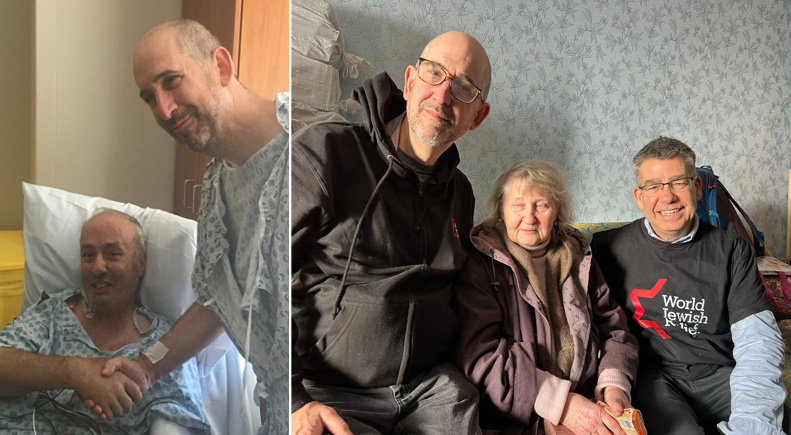
And then, four days after the surgery, a nurse came into my hospital room asking if I would like to meet my recipient, as they were open to meeting me. I leaped out of my bed as quickly as one can do just 96 hours after major surgery and walked down the hall to meet a kind looking man named Joe.
I told Joe I was curious to know what his plans were with his new life with my old liver. Did he have anything special that he wanted to do now? He responded that he didn’t want to disappoint me, but he had no plans to climb Mount Kilimanjaro. He just wanted to spend more time with his grandchildren. I told him how happy that made me and, after some nice conversation, returned to my room.
A couple of days later, when I was being discharged from the hospital, I walked back to Joe’s room to say goodbye. And I told him that it occurred to me that I owed him a thank you. While it wasn’t his intention to climb Mount Kilimanjaro, he had enabled me to climb my Mount Kilimanjaro. It was my goal to give someone my liver. It was my goal to save someone’s life. It was a long and arduous journey to get there. And, by receiving my donation, he enabled me to make the impact that I was seeking to make on someone’s life.
In 35 years of leading nonprofit organizations, with missions ranging from low-income housing development to environmental stewardship and from LGBTQ health equity to global humanitarian relief, it’s become increasingly evident to me – not as a belief but as a reality – that the gift is equally to the giver. It’s why the first words I always pose to someone I think might be interested in the work my organization is undertaking are never “How much can you give?” but instead, “Tell me about your dreams and visions for making impact on the world so I can understand if there are ways we might be able to accomplish that together.”
Indeed, I don’t believe anyone’s work in the nonprofit world is to be a fundraiser. Saying to someone “Give me your money” is the work of a bank robber. When we have conversations with a potential supporter, it’s not with the intention of keeping the money ourselves. And it’s rarely with the intention of keeping the money for our organization. Instead, we’re having conversations about how we can lovingly, thoughtfully, and effectively steward someone’s generosity to help them make the impact they are seeking to make in the world.
That’s not an ask. It’s an opportunity. That’s not a burden. It’s a gift. If I want Taylor Swift tickets more than anything in the world, and they seem impossible to get, the person who enables me to buy them is my hero, even though it might cost me a considerable amount of money. If I want to help people living through an invasion of Ukraine or facing a cholera epidemic in Mozambique and it feels impossible for me to make a difference, the person (or organization) that helps me to do that is equally – and I would say far more – heroic.
In a world with so many crises that seem insurmountable, where it’s easy to watch what feels like a nameless and faceless crisis through the media and feel concurrently deeply sad and completely helpless, I’ve never felt that the job that so many of us do in empowering people to make tangible impact is more important and more profound.
In my work today with World Jewish Relief USA, that includes helping people realize their dreams and visions for making impact by repairing war damaged homes in Ukraine, helping farmers rebuild their farms and fishers rebuilding their fisheries in hurricane-impacted Haiti, providing direct humanitarian relief to those facing a devastating drought in eastern Ethiopia, welcoming and supporting refugees from Afghanistan and Syria with English language classes and job placement, building trauma resilient schools in the north of Israel, providing maternal and neonatal care to mothers and babies in Gaza, and countless other life-saving programs and services.
By becoming my recipient, Joe helped me realize my own dreams and visions for making impact. That is what we do.
At its heart, our job isn’t about asking for money. Our holy work is offering individuals, families, foundations, and corporations trusted avenues for thoughtful, loving partnership to realize their visions for changing the world.
Far from bank robbers, we offer a gift to everyone with whom we speak. We change lives, not only the lives of those supported through our work, but also the lives of those we enable to make that impact.
We’re not fundraisers. We’re stewards of generosity and partners in possibility. We’re the sherpas that enable others to climb their Mount Kilimanjaros.
Indeed, the gift is to the giver.