
The Gog and Magog War: What’s Still Missing for Its Fulfillment?
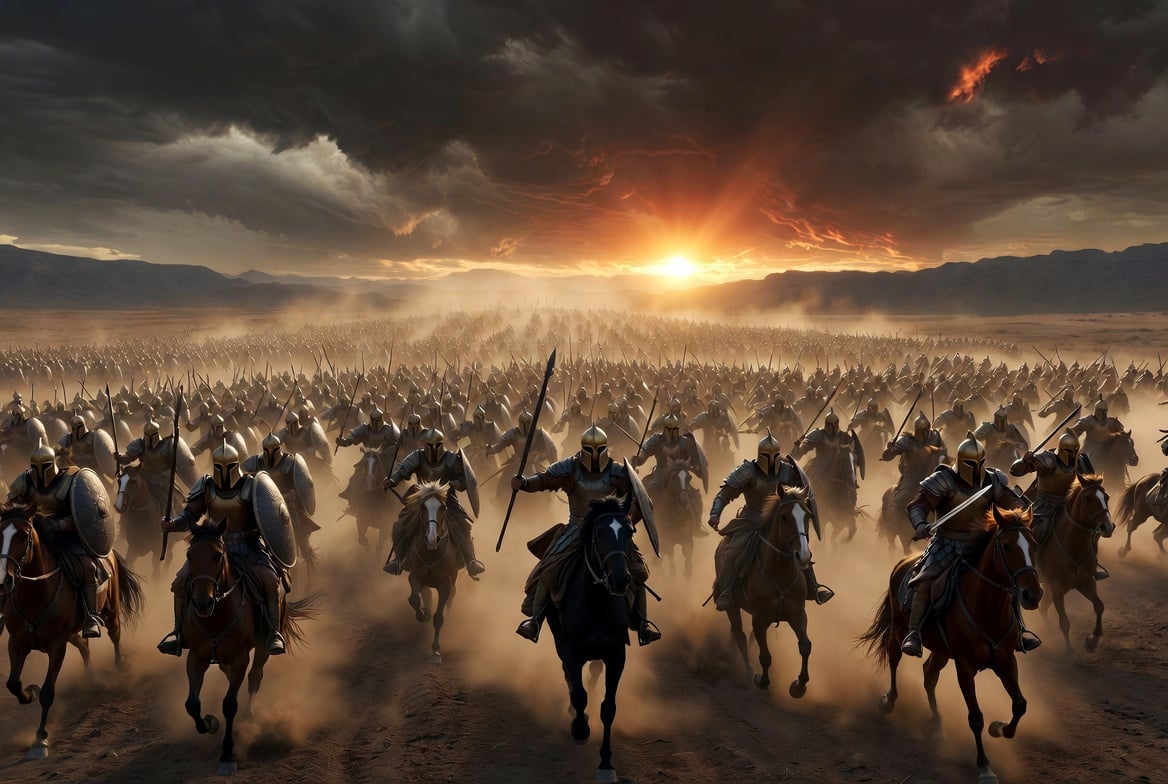
Ezekiel was a priest deported to Babylon in 597 BCE, eleven years before the Temple fell. His oracles run from roughly 593 to 571 BCE, and two chapters of his book, 38 and 39, contain its strangest vision. A coalition of nations led by “Gog, of the land of Magog” descends from the far north on a restored Israel. The victims are a people “dwelling securely, all of them living without walls, and having neither bars nor gates.” The invaders come on horses, a vast horde with swords, bucklers, shields and helmets. They never fight a battle worth the name. God intervenes with earthquake, plague, torrential rain and fire; the armies collapse on the mountains of Israel and turn their swords on one another. Israel then spends seven months burying the dead and seven years burning the abandoned weapons. The stated purpose is theological: “the nations shall know that I am the Lord.” That is the entire arc.
So who is who today? The identifications are old and, for most of the list, uncontroversial. Persia is Iran; the name barely needs interpreting. Cush and Put sit in Africa, roughly Sudan and Libya. Gomer and Beth-togarmah belong to ancient Anatolia, today’s Turkey. On these points the weightiest modern commentary on these chapters, written jointly by the Jewish scholar Jacob Milgrom and the evangelical scholar Daniel Block, agrees with the popular prophecy charts.
Russia is another matter. The chain that reads “Rosh” as Russia, Meshech as Moscow and Tubal as Tobolsk collapsed under philological scrutiny decades ago: Meshech and Tubal are the Mushki and Tabal of Anatolia, and most modern translations render the phrase “chief prince of Meshech and Tubal,” with no Rosh at all. What survives is a direction. The invader comes from “the remotest parts of the north,” and the arrow drawn from Jerusalem passes through Turkey and, stretched far enough, evokes Russia. Evokes. The text never names it.
The war of 2026 has put all of this back on front pages. Since the American and Israeli strikes on Iran began in February, prophecy teachers have flooded the internet with claims that Ezekiel predicted this war, and the excitement is not only Christian. Rabbi Tovia Singer declared that the war with Iran is Ezekiel 38 unfolding in real time, and the identification of Persia as leader of the final coalition has rabbinic pedigree reaching back at least to the Malbim in the nineteenth century.
Within Christianity the argument turns mostly on where this war sits on the prophetic timeline, and above all on whether it comes before the seven-year tribulation, Daniel’s seventieth week, or during it. Within Judaism, on when it comes relative to the Messiah, and whether the decree is fixed at all. In both camps, this year, a growing chorus answers: now.
One similarity must be conceded plainly: the axis between Iran and Russia is real. The two signed a twenty-year strategic partnership treaty in 2025, and in the current war Moscow has supplied Tehran with intelligence on American positions, drone components, and commitments of missiles and air defenses.
But look at the structure of the relationship and the script inverts. In Ezekiel, the northern power leads the coalition and marches at its head. In 2026, Russia has committed no troops, fought no battles, and profited as a cautious supplier, while for years the weapons flowed the other way: Iranian Shahed drones, launched by the thousands at Ukrainian cities, then license-built inside Russia itself. In the prophecy, the north arms Persia and leads the march. In the present, Persia armed the north, and the north sends invoices.
Believers will point to a verse that seems to anticipate exactly this reluctance. God tells Gog, “I will put hooks into your jaws” and drag him out (38:4): the leader of the coalition is pulled by circumstances, not by appetite, and the driving will belongs to God. What the rest of the coalition wants, the text never says. A Russia that resists entering the war is compatible with that verse. But compatible is not predictive. An argument that fits an eager Moscow and a reluctant one equally well forecasts nothing, so the hooks must wait with everything else.
That gap between resemblance and fit is the subject of the rest of this article.
The honest way to test a prophecy against the present is not to collect resemblances but to list requirements. Ezekiel 38 sets conditions. Here are six that today’s Middle East does not meet.
First, the land Gog attacks is at rest. The scene requires an Israel so much at peace that it no longer expects attack: in the prophet’s words, a people dwelling “without walls,” with “neither bars nor gates.” The Israel of 2026 is mobilized on multiple fronts, fenced, sheltered, saturated with air defense, and at war with the very country the prophecy names. Nobody surprises a nation on maximum alert. Until Israel has known a peace long enough to grow complacent, the opening scene cannot be staged.
Second, the horde marches. Horses, horsemen, swords and shields describe a mass ground invasion from the north. Commentators have long allowed that the weaponry is period language, a sixth-century prophet describing war in his own vocabulary, and the point stands. Yet even translated into modern terms, the mode of war remains a land invasion by massed armies. The war of 2026 has been fought with ballistic missiles, drones, warplanes and sabotage. No column has marched on Israel from anywhere, and no military on earth currently plans to send one.
Third, Persia’s role is small. In the coalition list Iran appears as one contingent among several, “with shield and helmet,” infantry in someone else’s column. The Iran of 2026 is the reverse: a power whose doctrine rests on missiles, drones and proxies precisely so that its soldiers never march far from home. For the text to fit, Iran would need to be demoted from missile state to marching contingent under a northern commander. The current hierarchy points the other way.
Fourth, the West is absent. No nation resembling a Western power joins the coalition, and none joins Israel’s defense either. The only outside voices in the text are Sheba, Dedan and the merchants of Tarshish, who watch the invasion form and ask a single question: “Have you come to seize spoil?” Sheba and Dedan sit in the Arabian peninsula, Dedan at the oasis of al-Ula in today’s Saudi Arabia, and a Riyadh that trades, looks on and protests without joining anyone’s war is a fair portrait of Saudi policy in 2026: a point in the text’s favor. The fit is only partial, though. Sheba’s old ground reaches toward Yemen, whose Houthis have spent these years firing at Israel rather than asking commercial questions. Tarshish no one can place with certainty, and this analysis will not try.
The point survives any identification: the text gives its bystanders one line of dialogue and no weapons. In 2026 the United States is a belligerent, striking Iran alongside Israel. For the scene to match, America would have to shrink from combatant to spectator.
Fifth, the peace has an address. An Israel dwelling securely without walls implies a political settlement accepted by its neighbors, and no settlement is more conspicuously absent than one with the Palestinians. The text presupposes a closed question where the region has an open wound. Whatever one believes about how that conflict should end, Ezekiel’s scenario cannot begin until it has.
Sixth, the motive is greed. Gog comes “to seize spoil and carry off plunder,” against a people rich in livestock and goods; the merchants’ question confirms it. The coalition of the text is predatory, not genocidal. It wants the land and its wealth, occupied and intact. The rhetoric aimed at Israel today promises elimination, not looting. This condition folds back into the first: plunder presupposes prosperity, and prosperity of that kind presupposes peace. Two variables fail together because they are one condition seen from two sides.
So the similarities are real. Persia, the north, Anatolia and Africa can all be found on today’s map of hostility toward Israel, and the year’s events explain why chapters written twenty-six centuries ago are trending. That much should be granted without embarrassment.
Yet read on its own terms, Ezekiel 38 describes a scenario that does not yet exist. The distance between text and present is not one detail but at least six, each independent of the others: a peace that has not been made, an army that no longer marches, an Iran built for a different war, a West too involved, a settlement too absent, a motive nobody has professed. Forcing the fit means erasing most of the text.
For a believer who takes Ezekiel seriously, and this analysis was written by one, the coldest conclusion available is this: what is missing is time. How much, no one knows. Only God does.
One question, then, to leave open. If the pieces ever did align, if peace came and prosperity followed and old hierarchies reversed, would a coalition bent on spoil rather than annihilation wage a different kind of war than the region has yet seen? The text is silent. So, for now, is history.