
The Golden Cat of King Solomon: What the Wise King Saw—and a Literary Agent Missed
For many years, I worked at Brooklyn Public Library. Countless children’s books passed through my hands. In picture books for the youngest readers, a page often contains only a sentence or two. The illustrator tells the rest.
There is an art to that. A good picture can stop a child from turning the page. A good sentence can prompt a question that leaves an adult searching for an answer.
When I wrote The Golden Cat of King Solomon, I wanted to inspire just such a question: What does true wisdom look like?
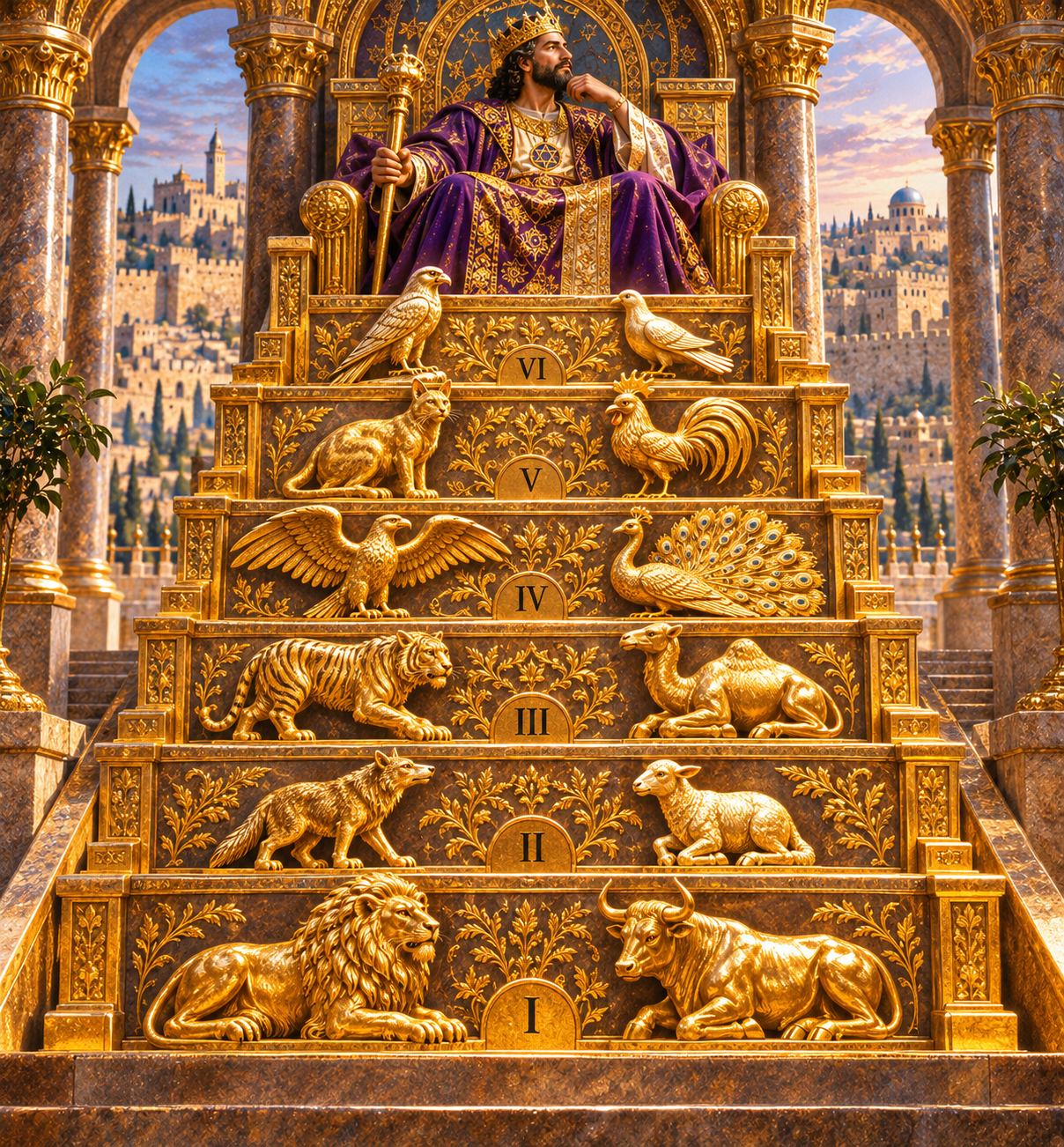
King Solomon was the biblical king of Israel who built the First Temple in Jerusalem and became renowned for his wisdom. Targum Sheni, an ancient commentary on the Book of Esther, describes his extraordinary throne. On its fifth step stand a golden cat and a golden rooster, facing one another.
I began to wonder: What if, before the cat was golden, he had been alive? How had he found his way to the palace? What had he said to King Solomon? And what had the wise king seen in him?
The ancient text does not describe such a meeting. That part came from my imagination. And so a story was born.
I wrote three versions and sent a literary agent the simplest one, intended for young children. A literary agent helps authors find publishers. This agent did not represent me; I had approached her to ask whether she would consider the manuscript.
Her reply was thoughtful and courteous. She liked the afterword, in which I discussed the ancient source, the modern Kanaani cat breed, and my work to preserve it. She even suggested that the material might lend itself to a nonfiction book.
But in her view, the story itself needed more action and a stronger narrative arc. In her letter, she summarized the events: the cat arrives at the palace, is welcomed, fed, and bathed, and then King Solomon finds a place for him on his throne.
The agent’s concern was that the cat had done nothing to earn such an honor. In her view, his arrival at the palace was not enough.
I reread her comment and thought about it. To me, the most important change happened not in the cat, but in the king: King Solomon saw something in his visitor that he had not seen before. Wasn’t that discovery an event in its own right?
I was about to write back when I stopped.
After all, her question concerned the cat. Why not let him answer?
I pictured him settling into a chair across from her desk.
“Very little happens in your story,” the literary agent said, placing the manuscript in front of her.
“I went to see King Solomon,” the cat replied.
“Exactly. You arrived. They let you in, fed you, bathed you…”
“I would hardly describe that last part as uneventful.”
The agent smiled.
“And then King Solomon found you a place on his throne. But what did you do to deserve it?”
“We talked.”
“A story needs to develop,” the agent explained. “The main character wants something, encounters difficulties, and tries to overcome them. Readers want to know whether he will succeed.”
The cat looked down at the manuscript.
“Are you expecting a heroic deed?”
“Not necessarily. I’m expecting something that will interest a young reader.”
“So am I. But a child might be interested in what a cat and a king have to say to each other. Not just in whether the cat escapes from danger.”
“The conversation has to lead somewhere.”
“It did,” the cat replied. “At the beginning, King Solomon didn’t know who belonged opposite the rooster. After we met, he did.”
“But what changed in you?” the agent asked.
The cat tilted his head.
“Why must the change be in me? I remained a cat. But King Solomon saw me differently. Can’t a story be about learning to notice someone?”
The agent put down her pencil.
“It can. But the reader needs to see that in the story itself.”
“Now that we can discuss,” the cat agreed. “If something isn’t clear, let’s make it clearer. I only ask that we agree on one thing: I shouldn’t have to save the palace before I’m allowed inside.”
He paused, then continued.
“There is a Jewish text called Perek Shirah—the ‘Chapter of Song.’ Tradition associates it with King David, King Solomon’s father, and with King Solomon himself. In it, different creatures praise the Creator, each with its own voice, its own song. The cat has a song, too.”
“And how does that relate to your story?” the agent asked.
“To me, it means that a living creature already has a place in the world. I don’t have to perform a heroic deed before I earn the right to sing. I’ve already been given a voice.”
The cat gently rested a paw on the manuscript.
“A child comes into the world without having accomplished anything either. Yet we’re already glad the child is here. We hold the baby. We listen. Nobody leans over the cradle and says, ‘You look wonderful. Now, what are your qualifications?’”
The agent laughed.
“But loving a child and constructing a story are two different questions.”
“Of course,” the cat replied. “I’m explaining what my author wanted to say. Now we can discuss how to tell it in an engaging way. That seems more useful than immediately sending me off to fight a dragon.”
The cat glanced around the office.
“Incidentally, is the dragon your next appointment?”
“No,” the agent said.
“Good. Then we have time for a civilized conversation.”
“There is an interesting foundation to your project,” the agent continued. “Especially in the afterword. The ancient source, the rare breed, the preservation work… Perhaps it could become a nonfiction book. About real cats and caring for them.”
“So you liked the explanation of my story more than the story itself?” the cat asked.
“Yes.”
The cat sighed.
“I set out to meet a reader and ended up in my own afterword.”
A brightly colored book lay at the edge of the desk. On the cover, a piglet in a traveling hat stood beside a suitcase.
The cat pulled it closer.
“Nicely drawn. It almost makes me want to carry his luggage. A major publisher?”
“A major publisher,” the agent replied.
“And translations?”
“German, French, Japanese… It’s a long list.”
“Then his journey was a success. Even if he never went anywhere inside the book.”
The agent smiled.
“What happens to him?” the cat asked.
“He plans to visit another town. His friend tries to talk him out of it. He doubts the trip will work out.”
“And that’s enough for a story?”
“If it’s well written and illustrated, it can be. A child wants to know whether he’ll decide to go.”
The cat looked at his own manuscript.
“So a little uncertainty can be enough. We don’t necessarily need a fire, a chase, or a shipwreck.”
“Of course not.”
“Then let’s look at my small events, too. The guard asks why I’ve come. King Solomon asks what I’m seeking. I answer. Wouldn’t a child want to know what happens next?”
“It all depends on the writing,” the agent replied.
“Agreed. Let’s discuss precisely that. Where the conversation holds a reader’s interest, and where it needs work.”
“You know how to argue.”
“I know how to hold a conversation. They appreciated that at the palace.”
The cat glanced at the piglet again.
“Has this book been published in Hebrew? In Israel?”
“I’d have to check,” the agent said. “Why do you ask?”
“Because the same character can mean different things to different readers. For my author, who wants to share Jewish values with children, the choice of an animal is not incidental.”
“You mean that a pig isn’t kosher?”
“Yes. But it isn’t only a question of what we may eat. There is an interpretation in Jewish tradition in which the pig represents an outward show of righteousness. It displays its split hooves as if to say, ‘Look, I’m kosher.’ But it doesn’t chew its cud, and without that second sign, it isn’t kosher.”
“So you mean a difference between appearance and reality?” the agent asked.
“Exactly. An impressive sign is presented, but it doesn’t tell the whole truth.”
“But this fictional piglet isn’t deceiving anyone. He’s simply going on a trip.”
“Then let him travel. I’m not a border guard,” the cat replied. “I’m explaining why my author chose a different image for his story. He cares about what a child encounters through a book.”
“Different families choose different books.”
“Precisely. That’s why my author didn’t demand that you rewrite yours. He wrote his own.”
The agent looked at his manuscript.
“And chose a cat.”
“He found a golden cat in the description of King Solomon’s throne,” the cat explained. “He wanted to introduce a child to that part of Jewish tradition. Not through a lecture, but through a living conversation.”
“But an ancient source doesn’t automatically make a book good.”
“Of course not,” the cat agreed. “Neither does the name of a major publisher. So we’ll both have to return to the writing.”
He gently closed the book about the journey.
“I’m not asking you to take the piglet off the shelf. I’m asking whether there might be room beside him for me.”
“There is another difficulty,” the agent said. “At present, I’m taking on new picture-book clients only if they are author-illustrators—people who both write and draw. I read your manuscript because I was willing to consider an exception. Do you draw?”
“No. But I know how to sit so that people start drawing.”
“That’s rather different.”
“Then let’s find an illustrator,” the cat suggested. “The author writes, the illustrator draws. Why deprive someone of a job?”
“You make it sound too simple. I need to know whom I could offer the book to. A publisher has to want to publish it.”
The cat thought for a moment.
“So while you’re reading, you’re thinking not only about whether you like the story, but also about who might want to publish it?”
“Yes. That’s part of my work.”
“Now I understand why there are only two of us in the room, but the conversation feels so crowded.”
The agent smiled, though she looked tired.
“I need to make a living, too.”
“Of course,” the cat replied gently. “I don’t begrudge you your bread. I’m only trying to understand: does my story need to be improved, or replaced with a different one that would be easier to sell? To my author, those are not the same thing.”
The agent touched the brightly colored cover.
“Books like this reach enormous audiences. Translations, reprints. Millions of readers.”
“And a great deal of work goes into that,” the cat said. “Illustrators, editors, translators, advertising, bookstores. This piglet has an entire industry behind him. At the moment, I have an author. Sometimes carrying a food bowl.”
“But you want millions of readers, too, don’t you?”
“Of course. I have no objection to a large print run. But the number of copies sold doesn’t, by itself, explain what a book gives a child.”
“Success must count for something.”
“It does. But the majority isn’t always right.”
The cat paused.
“Do you remember the story of Noah?”
“What does that have to do with publishing?” the agent asked.
“I’m talking about remaining faithful to your convictions. Noah didn’t abandon his path because everyone around him lived differently. In the biblical account, the majority perished in the Flood, while Noah and his family survived. For my author, that is a reminder that widespread approval is not the only measure of what is right.”
“But being in the minority doesn’t prove you’re right either,” the agent pointed out.
“Certainly not. That’s why I’m asking you to read the manuscript, not count the votes for and against it.”
The cat looked at the piglet.
“And I wish your character neither a flood nor poor sales. His relatives were in the Ark, too, incidentally. There was room for everyone.”
The agent laughed.
“Then what do you want?”
“For my author to be able to hold on to his values without apologizing for not having sold a million copies. He’s willing to work on the book. But he doesn’t have to abandon the reason he wrote it.”
“And do you never adapt to anyone?” the agent asked.
“I choose a warm place. Sometimes it happens to be someone’s lap.”
“So you do choose a person.”
“Yes. But I remain a cat.”
He settled more comfortably into the chair.
“My author says we remind him of Eden.”
“How?”
“Because it’s possible to be close without possessing one another. To love a living creature without demanding that it stop being itself.”
A truck passed outside. For a few seconds, they listened as the engine faded into the distance.
“Is your author willing to listen to an editor?” the agent asked.
“He is. He doesn’t consider every word he writes sacred. He’s a writer, not a guardian of typographical errors.”
“That’s a good start.”
“If a conversation needs shortening, a scene needs clarifying, or a better word needs finding, he’s willing,” the cat continued. “But he wants to preserve what he wrote the story for: wisdom, kindness, respect for a living creature. He wants to serve the Creator with the gift he has been given.”
The agent looked at the manuscript.
“You’re very protective of him.”
“He gave me a voice. It would be rude of me to remain silent.”
“And are you certain your story will find its readers?”
The cat glanced at the book with the suitcase, then at his own pages.
“I hope so. That’s why we came.”
The agent drew the manuscript toward her.
“Let’s try again. What did King Solomon see in you?”
“Start with the first page,” the cat said. “I’d like you to see for yourself.”