Jamaica's Rabbi
The Good Among Doctors — To Gehinnom..?
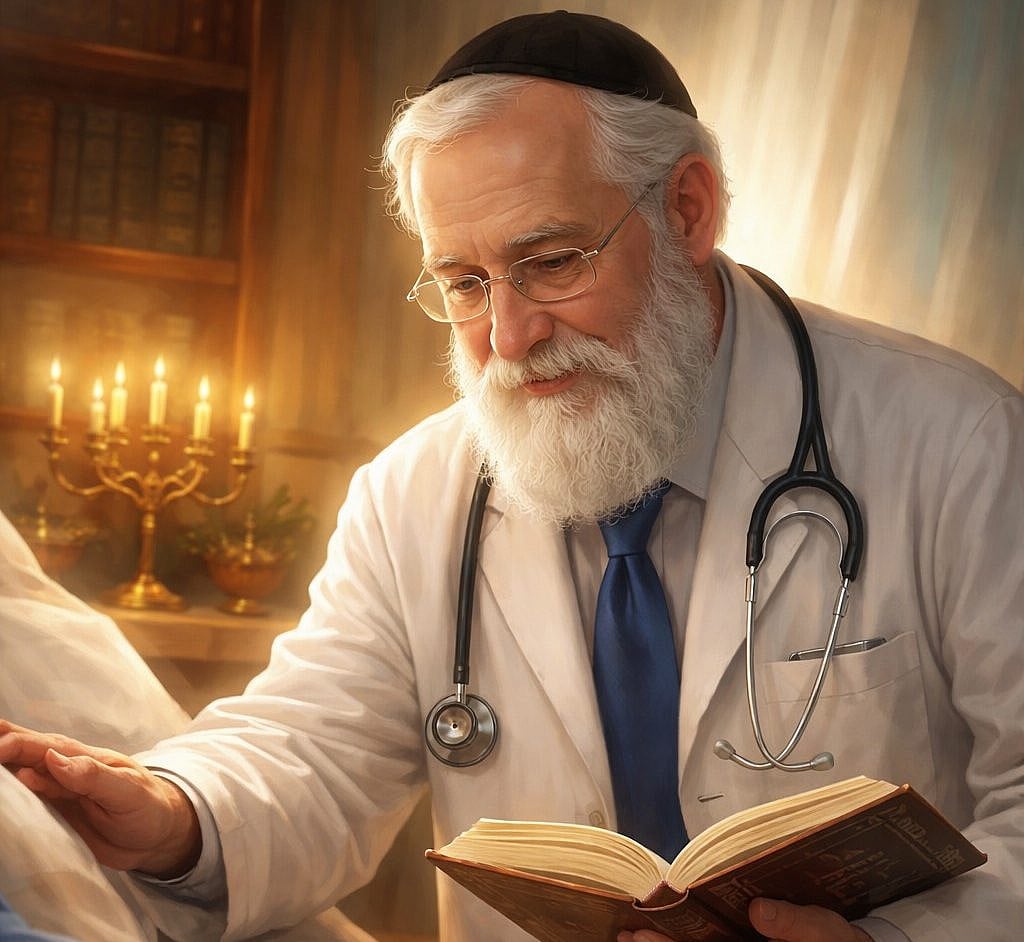
V’rapo yerapeh” — “And he shall surely heal. Photo by Chabad Jamaica
Every one of us has sat in a doctor’s office or beside a hospital bed and silently wondered:
Who really holds my life right now?
This week’s Torah portion, Mishpatim, contains the primary source for medicine in Judaism. The verse states: “V’rapo yerapeh” — “And he shall surely heal.” (Exodus 21:19) From here the Talmud (Bava Kama 85a) derives that permission was granted by Hashem to doctors to heal.
Without this verse, one might have assumed that illness is purely a decree from Heaven — and that human beings should not interfere.
But the Torah teaches the opposite. Healing is not only permitted — it is a Divine obligation.
The Shulchan Aruch, the authoritative Code of Jewish Law (Yoreh Deah 336), rules unequivocally that healing is a mitzvah. Maimonides — Rabbi Moshe ben Maimon, the great 12th-century Torah scholar and physician — writes that a doctor who is able to heal yet refrains from doing so is considered a “shofech damim,” a spiller of blood.
Medicine is not rebellion against faith. It is partnership with it.
And yet, the Mishnah makes a startling statement:
“Tov shebarofim leGehinnom (purgatory).” (Kiddushin 82a) translates to: “The best of doctors go to Gehinnom (purgatory/hell).”
Gehinnom in Jewish thought does not mean eternal damnation. It refers to spiritual consequence — accountability and purification.
Still, the statement is jarring.
How can the Torah command healing — and then warn that the best of doctors are in spiritual danger?
Rashi explains that when a doctor regularly sees illness, he may become desensitized. He no longer trembles before sickness. He no longer feels dependent on G-d. His heart can grow coarse. He begins to feel fully in control.
Subtly, medicine replaces dependence on Heaven.
The Talmud records that King Hezekiah once hid a book of natural remedies — and the Sages praised him (Berachot 10b). Not because medicine is wrong, but because people had begun relying only on remedies and had stopped turning their hearts upward.
The danger is not science – The danger is arrogance.
The Maharsha — Rabbi Shmuel Eliezer Eidels, a 16th-century Talmudic scholar — explains that the problem lies in the word “tov,” meaning “best.”
“Tov” has the numerical value of 17.
But the Amidah prayer contains 18 blessings — including “Refa’einu,” the blessing for healing.
When a doctor considers himself “tov” — 17 — he is missing 18. He removes prayer from the equation. He thinks: “My knowledge and skill alone made this success.”
It is this disconnection from the Source of life that creates spiritual danger.
Rabbi Yisrael Lifschitz, in his Tiferet Yisrael commentary, explains practically: when a doctor sees himself as “the great expert,” arrogance blinds him. He stops consulting colleagues. He stops reviewing texts. He resents second opinions.
When ego stands above life, tragedy can follow.
There is a well-known Chassidic story about the Rebbe Maharash, Rabbi Shmuel of Lubavitch. He greatly favored a certain physician. His followers wondered why, since greater experts existed. The Rebbe answered: most doctors enter the room with great confidence. They believe they know everything. There is no room for G-d there. But when this doctor encountered a difficult case, he would grasp his beard and say, “Hashem, help me. I do not know what to do.” Not because he lacked knowledge — but because he lacked arrogance. That humility invited the Divine Presence into the room.
The Lubavitcher Rebbe, Rabbi Menachem Mendel Schneerson, often emphasized the precise Talmudic language: “Permission was granted to the doctor to heal.”
Why permission?
Because healing is not independent human power. It is Divine authorization. The doctor acts but G-d heals.
At the same time, the Rebbe was unequivocal: one must seek the best medical experts and follow their guidance. The Torah commands us to use natural channels. But alongside medicine, one increases prayer, charity, and spiritual strength — because healing operates on both a physical and spiritual plane.
Rabbi Akiva Eiger offers another insight. “The best among doctors go to Gehinnom” does not mean punishment for cruelty. Rather, to save life, a doctor sometimes must adopt traits that resemble Gehinnom.
He must cut. He must operate. He must see blood and not faint. He must deliver painful truths. He must act with firmness and detachment. These traits resemble severity. But they are tools — not identity. The doctor must use them without becoming them.
And perhaps this message is not only for doctors.
This reflection is written as a prayer for a complete recovery for my dear wife, Chaya Mushka bas Esther.
When machines beep in the background and charts are reviewed, you realize how small you are — and how much you depend on both human skill and Divine mercy.
We seek treatment.
We ask questions.
We get second opinions.
We act responsibly.
But we never forget Who the true Healer is.
All the knowledge in the world is only 17 — “tov.”
The truly great doctor does not say, “I heal.” He says, “I serve.”
As we enter the Shabbat that blesses the month of Adar, the Talmud teaches:
“משנכנס אדר מרבים בשמחה” — “When Adar enters, we increase in joy.” (Ta’anit 29a)
The Gemara also states regarding this month: “בריא מזליה” — its mazal is strong and healthy.
Mazal in Jewish thought does not mean superstition. It means spiritual alignment — a current of Divine favor. Adar is a month in which hidden blessings are revealed. What appeared as danger in the Purim story turned into salvation.
May this month bring revealed mazal — revealed good fortune — and good health, spiritually and physically, for us, for our families, and for the entire world.
And may we merit to see fulfilled the verse:
“V’rapo yerapeh” — “And he shall surely heal.”
Not only the healing that comes through doctors and medicine, but the deeper healing of hearts, of relationships, of communities, of a fractured world.
And may we witness the ultimate healing with the coming of Moshiach — a time not of fantasy, but of global redemption: when suffering gives way to wholeness, when division turns into unity, and when the Divine presence is felt openly in everyday life. A world repaired. A humanity aligned with its highest goodness.
May that healing be revealed — in body and in soul — for all of us.
One Love. One Light.
Shabbat Shalom.
Related Topics