President, Hadassah Louisville, Hadassah Physicians Council, Hadassah Writers' Circle
The Good, Bad, and The Ugly: A Physician Encounters & Counters Antisemitism
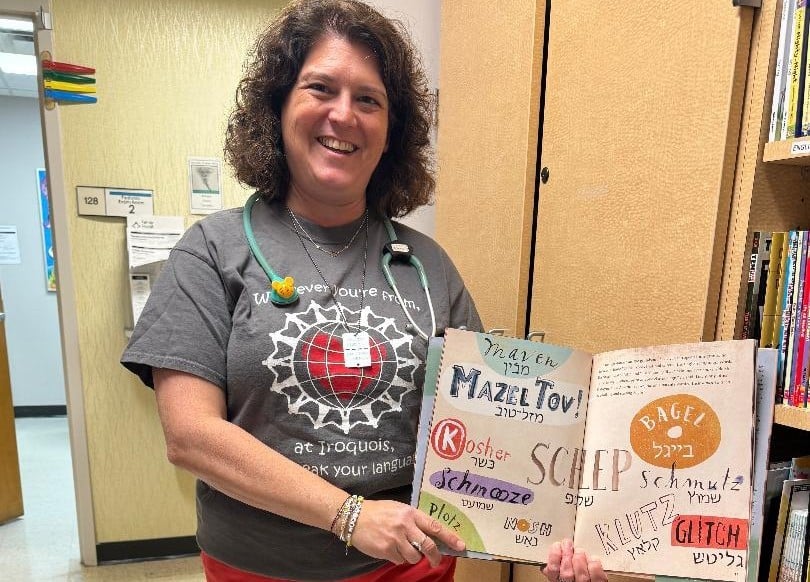
Photo of the author courtesy of the author.
It was like a scene from the movie The Wizard of Oz. “Are you a good witch or a bad witch?” Except this time it was personal and immediately put me on alert: I was being asked the equivalent of, “Are you a good Jew or a bad Jew?”
But instead of Glinda, a puffball of pink tulle and sparkles, asking the question, it was a co-worker, in casual jeans and a sweatshirt. A bit like Glinda, this co-worker is friendly and cheerful. He is a Spanish interpreter whose profession, you might say, is to make other people feel safe and comfortable by translating words and complicated medical concepts into a language familiar to them.
And I am a bit like Dorothy, an outsider from the fast-talking East Coast, dropped into this mostly Southern, slow-paced community with an estimated 14,000 Jews. I wear a rainbow color range of scrubs and glittery Crocs.
I am a pediatrician working in a community health center, where a majority of the patients are Christian, Hindu or Muslim refugees and immigrants. Our health center prides itself on cultural competency, with a sign stating, “Everyone is Welcome Here.” Part of our early literacy campaign includes giving developmentally appropriate books to children at their well child checkups.
I found one about a man who saves Yiddish books. As our interpreter and I prepared to see a pediatric patient, I asked our interpreter if he thought kids from other cultures would be interested in learning about Yiddish and its place in Jewish history. He replied that it depended on if the story were about good Jews or bad Jews.
When I asked him what a bad Jew was, he replied that a Zionist Jew was a bad Jew. It takes a lot for me to be speechless! And yet, I had to pause and take a few breaths to consider how to respond, since a cardinal rule of working in the civil service is “No politics at work.” I also was stunned that, despite my wearing “Bring them home” hostage tags daily since Hamas kidnapped 251 hostages on October 7; despite my wearing some version of the myriad of Magen David pendants I possess; and despite the three times I’ve been to Israel since the war began — each time bringing back Israeli chocolate for the staff — he had no idea that I was a Zionist Jew!
So how does one answer this type of question in this type of setting? Expeditiously, I evaluated the situation: I have a friendly and respectful working relationship with this individual; we were somewhat sheltered in a private cubicle so would probably not be overheard; and he genuinely seemed to be ignorant, rather than hostile.
So I took a calculated risk and answered honestly. “Well,” I said. “I am a Zionist Jew, so am I a bad Jew?” He was not expecting that question, but he responded with curiosity, which led to a thoughtful and intentional conversation about what the definition of Zionism is, how different Jews feel differently about Israel and the war and how social media can misinform uneducated people.
At the end of our conversation, he agreed to read Noa Tishby’s book, Israel: A Simple Guide to the Most Misunderstood Country on Earth.
Disinformation and antisemitism can come out of nowhere, when you least expect it, but at least I had a curious companion, and I was prepared to respond.
In the 30 years I have been in this profession, I’ve witnessed —and expected — sexism and racism, but antisemitism was never on my “bingo card.” I am used to patients often thinking my male medical student is the doctor and I am the nurse. I was surprised, but not totally shocked, when a parent, disgruntled by his wait time, made the racist comment that he knew the wait was due to the need for interpreters for all the languages he heard spoken.
But I was a bit discombobulated when I asked a 10-year-old child of immigrant parents what he wants to be when he grows up and he answered that he wants to join the fighters to get Palestine back. Usually, the kids want to be police officers or professional sports players or video game designers. I’ve had the unexpected reply, “I want to go to a college better than Harvard,” but being a martyr for Palestine? That was unexpected.
I find myself more apprehensive these days. When I noticed that a different Spanish interpreter had “1948” tattooed on her arm, I had to ask her what it meant, so I wouldn’t be triggered to draw the wrong conclusion. It turned out that her grandfather was born in Mexico that year. This is how I live these days, anticipating confrontation — not knowing when or where it will happen, but trying to follow the advice of TV sitcom’s college football coach Ted Lasso: “Be curious and not judgmental.”
The most antisemitism I have personally felt is professionally, through social media interactions, ironically with other physicians. Forums of the American Academy of Pediatrics (AAP) are intended to be a space for special interest groups to discuss patients, public health issues and advocacy.
After October 7, these spaces instantly became a hotbed of anti-Israel insults. When I spoke up for the hostages and Israeli children and about my own trauma as a Jewish doctor, I was accused of being a privileged, unfeeling, morally bankrupt pediatrician because I must be okay with Gazan children dying.
When I posted information about a webinar on the medical treatment of released hostages, the response was “What about Gaza?” To be clear, I am horrified by civilian death and destruction and conflicted about war tactics that damage healthcare infrastructure which has been exploited by terrorists. AND I can still be an advocate for the Jewish and Israeli people. The dehumanization of the Jewish experience has been insidious and relentless.
I still recall when a colleague used Holocaust appropriation to compare Gaza to the Warsaw Ghetto, and also commented, “If the Jews can get back their stolen paintings from the Nazis, then surely the Palestinians can get their homes back.” Seriously? I’ve been to the Warsaw Ghetto remains and the Mila 18 Bunker memorial to the Jewish resistance. The heroics that occurred in that underground space were nothing remotely related to the horrors the hostages endured for two years in Hamas tunnels. All of this was tolerated by the peer physician moderators.
Most of the Jewish doctors commiserated with each other about the hostility, but only privately, afraid to speak up in public. Many of them left the AAP because of the antisemitism they felt. I decided to stay and fight, using the tools within the organization, like filing an ethics complaint over violations of the Academy’s Code of Conduct and writing resolutions to address antisemitism. It’s been over nine months and that ethics complaint is still plodding along through the process. I find this to be unacceptably slow and can’t help wondering if it’s because it’s about antisemitism and not other more mainstream types of bias. But I can’t think of any context in which it’s okay, in a discussion forum, for colleagues to silence their peers by commanding, “If you don’t center Palestinian children, then you’d better sit this one out.”
I speak out through organizations like Hadassah — and particularly as co-chair of our Physicians Council. I’m also active in the American Jewish Medical Association, where we have a critical mass of pediatricians with the capacity to fight at organizational and legislative levels. With our communal strength, we successfully achieved adoption of two resolutions within the AAP — one to include Jews as minorities in Diversity Equity and Inclusion (DEI) spaces and another which defines antisemitism.
It is exhausting to be so vigilant all the time, to wonder when the medical space will become adversarial instead of collaborative and to be distracted from working on all the other health advocacy issues I care about. For example, I am worried about all the children that could die because of vaccine disinformation. I want to keep teens from getting pregnant or committing suicide. Even in these advocacy spaces, we are shamed and excluded unless we pass a litmus test for being the right kind of Jew — and that means anti-Zionist. What keeps me going is fighting back. My power is my voice.
I will continue to be like Ted Lasso – to remain curious, ask questions and have conversations. Hopefully, I will help make the medical profession once again a safe and ethical space for all Jewish patients and physicians.
Michelle is a member of the Hadassah Writers’ Circle, a dynamic and diverse writing group for leaders and members to express their thoughts and feelings about all the things Hadassah does to make the world a better place. It’s where they celebrate their personal Hadassah journeys and share their Jewish values, family traditions and interpretations of Jewish texts. Since 2019, the Hadassah Writers’ Circle has published nearly 650 columns in The Times of Israel Blogs and other Jewish media outlets. Interested? Please contact hwc@hadassah.org.
Related Topics
Related Posts