The Greatest Yearners for Jerusalem
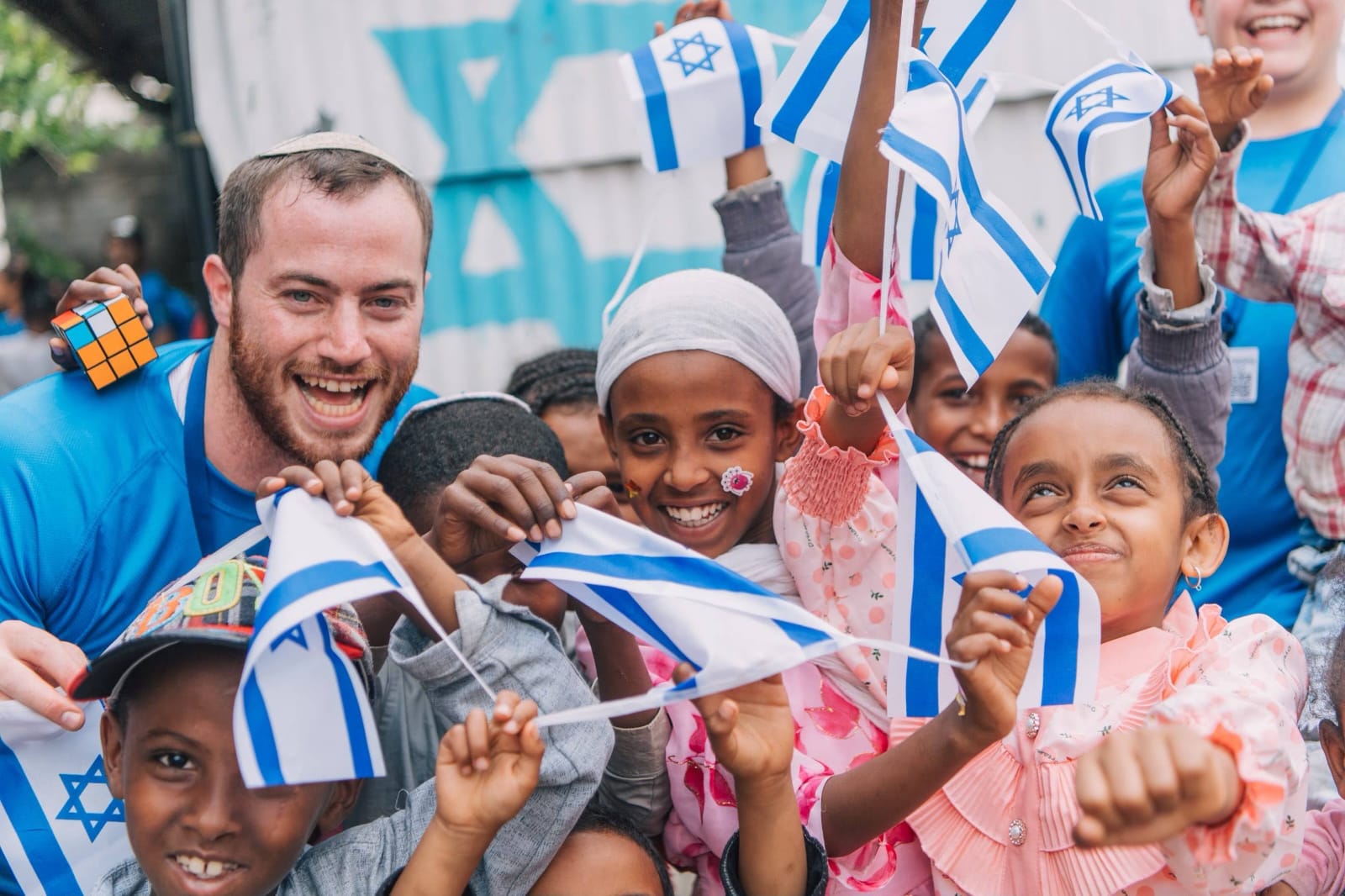
“Even though we are different colors, our blood is the same blood, our faith is the same faith. Don’t forget this. Don’t forget us.“
– Moshe, Chazzan and leader of Jewish community in Addis Ababa, Ethiopia
“I cried for weeks straight. Every prayer. Shacharit. Mincha. Maariv. Praying to make it to Israel. To have even just one second in Israel…And the greatest miracle happened. I was chosen. One of the select few. To be brought from my community in Gondar, Ethiopia, to learn in a yeshiva in Israel for six months. Those were the best six months of my life.“
– Takele, community leader in the Jewish community of Gondar, Ethiopia
But Takele’s story did not end there.
After six months, his student visa expired, and he was forced to return to Ethiopia. He returned home carrying memories of Israel—and is still waiting for the day he can return.
Today, I am writing these words from Addis Ababa.
I came here as a volunteer on a medical mission from Israel with Operation Ethiopia, a family-led NGO helping Jews and some of the poorest communities in Ethiopia receive much-needed eye care. I expected to spend my time helping with eye care, handing out a few gifts to children, and then returning to the blessed and chaotic life I love in Israel.
But after visiting the Addis community—after meeting families and hearing the stories of people like Takele and Moshe—I realized there is a much greater mission before us.
There is a part of our family still waiting to come home.
At the very least, we must hear their story.
I am writing this in the hope of opening your eyes—and your hearts—to our brothers and sisters still waiting in Ethiopia.
Before coming here, I didn’t realize just how many people were still waiting.
You may read this and think, as I did just six months ago before my first visit:
“Wait… there are still Jews in Ethiopia? I thought everyone came during those incredible Mossad operations.“
Unfortunately, the answer is yes.
There are still thousands of Jews in Ethiopia.
“Alright,” you might ask, “but they are there because they want to be there, right?“
The answer is a resounding no.
Their hearts—and often much of their families—are already in Israel. Though extraordinary work has been done over the past decades, the mission is not yet complete.
To summarize a rich and complex history in just a few sentences: the Beta Israel community preserved Jewish life in Ethiopia for centuries, largely isolated from the rest of the Jewish world. Their longing for Jerusalem never faded. In 1984, Operation Moses secretly brought nearly 8,000 Ethiopian Jews to Israel. In 1991, Operation Solomon airlifted more than 14,000 Jews to Israel in just 36 hours—one of the most remarkable rescue missions in modern history. Additional Aliyah continued for many years through family reunification and smaller government operations, but no large-scale rescue has taken place in over two decades.
The yearning never stopped.
The Aliyah did.
History books often end there.
But for thousands of Ethiopian Jews, the story did not.
More than 15,000 Jews are still waiting.
Waiting simply to come home.
15,000 Jews who already left their hometowns to begin the long journey to the Promised Land.
15,000 Jews who have been stranded on the Derech Arukah Ba’Midbar–the long journey in the wilderness.
As one community member told me,
“We have been waiting here for 30 years. We don’t want it to become 40.”
During my visit, two images became impossible to forget.
Walking into the shul, you are greeted on the right by what appears to be a simple memorial wall. Focused on my Tefillah, I barely noticed it at first. Later, I looked again and realized this was no ordinary memorial.
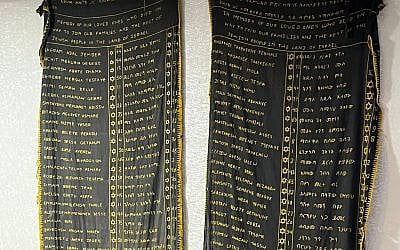
Memorial to Ethiopian Jews who died on their journey to Israel. (Abel Gashaw)
What first caught my eye was a column listing the ages of those commemorated.
So many were children.
Then I looked up and read the title:
“In memory of our loved ones who died on their way to join our families and the rest of the Jewish people in the Land of Israel.”
This has never been a simple journey.
If the first wall spoke of the cost of the journey, the second spoke of the hope that still refuses to die.
The second image hangs brightly in the children’s classroom.
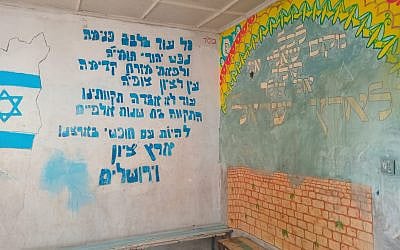
Painting in children’s classroom, Addis Abbaba (Abel Gashaw)
Above children dancing joyfully to “Od Yoter Tov,” with kippot and tzitzit flying through the air, are the words:
“L’chol Makom Asher Ani Holech, Ani Holech L’Eretz Yisrael”
“Wherever I may walk, I am walking towards the land of Israel.”
It is a beautiful sentence.
But in its context, it breaks your heart.
How much longer will they remain “on their way”?
When will they finally be in Israel?
I have not been able to stop thinking about those two walls.
As Tisha B’Av approaches, I cannot help but think of our brothers and sisters in Ethiopia.
I cannot tell you exactly how the Beit HaMikdash will be rebuilt.
But I do know of one broken wall we have the ability to rebuild.
Two thousand years ago, our Mikdash was destroyed.
Two thousand years ago, our people were scattered—including those who eventually found refuge in Ethiopia.
Today, we have the opportunity to reunite what history separated.
As I searched for words to make sense of these experiences, I found myself returning to a 30-year-old sicha, discussion, by Rav Adin Even-Israel Steinsaltz, originally written to encourage action on behalf of Soviet Jewry trapped behind the Iron Curtain. His words feel just as true today:
“I am doing one thing only. I want to be a partner in what it says in one of the prayers: Guardian of Israel, protect the remnant of Israel, so that Israel—the people who proclaim Shema Yisrael—will not be lost.”
The simple reading of this prayer is a plea to G-d, the Guardian of Israel, to protect the scattered remnants of our people.
Rav Steinsaltz reads the prayer differently—and in doing so places the responsibility on us.
We are the Shomer Yisrael – the Guardians of Israel.
We are called to guard and care for the scattered remnants of our people.
Only then, when we have fulfilled our role as our brothers’ and sisters’ keepers, can we truly call ourselves the nation of Omrei Shma Yisrael – the people who proclaim Shema Yisrael.
If you have read this far, I ask you to join me in being a Shomer Yisrael– a Guardian of Israel.
Learn.
Care.
Share their story.
And if this story moved you, don’t let it end here. Speak about them. Advocate for them. Help bring another family home.
Together, we can rebuild one Oleh, one family, one brick at a time.
May we merit the rebuilding of the Beit HaMikdash speedily and in our days!
Nothing I can write will ever be as meaningful as hearing these stories directly. For an emotional video of the learning program attended by Takele, see the following article and video (in Hebrew).
For some perspective on the Jewish life in Ethiopia, watch this video from a recent visit of Rabbis to Ethiopia as part of the organization SSEJ, Struggle to Save Ethiopian Jewry as well as this video from an earlier visit to Ethiopia from members of SSEJ describing the poverty of the Jewish community in Ethiopia.
To learn more about the intense and inspiring stories of early Mossad operations, see Red Sea Spies: The True Story of Mossad’s Fake Diving Resort by Raffi Berg (Icon Books, 2020) or The Red Sea Diving Resort, an original movie by Netflix (2019).
For readers interested in a concise overview of the history of Ethiopian Jewry, I recommend Rabbi Dr. Sharon Shalom’s From Sinai to Ethiopia: The Halakhic and Conceptual World of Ethiopian Jewry, especially the introduction entitled, “A Short History of Ethiopian Jewry” accessible on Sefaria.
Am Yisrael Chai!