
The green wave – how to reduce highway travel time
How to reduce highway travel time, lower gas consumption, and prevent accidents, at a minimal cost – and why the government won’t do it.
We pride ourselves on being the “startup nation”, positioned at the cutting edge of science and technology. But in one area, we’re still locked in the mindset of the 1960s, when private vehicle travel not only wasn’t the norm, but was actively frowned upon by successive socialist-led governments as decadent. You see the results every day, with blocked highways, jammed-tight urban roads, cars parked on pavements, and a high accident rate.
For the moment, I’m leaving aside urban traffic control, because that’s a special case with multiple variables like alternative transport routes (buses, trains, etc) and concentrating on inter-urban traffic along major highways.
A short history of controlled traffic flow
In the 1950s and ‘60s, European countries like Germany, the Netherlands and France became enthusiastic adopters of “the Green Wave” method of flow control. Engineers realised that if signals along an arterial were given carefully calculated offsets, a platoon of vehicles could travel through many intersections without stopping. Without major costs, simply timing the phases of traffic lights at intersections produced major improvements in traffic time, reduced accidents, and even became a valid tool for speed control.
In the same time window, American cities adopted green waves extensively. However, they encountered a problem because most US cities are built on grids, so optimising one avenue often disrupted the cross streets. Eventually engineers moved away from simple progression toward network optimization, which made the mathematics much more complicated.
London was a special case, because its streets evolved over centuries rather than being laid out on a grid. Distances between intersections are highly irregular, traffic volumes vary enormously, and bus lanes, pedestrian crossings, bicycles and turning restrictions further complicate matters. Consequently, London became one of the birthplaces of adaptive signal control. The UK developed SCOOT (Split, Cycle and Offset Optimisation Technique) in the late 1970s and early 1980s. But it’s a complex and expensive solution, requiring constant traffic density monitoring, feeding data into a central computer and allowing dynamic control of individual traffic lights.
Australia took a slightly different route. Sydney developed SCATS (Sydney Coordinated Adaptive Traffic System). Like SCOOT, it uses detectors and computers, but unlike SCOOT, it tends to select among stored timing plans and adjust them according to observed demand. It has become one of the world’s most widely deployed traffic-control systems, used in many countries.
In the early part of the 21st Century, systems such as TRANSYT, MAXBAND and MULTIBAND appeared. They optimize many inputs, and usually treat the entire city as a giant optimization problem. These systems produce excellent results, but require extensive back-end power and data collection.
Now, advanced countries are already in the fourth generation of flow control. Adaptive systems assume traffic is never constant, monitor traffic density via loops embedded in the road, radar, video cameras, Bluetooth tracking, GPS, and connected vehicles. Everything feeds real-time information into the controller, which “talks” back to the traffic control points.
In Israel – we don’t even have 1960’s style generation 1 traffic flow control.
Highway 3 – a typical example of a solvable problem
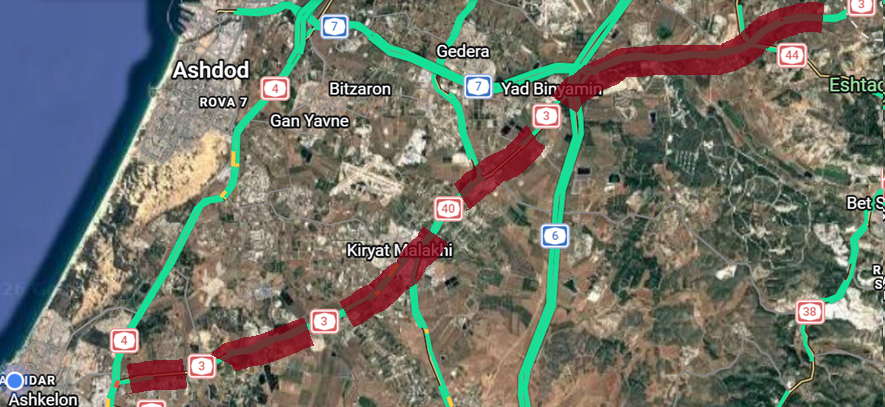
I’m presenting Highway 3 as a special case, but in fact it’s applicable to the whole country. Highway 3 is one of the major inter-urban routes in the country. It bisects Israel from the sea to the green line almost exactly at the mid-point of the country. I’ve been travelling the route for more than 15 years, at some points daily in order to get to work, but more lately only when I have to, because I avoid it as much as I can.
From the start of Highway 3 on the eastern fringe of Ashkelon, to Modiin (positioned right on the green line) the distance travelled is 64.8 kilometers. It’s a dual-lane highway the whole way so, optimally, travel time should be somewhat less than 45 minutes without exceeding the speed limit. But, the “highway” from start to end crosses 28 intersections, each one controlled by a set of traffic lights. My “best case” travel time has been just over 75 minutes. Frequently, I don’t make it in two hours. And it’s not caused by traffic congestion. The culprit is red lights at intersections, sitting and waiting for 30-40 seconds, over and over and over, while no traffic crosses. Frequently I get caught at six or seven red lights in a row – slowdown, stop, wait, accelerate, slow, stop, wait, accelerate, on and on and on. On one bad drive (the one that turned me off using the road unless absolutely necessary), I was caught at 20 out of the total of 28 lights.
Everytime you stop to wait at a red light, you burn a little bit of extra fuel while the engine idles, and wear down your brakes a little bit more as you brake. When you accelerate away from the lights, you burn a whole lot more fuel – roughly 5 times more than you would have if you were travelling steadily over the same distance. Multiply that wastage by the thousands of vehicles that travel the route every day. Multiply that by 365 days a year, and you will compute a staggering amount of total wastage – literally, money being burned for nothing!
I know that there are solutions that would require up-front expenditure on hi-tech devices and AI-driven computer centers that can monitor and control traffic flow real-time. I also know that Israel has higher priorities right now. But I also know why the government hasn’t ever seriously looked into implementing even the most basic 1960s model of traffic flow control. The simple fact is that the government benefits directly from every liter of fuel that’s burned for no purpose. Roughly 60% of every shekel spent on gas (sales and excise tax) along with tax on fuel company profits, goes straight out of your bank account, and into the government’s coffers.
Here are the hard figures:
Suppose gasoline costs ₪7.20/litre at the pump (I know, I’m dreaming!) Crude oil costs ₪1.70, refining & distribution – ₪1.20, fuel excise – ₪3.20, Ma’am ₪1.10. Total government revenue per liter – ₪4.30, or 60%. That’s 60% of the value of every wasted liter of gas has been shunted off into the Treasury, to be doled out by the leader on whatever he needs to support his government. Fixing the problem of traffic flow would cost the government revenue, not capital, and so they’ll never do it
Final thoughts
There is a simple style 1960 “green wave” solution that would cost less than ₪100,000 to implement on Highway 3, and take less than one month to have up-and-running. It would save around 20-25 minutes of travel time every trip for tens of thousands of people every day, and reduce accidents, fuel costs, and vehicle repairs amounting to millions of shekels every year. I’ve done the computations (with a little help from my AI friends). Anyone who is interested can send me a note, and it’s yours – free, gratis and for nothing. I’m not expecting Misrad Harishui (Ministery of Transport) to come knocking on my door.