

Engineer, Entrepreneur, Author and lifelong student
The Ground Shifted Under Our Feet
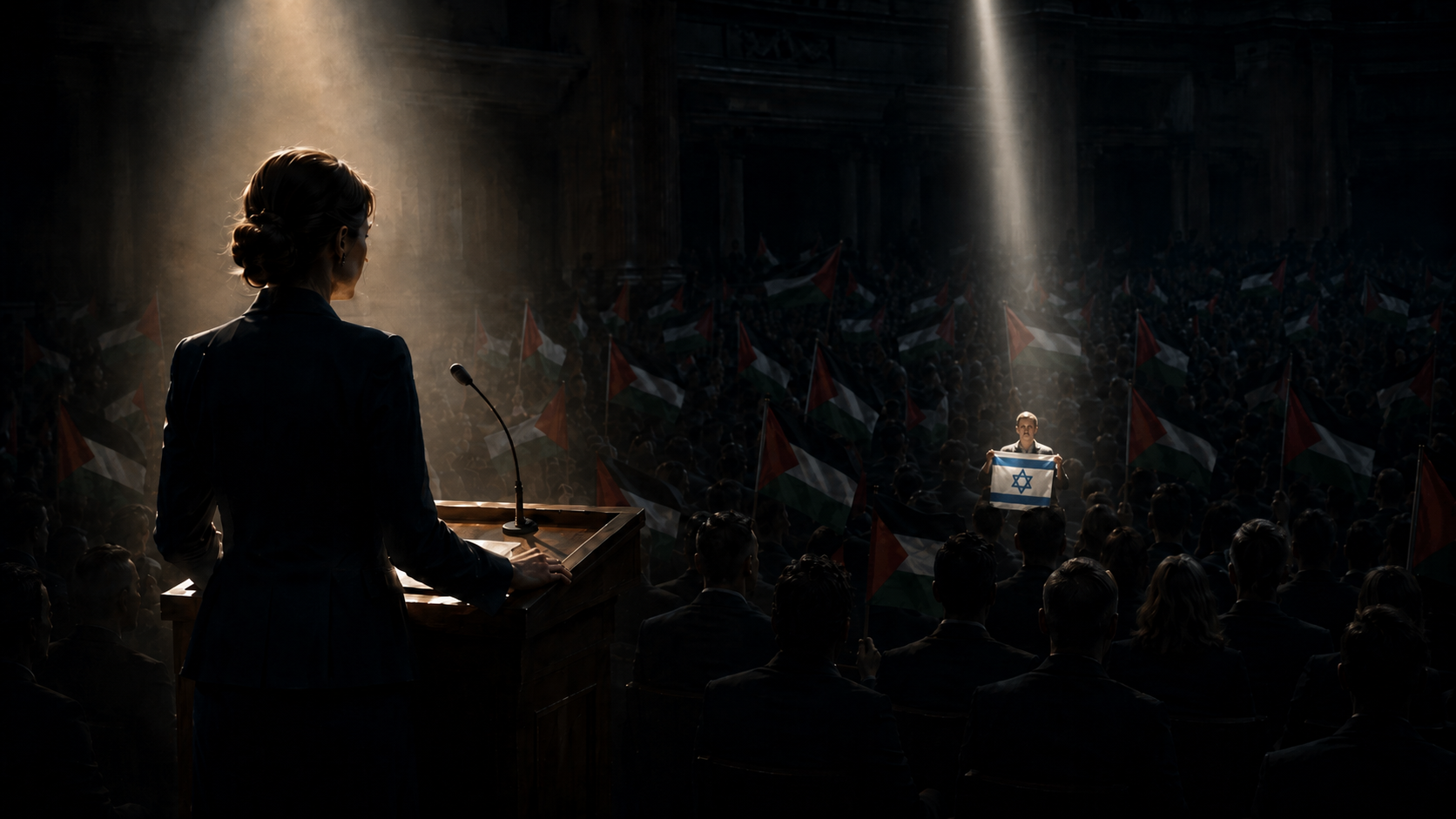
Illustration: Gideon Paull, created with ChatGPT.
A clergywoman stood alone for Israel before 330 churches. Her courage left me — and should leave every Jew in the West — with one unavoidable question.
This past week, the California-Pacific Annual Conference of the United Methodist Church held its 42nd annual meeting in La Quinta, California. The gathering brings together more than 330 churches, around 50,000 members, from across Southern California, Hawaii, and Guam — the working machinery of one of the largest Protestant denominations in the world. Most years it is a quiet affair of budgets, appointments, and resolutions. This year was no different — until it wasn’t.
A motion was added to the agenda. Resolution 26-03 called on the church to recognize and act against the “genocide, ethnic cleansing and apartheid” of the Palestinian people at the hands of what its authors described as an oppressive Zionist regime. It would have obligated United Methodist clergy to carry that cause into their congregations and preach it from their pulpits. The text was blatantly harsh and one-sided. There was no mention of October 7. No mention of the Hamas atrocities. No mention of Hezbollah’s rockets falling on the towns and villages of northern Israel. It was written and promoted by the Cal-Pac Palestine/Israel Task Force and their supporters, who rose to denounce Israel in the same language, with the same fury, that we have come to know from university quads and the sidewalks outside our synagogues.
And then one voice rose against the tide.
A single clergywoman from Canoga Park, in the San Fernando Valley, walked to the microphone. She did not deny the suffering of the Palestinian people; she would never. She understood that to oppose the resolution outright would be futile; the room had already made up its mind. So, she did something harder. She went after the words themselves. She reminded the conference of past resolutions affirming Israel’s right to exist. She asked that the motion be amended to name Hamas’s brutality, to name the Israeli families murdered and taken hostage, to acknowledge the rockets of Hezbollah and the hand of Iran. She pointed out that “genocide,” “apartheid,” and “ethnic cleansing” were political words — words that most honest observers concede rest on a contested and one-sided narrative.
She knew the cost. She knew she might be canceled. She knew it could damage a career built over years as a respected, ordained pastor. And she stood there anyway. Because, she told me later, it was the right thing to do — for her husband, and for the Jewish people.
No one came to the podium to stand beside her. But afterward they came to her quietly — in the hallways, in whispered thanks, in text messages of support they were too frightened to say aloud. They told her they agreed. They told her they simply didn’t know enough to speak. When her amended resolution was finally put to a vote, it drew 31 percent — despite the effort, the original harsh language of the resolution was adopted as written. She called that a victory. I confess I did not see it that way. Most resolutions at that conference pass with 99 percent support, she reminded me. To move nearly a third of the room — that, in her words, was a win.
That brave woman is my wife.
* * *
She is the spiritual leader of her congregation, a Korean American pastor whose life’s work is the spiritual well-being of her people — Scripture, prayer, study, and the slow, patient labor of love. She has spent her ministry teaching how the Torah breathes through the New Testament, how the older covenant carries the newer one. Politics is not her world. And yet politics came for her anyway.
These resolutions are not new. Not to the churches, not to the universities, not to the corporations and activist nonprofits where the same script is read every week. We watch anti-Israel motions pass somewhere almost daily now. The United Methodist Church is among the largest such bodies in America and in the world, and since its split over the question of LGBTQ inclusion a few years ago, the remaining body has moved swiftly to the progressive left. Its resolutions increasingly concern radical social action and promote political activism rather than focusing on spiritual life. We see this everywhere. And as Jews in the West, it should worry us.
For a long time, when I voiced these fears to my wife, she admitted she did not understand them. She thought they were just that — fears, surfacing from somewhere inside me, with no solid ground beneath them. Then she sat in that room in La Quinta, listening to her husband’s people being demonized. And afterward, she told me she finally understood. She felt it too. She felt the ground shift under our feet, and the two of us standing, suddenly, in a new and unfamiliar country.
She is a practical woman, and she did not stay frightened for long. She moved, as she always does, to the question that frightened people are most afraid to ask: What now? What do we do with what we know? What plans do we make? How do we protect ourselves — not only us, but every Jewish family living in the Western world?
Jewish people, she told me, have three choices.
The first is to leave — for Israel, or for anywhere a Jew can live without being singled out for who they are.
The second is to stay, believing that this too will pass.
The third is to disappear — to assimilate so completely that nothing of one’s Jewishness shows on the surface.
Those are the three. And then she did what she always does: she turned them over and examined them honestly, on our terms.
When the ground shifts under your feet, which of the three doors will you reach for?
What she witnessed at her conference, she said, was society in miniature. A few loud, angry voices drowning out everything else. A large, uninformed majority with no stake and no knowledge, unwilling to raise a hand. And a frightened minority who support Israel in private and dare not say so in public. In a society arranged that way, the Jewish people cannot win the argument. We can choose the third option: to assimilate, to blend, to vanish into the crowd — as so many Jews did when they lined up behind Mamdani in New York. We can keep telling ourselves that the social-justice gospel of Tikkun Olam, which has captured so much of our youth in the Reform movement, will keep us safe. But our memory is short. No amount of assimilation saved the Jews of Europe. None will save us now.
My wife knows discrimination. As a Korean American, she has lived it. But this, she says, is something else — a different order of thing, one she had not understood until she stood at that microphone. And that, she admits, is what frightens her.
Will Palestinian activists one day march into her church on a Sunday morning, faces covered with keffiyehs, flags raised, chanting “from the river to the sea”? We don’t know. Will her denomination move to cancel her? We don’t know. What we do know is that she has made enemies — vocal, powerful enemies — for the crime of asking that a resolution tell the whole truth.
So, I will ask you what I have been asking myself. When the motion comes to the floor of your organization, your campus, your company, your union — and it will come — will you walk to the microphone? Or will you send a quiet text afterward and call it support? When the ground shifts under your feet, which of the three doors will you reach for? And are you honest enough to admit that you may already have chosen?
A woman whose only calling was the spiritual care of her community was thrown into the center of the most contentious argument on earth. And no matter what it costs her, she says she would do it again.
It was the right thing to do, she told me.
I had no choice.
–
The author’s wife is an ordained United Methodist pastor serving First United Methodist Church of Canoga Park in the California-Pacific Annual Conference.
Related Topics
Related Posts

