
Professional Indian author and strategic affairs writer.
The H3+ Problem: How the New US-Iran Deal Redraws the Map for South Asian Security
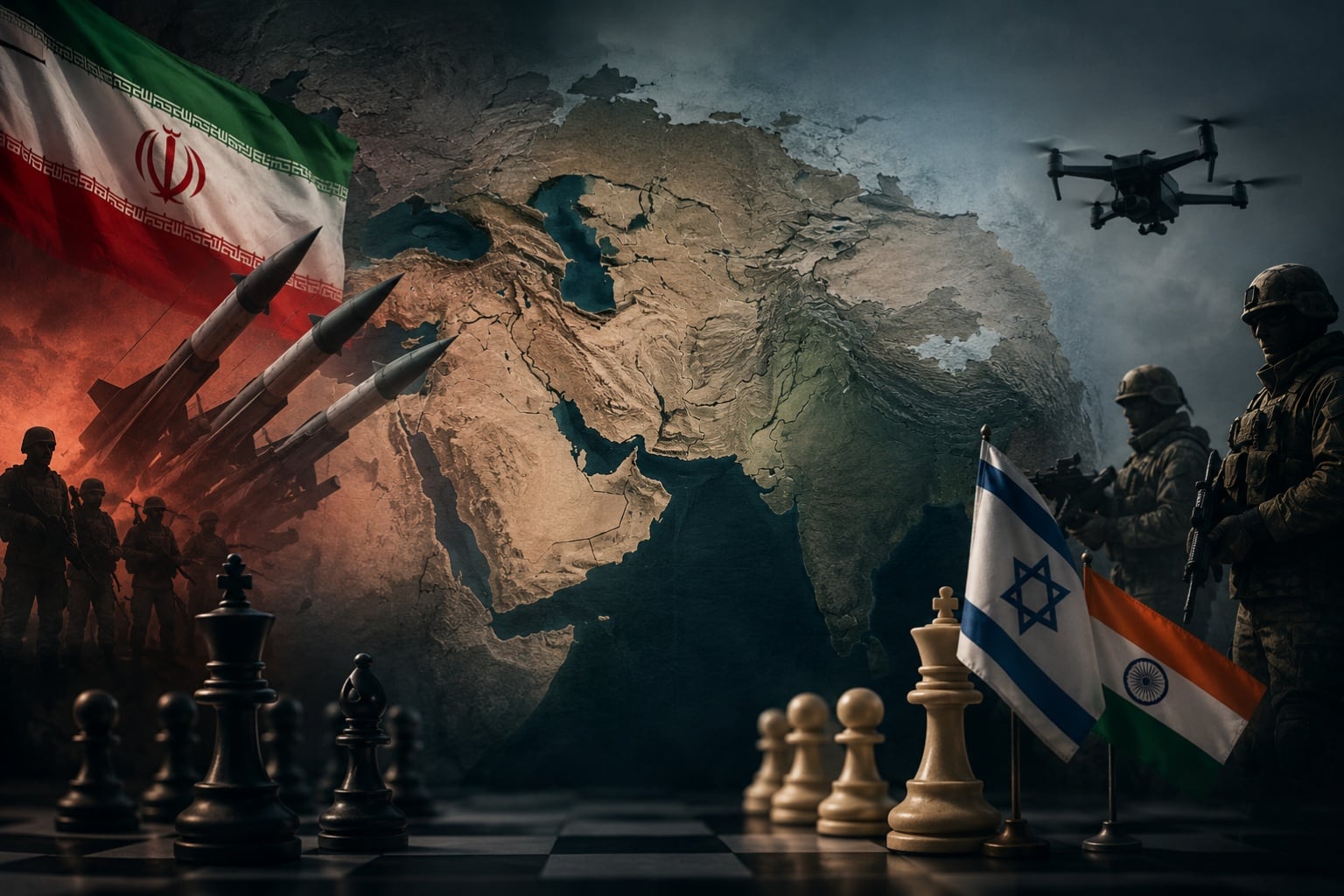
Conceptual illustration: A geopolitical map spanning the Middle East and South Asia, with military assets and strategic symbols representing the security implications of renewed U.S.-Iran engagement, shifting regional power dynamics, and emerging proxy-network challenges. Image: AI-generated (free for commercial use).
The ink on the new memorandum of understanding between Washington and Tehran is barely dry, and already a profound cognitive dissonance is taking hold across the globe. In Western capitals, the sudden sanctions relief and unfreezing of Iranian assets are being quietly celebrated as a pragmatic, if distasteful, masterstroke. The Strait of Hormuz is slated to open. Global energy markets are stabilizing. The immediate threat to American maritime hegemony seems delayed.
Look closer at the map, however, and the narrative changes entirely. Moving east from the Persian Gulf toward the Arabian Sea, the diplomatic triumph in Washington transforms into a severe strategic headache for South Asia. By releasing billions of dollars into the Iranian economy, the international community has inadvertently supercharged the Islamic Revolutionary Guard Corps (IRGC) and its sprawling network of proxies. While the world focuses on the traditional Middle Eastern theater, Hamas, Hezbollah, and the Houthis, a newly enriched Tehran is poised to activate what security analysts are calling the “H3+” network.
The primary victim of this revitalized proxy infrastructure will be the fragile security architecture of Pakistan, triggering a cascade of geopolitical consequences that will inevitably crash onto India’s borders.
To understand the sheer scale of the incoming threat, one must examine Iran’s historical methodology. The IRGC does not build conventional armies; it cultivates asymmetric militias capable of bleeding adversaries from the inside out. For the past decade, heavily sanctioned and cash-strapped, Iran still managed to sustain the Liwa Zainabiyoun, a militia composed entirely of Pakistani Shia fighters trained by the Quds Force. Originally deployed to defend the Assad regime in Syria, thousands of these battle-hardened militants have been slowly filtering back into the porous borderlands of the Afghanistan-Pakistan region.
Until now, their activity was constrained by Tehran’s limited operational budget. The sudden influx of unfrozen assets changes the math completely.
We already witnessed a preview of this volatility in early 2024, when Iran launched unprecedented missile and drone strikes deep into Pakistan’s Balochistan province, targeting the Sunni militant group Jaish al-Adl. Pakistan retaliated with air strikes inside Iranian territory. That skirmish exposed the deep, festering vulnerabilities along their shared 900-kilometer border. Now, picture that same border dynamic, but arm the Iranian side with billions of dollars in fresh capital and a mandate to project regional power without the immediate fear of American military reprisal.
Pakistan is currently grappling with a fracturing economy, a resurgent Tehrik-i-Taliban Pakistan (TTP), and deep internal political divisions. A well-funded Iranian intelligence operation utilizing the Zainabiyoun network to secure its eastern flank will plunge Pakistan’s restive provinces into deeper chaos.
For India, the destabilization of its nuclear-armed neighbor presents a nightmare scenario. The strategic establishment in New Delhi has long operated on the principle that while a hostile Pakistan is dangerous, a fractured, collapsing Pakistan serving as a playground for foreign proxy wars is an existential threat. When militant infrastructures are emboldened in the region, the violence rarely stays contained.
A flush Iran also severely complicates India’s strategic autonomy. New Delhi has spent years delicately balancing its relationship with Tehran, driven primarily by the need to develop the Chabahar Port. Chabahar was envisioned as India’s gateway to Central Asia, bypassing Pakistan entirely. Yet, as Iran grows wealthier and less dependent on isolated diplomatic lifelines, India’s leverage diminishes. If Tehran feels emboldened to use its proxy networks to dictate terms across the Arabian Sea, India will find its vital trade routes and energy shipments constantly subjected to the whims of the IRGC.
Here, the strategic reality of New Delhi seamlessly merges with the daily reality of Jerusalem. The India-Israel nexus is built on a foundation of shared democratic values and robust technological exchange. Above all, it is forged by the shared, visceral experience of surviving in a neighborhood defined by state-sponsored terrorism.
Israel has spent decades fighting the original iterations of Iran’s proxy doctrine. The Israel Defense Forces understand intimately what happens when international agreements prioritize distant diplomatic victories over local security realities. A piece of paper signed in a Western capital provides zero protection against a Hezbollah anti-tank missile fired from a civilian structure in southern Lebanon.
India is now staring down a similar barrel. The strategic isolation Israel feels when its allies demand restraint in the face of Iranian aggression is the exact isolation India will face as the Asian security environment degrades. Both nations are learning a harsh lesson about the current era of global politics: traditional superpowers are increasingly willing to offshore their security risks. The United States has essentially purchased quiet in the Gulf by financing the architects of terror in the Levant and South Asia.
Preparing for the H3+ era will require a radical shift in how India and Israel cooperate. The minilateral frameworks of the past, focused heavily on economic and agricultural development, must urgently pivot to hard security. Intelligence sharing regarding the movement of IRGC funds and personnel must become seamless. Defense technology partnerships must accelerate the development of localized, AI-driven border surveillance and anti-drone systems capable of neutralizing asymmetric threats before they cross sovereign lines.
The global order has shifted. The agreements meant to contain the fires of the Middle East have simply provided the fuel to spread them further east. As international pressure on Iran evaporates, the burden of containment falls squarely on the nations standing directly in the path of the proxies. The illusion of a comprehensive peace has been broken. For both Jerusalem and New Delhi, the real work of defending their borders has just begun.
Related Topics
Related Posts