
An Aging Jewish Feminist
The Happy Holiday: Succot Memories and Guests
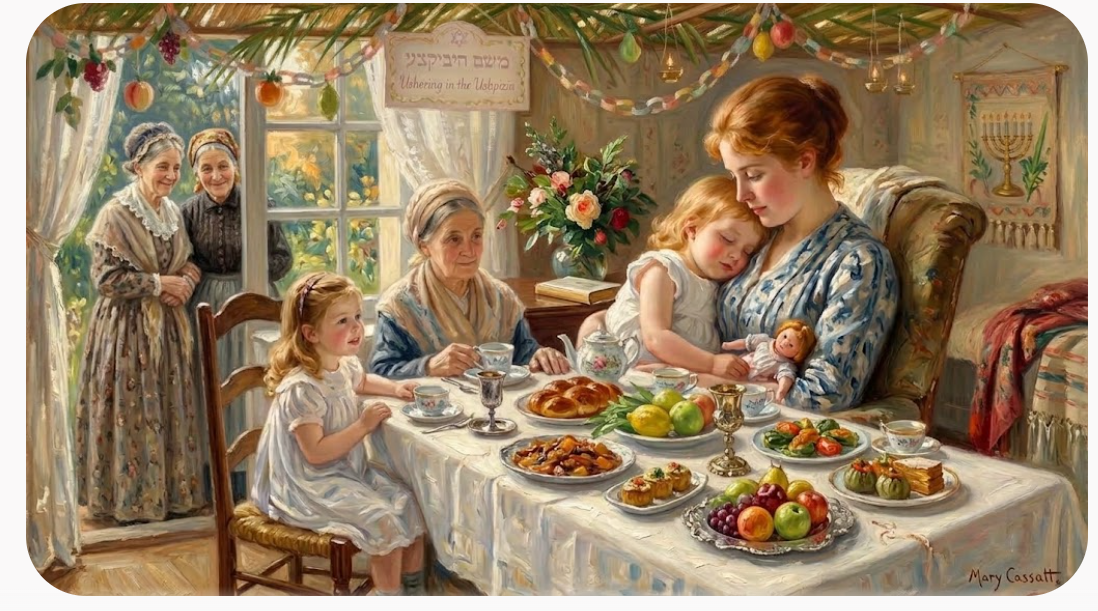
The Holiday of Joy
On Sukkot, we are commanded to be happy!!
You shall rejoice in your festival, וְשָׂמַחְתָּ֖ בְּחַגֶּ֑ךָ, with your son and daughter, your male and female slave, the Levite, the stranger, the fatherless, and the widow in your communities.
You shall hold a festival for the Eternal your God seven days, in the place that GOD will choose; for the Eternal your God will bless all your crops and all your undertakings, and you shall have nothing but joy– וְהָיִ֖יתָ אַ֥ךְ שָׂמֵֽחַ (Deuteronomy 16:14–15).
Sukkot is called zman simchateinu, “the time of our joy,” because the Torah itself emphasizes that this chag is to be filled with simcha (see also Leviticus 23:40).
There are many explanations for why Sukkot is particularly associated with happiness. One is that it follows immediately after the solemn days of Rosh Hashanah and Yom Kippur. Having gone through the process of repentance and atonement, a Jew may enter Sukkot feeling purified and experiencing an unusual sense of closeness to God. Perhaps this spiritual renewal amplifies the joy and contentment associated with the holiday.
In fact, Sukkot is unique among the biblical festivals in the emphasis it places on joy. But this raises a question for me: What exactly is there about Sukkot that is supposed to make us happy?
What Is So Happy About Sukkot?
In Israel, Sukkot means sitting outside. In the evening, the weather can be very pleasant—except for the mosquitoes. At lunchtime, however, it can be 38 degrees Celsius in the shade, at which point the mosquitoes are replaced by flies. And at my age, there is not necessarily anything joyful about sitting on plastic chairs.
Last year I did not build a sukkah, but I was still living in my home in Omer and had friends who invited me to their sukkot for meals. This year will be completely different. I will be celebrating Sukkot in my new synagogue—I just paid my membership dues—which is only two minutes away by car. They are having a communal dinner in the evening, and I have signed up to bring a pasta salad.
That is one of the interesting things about holidays: the rituals may remain the same, but the circumstances in which we celebrate them can change completely.
Memories of Sukkot
I am also nostalgic for Sukkot as it used to be.
The happiest part of Sukkot for me was having our entire family come together to celebrate all the October birthdays—my daughter, son-in-law, and grandson—as well as other events that had been overlooked during the summer, including my own birthday.
On October 5, 2023, my daughter, son-in-law, and granddaughter came to our sukkah after traveling around the world with the intention of staying. We had one of our usual happy family moments. Who knew at the time that everything was about to change?
By October 9, they had bought tickets and were on their way out of the country, once again wandering the world.
So my memories of that Sukkot are complicated. They are happy memories, but they are also connected to what happened immediately afterward.
Still, over the years we had many wonderful celebrations in our sukkah. We loved having friends over for coffee and cake, and we shared meals and conversations with close friends and family.
For the past several years—beginning around the time of COVID, which also coincided with the addition of a new pergola—the opening of our sukkah looked out at our metal storage shed. I tried to improve the view by putting up an entire array of pictures with magnetic backings. They stayed there for the whole seven days. Sometimes they fell down, but we loved looking at them.
We also decorated the walls of the sukkah with pictures. In earlier years, these included the traditional pictures of the Ushpizin—the seven guests whom we symbolically invite into our sukkah.
And that brings me to one of my favorite Sukkot traditions.
Who Are the Ushpizin?
Ushpizin is an Aramaic word meaning “guests” or “visitors.” The tradition is associated with the Kabbalistic book, the Zohar, in which seven biblical figures are imagined as visiting our homes during Sukkot.
It is somewhat like Elijah coming to visit on Passover, for whom we have a special cup on the Seder table. We invite these spiritual guests into our sukkah as an expression of hospitality. It makes sense that Abraham usually gets top billing. One of the first people in the Bible to invite strangers into his home is Abraham, who greets three mysterious visitors while sitting outside his tent in the heat of the day. Traditional Ushpizin posters or ready-made sukkah decorations generally feature seven men, arranged in chronological order: Abraham, Isaac, Jacob, Joseph, Moses, Aaron, and David. But, fortunately, there are no rules that say our guests have to be men.
From Ushpizin to Ushpizot
Under the influence of feminism, ushpizot—the feminine form of ushpizin—were introduced. These often include biblical women such as Sarah, Miriam, Deborah, Hannah, Abigail, Huldah, and Esther.
One could also invite more controversial biblical women—Eve, Rebecca, Leah, Rachel, Dinah, Bathsheba, or Ruth—and imagine the conversations they might have around the table.
And why stop with biblical figures? We could invite historical women: Donna Gracia, Emma Lazarus, the poet Rachel, Golda Meir, Shulamit Aloni, Kamala Harris, Ruth Bader Ginsburg, or even Gal Gadot. These choices can sometimes be political, which might lead to interesting—and hopefully peaceful!—conversations around the table.
Or we could invite couples, family members, or people from our own photo albums and old computer files. In other words, we can let our imagination guide us. And, of course, we can even ask AI to introduce us to people we don’t yet know.
My Own Ushpizot
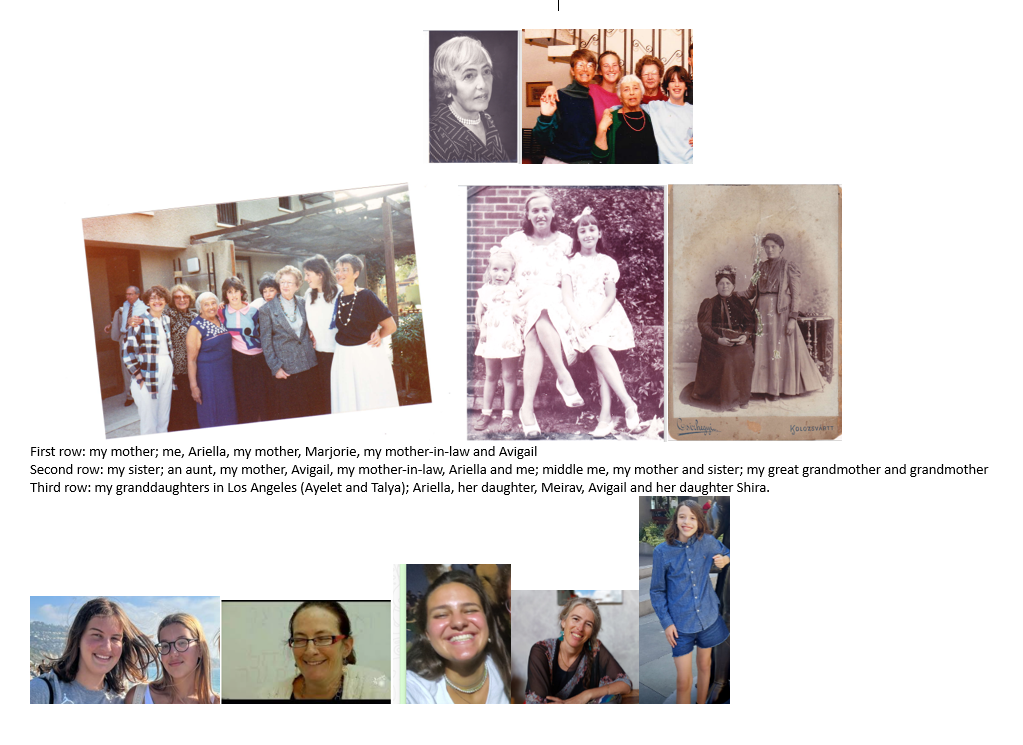
One of our closest friends has been putting up pictures of her maternal family in her sukkah for years. I thought this was a wonderful way of including people who are no longer with us. So I decided to adapt her idea and make my own family my ushpizot.
With one exception—my mother and sister—we are all still alive and hanging in there! The challenge was how to choose only seven people.
I have four granddaughters and two daughters. That’s already six, which doesn’t leave much room for an ancestress. So if I had my own sukkah this year, my list would be:
My mother and my sister
Me
My two daughters
My three granddaughters
Well, that’s actually seven people if I count my mother and sister together—and perhaps that is another example of the fact that there are no real rules.
The next step was to create a picture of all of us. That wasn’t too difficult, since I have an enormous number of photographs on my computer.
Then came the task of writing a little blurb honoring each person for something special about them. That wasn’t too difficult either.
I cheated a little. I also found a picture of my maternal grandmother and her mother—my great-grandmother. And while I was at it, I found a picture of my mother-in-law as well.
There are no rules.
 Creating Our Own Joy
Perhaps that is one of the things I like most about Sukkot. The Torah commands us to be happy, but it doesn’t tell us exactly what that happiness has to look like.
For me, Sukkot has been about family, friends, photographs, memories, stories, laughter, and sitting together—even on those terrible plastic chairs.
This year, my sukkah will be different. My home is different. My synagogue is different. My family circumstances are different.
But perhaps that is also part of the meaning of simcha: finding ways to celebrate even when life has changed, and bringing the people we love—those who are physically with us and those whom we remember—into the sukkah with us.
Hag Sameach!
By the way, the standard greeting during the holiday itself is Mo’adim le-Simcha, and the traditional response is Chagim u-Zmanim le-Sasson.
May we all have a happy holiday.
Related Topics