Courtyards and Characters: Wandering Through Jerusalem’s Living Stories
The Haredi Bargain
Reflections on what the Haredim bring to Israel and what they demand in return
The Haredim
Last time I told you about Menachem, my plumber, who, somewhere between fixing my toilet and unclogging the drains, managed to reduce the upcoming Israeli election to a single question:
“Who would you rather have in the government, the Haredim or the Arabs?”
It was an insanely blunt question, but as I wrote then, he really hit on something essential. Most of the major parties competing in this election are explicitly Zionist parties. They disagree, usually intensely, about what the Jewish state should look like, but they begin with the premise that their purpose is to shape and strengthen it.
The two main Haredi parties are different.
Shas and United Torah Judaism exist primarily to represent the specific interests and worldview of Israel’s Haredi, or ultra-Orthodox, community. Their relationship with Zionism is complicated, but suffice it to say that neither identifies with the classical Zionist political tradition. And yet, for decades, Haredi parties have been among the most important players in determining who governs the Jewish state.
Haredim already comprise roughly 14 percent of Israel’s population, and with nearly 60 percent of them under the age of twenty, their share of the country is growing rapidly. They will increasingly shape the future of this country.
But, before deciding whether Menachem’s question is a fair one, we need to ask another question:
What do the Haredim bring to an Israeli government, and what does their political power cost the rest of the country?
The Power of Our Merit
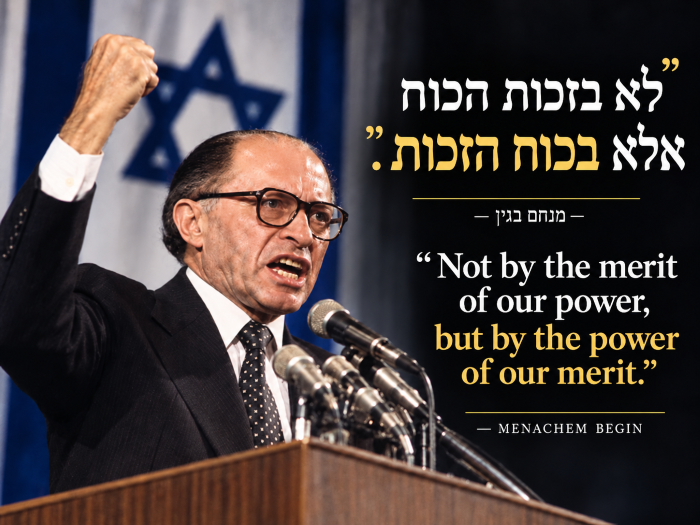
A different Menachem, Menachem Begin, when discussing the existence of the State of Israel, once famously said that the Jewish nation endures:
לא בזכות הכוח אלא בכוח הזכות.
Not by merit of our power, but by the power of our merit.
I have always loved that quote.
After nearly 2,000 years of exile, the Jewish people gathered themselves from virtually every corner of the earth and returned to our ancient homeland. We resurrected an ancient language. We rebuilt Jerusalem (a work in progress). We created a sovereign Jewish state that has become one of the strongest countries in the world, with one of the most sophisticated militaries in the world and an economy that has produced extraordinary achievements in technology, medicine, science and innovation.
None of this was a given. In fact, much of it seems quite miraculous. And these miracles demand something of us. The relationship between God and the Jewish people is covenantal by nature, based on a binding mutual commitment. In other words, there’s a deal: God will protect us and allow us to thrive here, but we must remain steadfast in our loyalty to His Torah and mitzvot. We believe that our presence and success in this land are connected not only to our military strength, but even more, to our willingness to uphold our side of that covenant through Torah and mitzvot.
Our existence here is not simply בזכות הכוח, by merit of our power. It is בכוח הזכות, through the power of our merit. It is the merit accumulated through thousands of years of Jewish faithfulness and sacrifice, and through our continuing commitment to the covenant between the Jewish people and God.
We have an end of that covenant to uphold.
If we believe that the extraordinary blessing of Jewish sovereignty after 2,000 years is not simply an accident of history, then Torah and mitzvot are not peripheral to the success of the State of Israel. They are part of the foundation upon which that success rests. Hashem blesses this people and this nation when we remain committed to the values and obligations that have sustained the Jewish people throughout our history.
And nobody in Israeli society takes that responsibility more seriously than the Haredim.
Tens of thousands of Haredi men spend their days immersed in Torah study. Haredi families organize their lives around Shabbat, kashrut, prayer, Torah education and mitzvot.
You don’t have to believe that every Haredi man should spend his life in yeshiva to believe there is something enormously valuable about having a community within the Jewish state that dedicates itself so completely to Torah.
I certainly believe this.
If Israel is going to be more than simply another successful Western country on the eastern Mediterranean, if the word Jewish in “Jewish state” is supposed to mean something, then preserving Torah learning and serious Jewish religious life matters.
That is a very significant part of what the Haredim bring to the table.
Who Carries the Burden?
But while our nation cannot survive on power alone, it cannot survive without it either.
This is where the Haredi question becomes much more difficult.
Since October 7, hundreds of thousands of non-Haredi Israelis have left their homes, spouses, children, businesses, universities and careers to serve in the reserves. Some have served not for weeks, but for months, returning home only to be called up again.
Meanwhile, the number of Haredi men of military age who have not enlisted has become enormous. In May, an IDF representative told the Knesset that Israel was approaching 80,000 to 90,000 Haredi draft evaders.
That number is particularly difficult to digest because Israel does not have a surplus of soldiers but rather a shortage. And the burden then falls on everyone who does serve.
And this adds tremendous financial stress on the tax payers. The law here requires that the government compensate reservists based on their regular civilian income (subject to minimum and maximum payment levels). In other words, they are not simply paid a standard soldier’s salary while serving. The Bank of Israel estimates that adding just 7,500 Haredi recruits per year could substantially reduce Israel’s dependence on reservists and save the economy at least NIS 9 billion, or almost 3 billion USD every year.
But those numbers still don’t capture the real cost because they don’t consider the burden of the wife putting three children to bed by herself for another 60 nights. They don’t measure the business owner watching his company struggle while he is in Gaza or Lebanon. They don’t measure the university student postponing another semester, or the children wondering when their Abba is coming home.
And that is where resentment toward the Haredim has become so intense.
Whereas the argument was once: Why should my son serve if your son doesn’t?
It has changed to: Why should my son serve again because your son doesn’t?
That is a much harder question.
For many Israelis, this boils down to the deeper question of shared responsibility. Can a growing community continue to depend on others to defend the country and sustain its economy, while it uses its political power largely to protect its own way of life and secure resources for its own institutions?
Israel simply does not have enough soldiers for the security demands it now faces. With the army needing thousands more combat troops, with regular service being extended, and with reservists being told to continue to expect months away from their families and careers year after year, the burden on those who serve has become crushing. For many of them, bringing Haredi parties back into a coalition with the expectation that broad army exemptions will continue feels like a betrayal: We have been carrying this country on our backs for three years. How can you ask us to keep carrying more while allowing an entire community to remain outside the burden?
To their defense, the Haredim do not see themselves as refusing to contribute. They believe that Torah study is itself an essential contribution to the survival of the Jewish people and that mass conscription threatens the very fabric of the religious society responsible for sustaining that Torah.
Their critics do not necessarily reject the value of Torah study. They reject the proposition that this contribution can justify exempting an entire and rapidly growing population from the physical burden of defending the country.
Haredim often see themselves as the guardians of the flame, preserving the Torah and traditions that have sustained the Jewish people for generations. Many other Israelis would answer that the flame belongs to all of us, and that there are many ways to carry it forward.
The question of Haredi military service has moved to the very center of this election campaign. For many Israeli voters, how a party proposes to resolve the issue has become one of the most important considerations in deciding whom to support.
The Power of the Kingmaker
And then there is politics.
Israel’s parliamentary system gives small parties extraordinary leverage when neither major bloc can reach 61 seats without them, which they never can. That isn’t uniquely a Haredi phenomenon. Arab parties, Religious Zionist parties and small centrist parties can all become kingmakers under the right circumstances.
But the Haredi parties have become exceptionally skilled at using that leverage. Their priorities are generally quite clear: protecting yeshiva study and exemptions from military service; funding Haredi schools and institutions; preserving the autonomy of educational systems that often do not teach the full core curriculum; supporting large families and religious institutions; and protecting Haredi authority over questions of religion and state.
There is nothing inherently illegitimate about that. That is what political parties do. They represent their voters.
The problem comes when the price of assembling a governing coalition means that the interests of roughly 14 percent of the population can sometimes outweigh policies that a much larger portion of the country considers essential.
Money is one concrete example. In the 2026 budget, funding for yeshivas and kollels increased from NIS 1.7 billion to NIS 1.9 billion ($558 million to $623 million). At the same time, the government imposed broad cuts that took tens of millions of shekels from health, welfare, education and, perhaps most painfully, from rebuilding the kibbutzim and communities that were hit hardest along the Gaza border on October 7th. Those cuts were driven in large part by Israel’s enormous wartime defense needs, and the money was not simply being transferred from hospitals and schools to yeshivas. But budgets are ultimately about choices. When Haredi parties are essential to keeping a coalition alive, funding their priorities becomes part of the price of keeping that government together.
This reflects something deeper about Haredi politics. Haredi parties have traditionally entered government less with a vision for governing the country as a whole than with a mandate to protect their own community. Their role has often been less to lead the state than to advocate for themselves and for safeguarding Torah life, preserving Haredi institutions and securing the resources their community needs.
I should make clear that I am speaking here about Haredi political parties and their approach to government, not about individual Haredim. Many Haredim feel deeply connected to Israel and want to contribute to its future while remaining fully committed to their religious way of life. In fact, a growing movement within Haredi society is beginning to challenge the old political assumptions. One example is a new party, HaTzibbur HaCharedi (the Haredi Public), which seeks to preserve Haredi religious life while addressing employment, education, military service for those not engaged in full-time Torah study, and greater participation in Israeli society. It may not cross the electoral threshold this time, but it reflects a growing desire for change from within the Haredi community itself.
A Conversation in the Sukkah
To understand all of this a little better, I walked next door and sat down in the sukkah of my neighbor, Professor Benny Brown.
Brown is an Israeli academic, philosopher, and professor of Jewish Thought at Hebrew University, as well as one of Israel’s leading scholars of Haredi society and thought. He has spent much of his academic career studying Haredi ideology, halakha, leadership, and the complicated relationship between the Haredi community and the modern State of Israel. He is also a close friend and neighbor who loves a good schmooze.
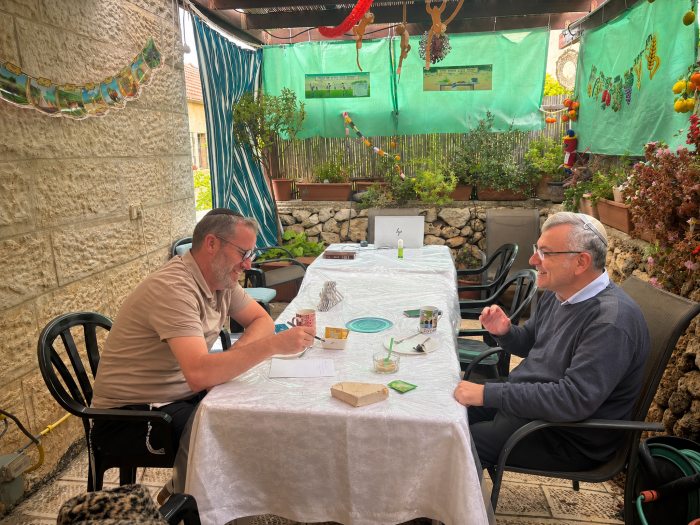
One of the things Benny explained to me helped me understand why changing the relationship between the Haredim and the rest of Israeli society is so difficult.
When pressure on the Haredim feels ideological, Benny explained, they tend to dig in.
If the message they hear from the rest of Israeli society is that you are the problem, that their way of life needs to change, that their schools need to become like ours, that the yeshiva world needs to be dismantled, or that becoming integrated into Israeli society requires becoming less Haredi, the instinctive response is resistance.
They go into what we might call fight-or-flight mode (my words, not his).
And once that happens, nothing will change.
According to Benny, that reaction doesn’t necessarily depend on whether the Haredi parties are sitting in the government or the opposition. If they perceive an issue as an ideological assault on Haredi identity, they will fight it from inside the coalition or outside it.
That means the discourse itself has to change.
If the rest of Israeli society approaches the Haredim with the message that we are against you, we disapprove of the way you live, and our goal is to change you, we should not be surprised when they build higher walls around themselves or take to the streets in violent protest.
Ideally, the message would be: We value Haredi society and its commitment to Torah, and we want to find a way to preserve that while building a sustainable future for the country we share.
But Brown acknowledges that Haredi political opponents are unlikely to deliver the first half of that message convincingly. A more realistic approach, he argues, is to make clear that the pressure is practical rather than ideological: We are not trying to change who you are, but the present situation cannot continue. Instead of arrests and physical coercion, which are likely to provoke greater resistance, the state can reduce financial benefits and subsidies for those who do not serve.
That also gives Haredim who are willing to enlist a socially acceptable explanation: I’m not rejecting the Haredi world. I simply have no choice. In a community where there can be an enormous difference between choosing something as a matter of principle and doing it reluctantly because circumstances leave no alternative, that distinction can create real room for change.
But until that discourse changes, Benny says, it is difficult to imagine much else changing.
How Change Can Happen
But Benny stresses that practical and economic pressure can produce a very different response.
If learning certain skills opens the door to a better job, people may learn them. If entering the workforce creates opportunities that otherwise would not exist, people may enter it. If economic realities make certain changes advantageous without demanding an ideological surrender, Haredim can be remarkably pragmatic.
And their success in breaking into the workforce is everyone’s priority here. The Haredi population is growing rapidly. The OECD estimates that by 2060, more than one in four young Israeli adults will be Haredi. If a large portion of that population remains outside the workforce, Israel will have a much harder time paying for its military, schools, hospitals and other basic needs.
If we want to see real change, then the question can’t be: how can Israel force the Haredim to become more like everyone else. Instead, it has to sound more like: how can Israel create a system in which Haredim can remain Haredi while economic incentives gradually encourage greater participation in the workforce, education and the responsibilities of Israeli citizenship.
When Support Becomes Enabling
And that brings us back to the political question.
Benny told me an old Israeli joke:
A third of the country works. A third serves in the army. And a third pays taxes. The problem is, it’s all the same third.
It’s funny because it touches a nerve.
The problem with repeatedly bringing the Haredi parties into a governing coalition may not simply be that they receive too much money or too many exemptions.
The deeper question is whether the political system is enabling a social structure that isn’t good for them and will ultimately have to change anyway.
When a coalition depends upon Haredi votes for its survival, the Haredi parties have enormous leverage to protect their community from precisely the economic pressures that Benny says are most likely to produce gradual change.
When the Haredim are critical to the survival of the coalition, then their funding can be maintained and the economic consequences can be softened. This means that difficult choices can continue to be kicked down the path.
There is a familiar concept in family life called enabling. Sometimes, in our desire to protect someone we care about from hardship, we continually remove the consequences of his choices. Our intentions may be compassionate, but by eliminating every pressure to change, we can inadvertently make change less likely.
Something similar may be happening politically, Benny suggests.
Excluding the Haredi parties from government might not be an act of hostility toward Haredim at all. Perhaps, paradoxically, it could create precisely the kind of practical economic pressures that will allow change to emerge from within Haredi society rather than being imposed ideologically from outside it.
That doesn’t mean cutting off Haredi families or punishing children for the choices of their parents. And it certainly doesn’t mean trying to dismantle the yeshiva world.
It means asking whether government policy should continually insulate an increasingly large portion of the population from economic choices that most other Israelis are required to make.
And, just as importantly, it means changing the way the rest of Israeli society talks to and about the Haredim.
Putting pressure on them may be necessary, but humiliating them is counterproductive. Economic incentives may produce change, but an assault on their very identity will trigger fierce resistance.
The goal cannot be to make Haredim less Haredi. The goal should be to create the conditions in which Haredi society can preserve what is precious about itself while assuming a greater share of the economic and national responsibilities required to sustain the country.
Being outside of the governing coalition could be a good place to start.
The Bargain
And that brings us back to Menachem the plumber’s question.
There is a bargain implicit in bringing the Haredi parties into a government.
What Israel receives, in my mind, is representation of a community that preserves Torah learning, religious commitment and a profoundly Jewish way of life on a scale that exists almost nowhere else in the world.
For someone like me, that is extremely valuable.
But it comes at a price.
The price is continued resistance to broad Haredi military service, placing an unbearable burden on those that do serve. It also means billions of shekels directed toward their specific priorities at the expense of other critical needs here right now. And, of course, it means disproportionate political leverage for parties willing to bring down a government if their fundamental demands are not met.
And, according to my neighbor, Professor Benny Brown, there is a less obvious price: by continually shielding Haredi society from the practical pressures that might produce organic change, the political system is actually enabling them and delaying changes that are ultimately in the Haredi community’s own best interests.
Both sides of this argument are making claims about what it means to maintain the Jewish state.
The Haredi argument, at its strongest, says: A Jewish state that loses commitment to Torah is ultimately losing the reason it exists.
The argument of the reservist and their supporters, at its strongest, says: A Jewish state whose citizens will not share the burden of defending it will ultimately lose the ability to exist.
In just under three weeks, we will be forced to make this decision.
Next week we will attempt a similar analysis of what it means to bring an Arab party into the coalition.
Related Topics
Related Posts