


The Hareidi basis for peace in the Middle East
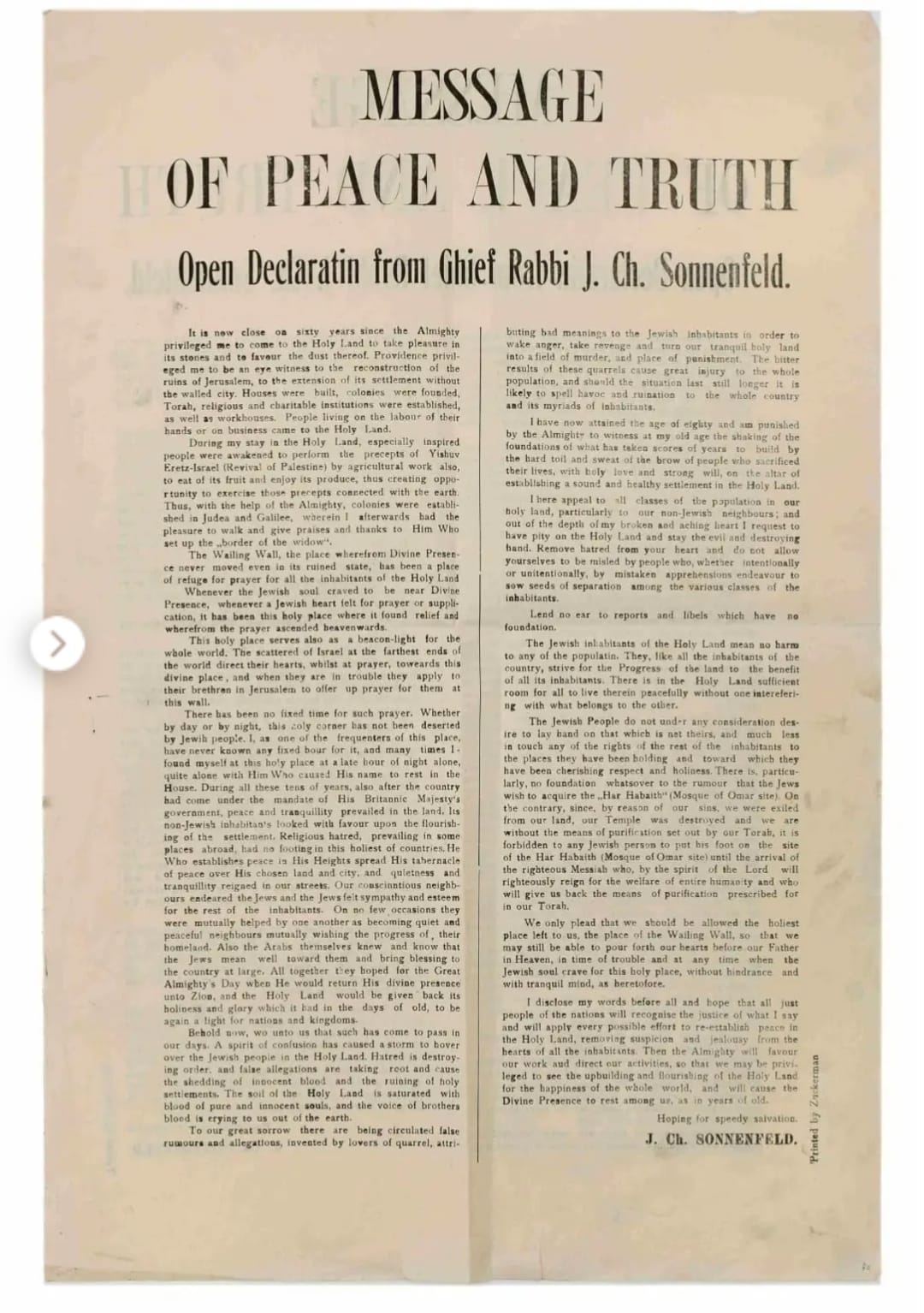
I. Judaism, Democracy, and Modern Political Language
It needs to be stated that Judaism is not “democratic.” There is the priesthood, the Levites, and the common garden Israelites. Then come the women, the children, and the slaves. Nothing democratic there. Similarly, Judaism is not “feminist.” Jewish wisdom, responsa literature, and philosophy—developed long before the birth of the concept of the nation-state—belong to a different category than modern political ideologies. Attempting to reconcile Judaism with modern constructs, which have their own inherent value, stems from a desire to please everyone… including ourselves.
Indeed, anyone in the Israeli political arena who speaks of a “Jewish democratic state” or a “democratic Jewish state”—from Ben-Gurion, Benjamin Netanyahu, Benny Gantz, and Gadi Eisenkot to Yair Golan—is using these terms to “play to their base.” I get it—they’re trying to evoke Jewish emotions about heritage as well as demonstrate their commitment to liberal values. Unfortunately, used together and with such frequency, “Jewish and democratic” has been rendered both populist and hollow.
It also needs to be stated that the Jewish People (Am Yisroel) is not the same as the Jewish Nation (Umas Yisroel/Umat Yisrael). A Jewish American is part of Am Yisroel, the Jewish People, but he cannot vote in Israeli elections. However, an American Israeli, after having made aliyah, can go to the American consulate and sign up to vote in American elections…and vote for American candidates offering to serve the American nation.
According to the Judaism of my parents and grandparents, Jews attain “nationhood” only in the messianic era, when the Temple is rebuilt, the Davidic dynasty is restored, and the priesthood and the Sanhedrin regain their authority. I pray for this every day. But until then, I have no desire to live in a halachic community sanctioned by state mechanics.
And so I chose democracy. I thank the democratic state in which I live because it grants me religious freedom—even if, theologically, it disagrees with me. But banning my Muslim friends from bringing bread to their hospitalized relatives on Pesach does not make me “more Jewish,” nor does alienating non-Jewish Israelis contribute to my personal security.
Outside a modern nationalist framework, rabbinic literature offers a sophisticated system governing relations between Jews and non-Jews. Jewish Peoplehood does not require political dominance to maintain its integrity. The challenge arises only when “Jewish nationhood” is interpreted in modern statist terms—a framework that rabbinic literature itself does not mandate before the messianic era.
And so I address both Jewish Israelis who define themselves as “secular” and Jewish Israelis who define themselves as “national religious” when I say: it is the modern nationalist construct—not Judaism—that must adjust to present realities.
II. Am Yisroel, Umas Yisroel, and the Question of Palestine
If Am Yisroel are a People rather than a “nation” in the modern sense—albeit one with a covenantal relationship to the Land of Israel—and if Jewish statehood is reserved for the messianic period, then the State of Israel does not need to relate to the Palestinian nation as a competing nation. Jewish identity is not diminished by Palestinian statehood. Am Yisroel own a library with a staggering number of texts against the manufacture, production and selling of armaments. By contrast, Umat Yisroel is a military powerhouse, selling weapons systems to over eighty countries across the globe.
Amongst Jews who are confident in their Am Yisroel identity, debates about whether there is, was, or should be such a thing as a “Palestinian nation” lack meaning. We could debate ad infinitum, whether some Palestinians trace their ancestry to local tribes predating the Mandate; that some families came from Egypt; that others were brought from Iraq by the British to build the Haifa port; that some hold Jordanian passports; and so on. These narratives matter—but they do not bring us closer to resolving a conflict that affects people’s moral rights. Nor do they negate the simple fact that some seven million non-Jews living between the Mediterranean Sea and the Jordan River are capable of calling themselves Palestinians.
For Am Yisroel, making peace with Israel’s neighbors—all our neighbors—and being seen to make peace—is the only course of action that makes sense. Indeed, since parts of Gaza, Lebanon, and Syria are more credibly part of the biblical Land of Israel than the city of Eilat, peace would bring access to more covenantal land, not less. I mention biblical borders not as a territorial claim, but to highlight how our modern anxieties have shrunk the expansiveness of our own texts. Meanwhile, Umas Yisroel’s foreign policy is increasingly constrained by the agendas of larger powers.
Until the fundamental differences between Am Yisroel and Umas Yisroel are understood—and internalized—our fractured Israeli society cannot heal, and the State of Israel will stand increasingly alone on the geopolitical stage. We need new models. New models for the divisions within Israeli society and new models for our relations with our non-Israeli neighbors. And we ignore the interconnectedness at our peril. And yes, it’s not easy. After all, Yisroel” means “to struggle with God”.
III. A Past Model: Ottoman Citizenship as Shared Civic Glue
During the last years of the Ottoman Empire, in the territories now called Israel, Syria, and Lebanon, we find an interesting and unique example, and a potential, replicable model for co-existence amongst Jewish Israelis, Arabic-speaking Israelis and Palestinians.
In the Balkan Wars (1912-1913) Palestinian Jews and Palestinian Arab Muslims fought side by side in the Turkish army. Additionally, the Young Turk Revolution of 1908, led by both Jews and Muslim citizens of the Ottoman Empire, was an attempt to nurture a new type of Ottoman citizenship which aspired to be a kind of flexible civic glue that bonded individual citizens to meet their needs for physical security, but that was sufficiently pliable to grant just enough autonomy to specific ethnic/religious communities, thereby facilitating community pride, cultural vibrancy and contentment.
For various reasons, not least the outbreak of World War One, the Young Turks failed and four years later the Middle East was a different beast altogether, thanks to the magnificent double , triple, multiple dealings of the British.
But the idea of a democratic state, which has the humility and confidence to grant equal citizenship to all citizens without pre-conditioning them to swear until-death allegiance, is something towards which we cannot afford not to strive. We need to find a better glue. Investing in civil society saves lives and a genuinely democratic Israel is Am Yisroel’s best chance of survival.
IV. Toward a Jewish Ethic of Democracy and Peace
So, if you want to preserve your Jewishness: become an advocate for improved democracy in Israel, keep shabbos, be informed of Jewish history including our almost two-thousand-year-old responsa literature, speak Hebrew (but not at the expense of Arabic, Yiddish, Ladino, and other cultures diminished by Zionism), have lots of kids who will continue your tradition, learn Torah and sing Jewish songs with them, go to the mikva, do chesed, keep the environmentally sound laws of shmitta (rather than “selling” your land to non-Jews and then “buying” back the produce (!)), and invest in businesses owned by your co-religionists.
But please don’t invest in businesses that create weapons of mass destruction. Because ultimately, Judaism is a moral-ethical code; checking-lettuce-for-bugs is training ground to heighten our sensitivities. And when we forget that, we have lost everything.
Finally, if you are a person who cares about Am Yisroel in equal measure as you care about the Eretz Yisroel and Toras Yisroel, rather than elevating the land, or the Torah or the “nation” in a near-idolatrous fashion, I’d love to hear from you.