

The Institute for Safety in the Criminal Justice System
The hero of Bondi and my family’s hero from 1929
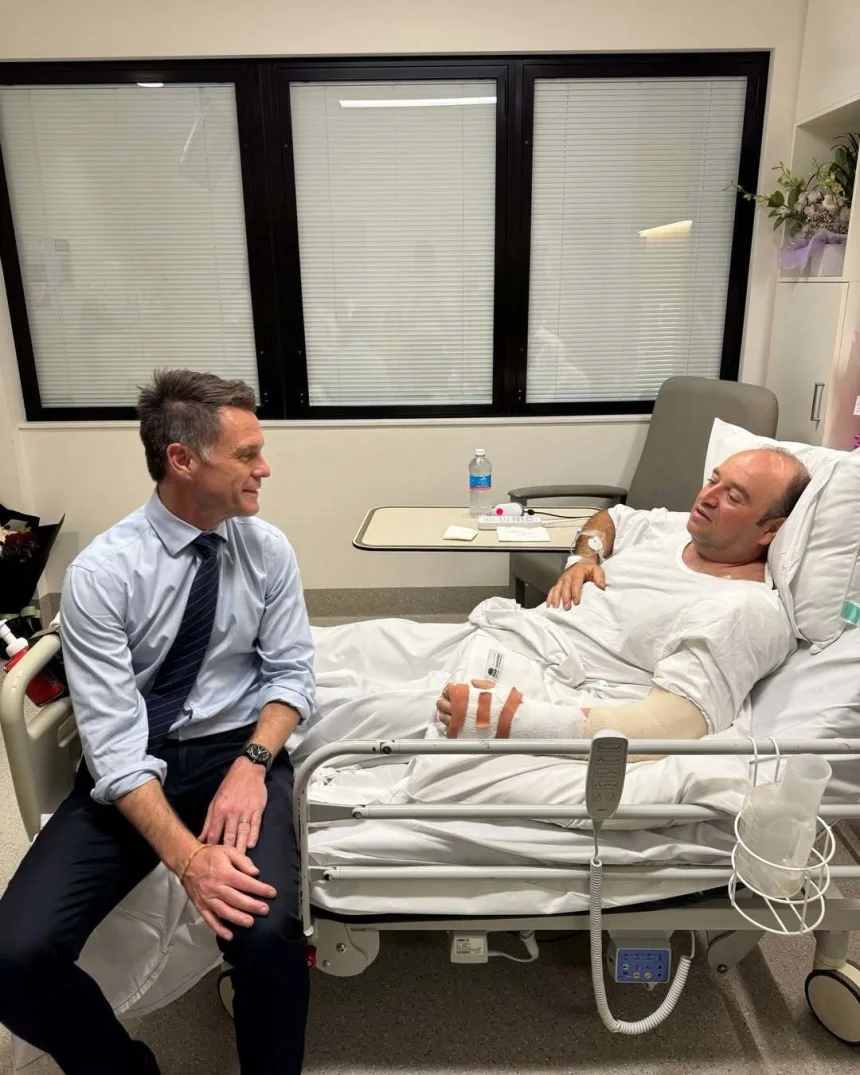
NSW Premier Chris Minns meets Ahmed al Ahmed, who is recovering in hospital from injuries he sustained in the attack. Chris Minns/Facebook
There are moments in life when a person chooses which facts will become a story. Not in the sense of “what happened,” but in the sense of: what, out of what happened, will be the compass we carry forward.
At one such moment, I stood at the University of Haifa’s doctoral graduation ceremony and delivered the valedictorian’s address on behalf of my cohort.
I could have spoken about an academic achievement, about a research journey, about gratitude to my advisers. I spoke about all of these. But I deliberately chose to open with a family story: my great-grandparents, who came to Haifa more than a hundred years ago and rented an apartment opposite the port, on Nazareth road. And in 1929, during the 1929 riots, their Arab landlord “stood at the front of the building… and stopped the rioters with his own body.”
Why that, there, and before a festive audience? Because that story, for me, is not a historical anecdote. It is the essence of this land and of the possibility within it: the intensity of its tensions and the solidarity embedded in it, even to the point of self-sacrifice. It does not deny the violence. It does not paint a sweet picture. It tells a hard truth and a strengthening truth together: within a charged reality, one person can choose humanity.
This week I read the story of Ahmad al-Ahmad, who subdued a gunman in an antisemitic attack at Bondi Beach in Sydney. In his first interview, he described how he acted almost without thinking: “I wasn’t worried… I had one goal—to take the weapon from him and stop him from harming human lives, and above all to prevent the killing of innocent people.” He did not describe an ideology. He described a human instinct. He did not ask for a prize. He asked to stop the massacre.
There are stories that reveal themselves to us as a mirror. This was a mirror. Not because the context is the same – Australia is not Haifa in 1929, and our time is not the 1929 riots – but because the human structure is the same: a moment in which reality pushes people into categories (“Jews”, “Arabs”, “Muslim”, “antisemitism”, “rioters”), and a moment in which one person refuses to be a category. He chooses to be a person. And he does so not with words, but with his body.
Here lies the point that mattered to me already then, in my doctoral speech: stories like these are not romance. They are social technology. They are the way societies create norms and define what is worthy. We do not merely “remember” an act of heroism; through memory we shape the likelihood that someone else will do something similar in the future. When a community tells, again and again, the story of someone who stood against violence to protect innocents, it is in effect telling its children: it is possible. It is required. It is worthy of esteem.
Here is the claim I allow myself to make: we are preserving the memory of that Arab landlord’s act of heroism a hundred years later. And I believe that even a hundred years from now there will be Jews – and perhaps also Arabs – who will carry the name of Ahmad al-Ahmad in their hearts, because this story will carry them. It will not “defeat” history, it will not erase suffering, and it will not solve a conflict, but it will provide a source of inner strength: proof that evil is not the whole story, and that within fear one can choose responsibility.
The Jewish community in Australia is entitled, and perhaps even obliged, to weave his name into its memory not only as a local hero of a traumatic event, but as testimony to possible shared life. Put simply: alongside bereavement and terror, to be able to say in a clear voice: within the darkness, there was a person who chose to save lives. He was not “ne of us” in the tribal sense, and he was “one of us” in the deep human sense.
Does this mean that everything will work out? No. Trust between populations is not built from one story alone. It is built from fair institutions, equal enforcement, personal security, mutual recognition, a public language that refuses generalizations, and real opportunities for neighborliness. But stories like these do one critical thing: they repair our moral imagination. They break the false belief that every person is only an emissary of his group. They remind us that a person can choose against the pull of hatred even when the threat comes from within their own community.
And therefore, if we truly want the rebuilding of trust and a future of good neighborly relations, there is a practical step here that is not a slogan: to make this memory something public, educational, shared. To honor Ahmad respectfully and without condescension; to integrate his story into community discourse, in schools, in community gatherings; to hold a remembrance event that is also an event of responsibility, not a publicity ceremony, but a statement: we choose to illuminate models of civic courage, because we want a society in which the response to violence is the protection of innocents, not revenge and not demonization.
Perhaps that is why I chose to tell my family story precisely in my doctoral graduation address: because in academia we are supposed to believe that we can learn, change, design rules, and influence reality, not only analyze it. And my family story from 1929 was for me a small but stubborn proof that there is human material to work with. That there is a basis for trust, even if it is cracked. That there are deeds that can be set up as a pillar of fire against the darkness of generalizations.
In the end, there is no way to guarantee a better future. But there is a way to increase the chance of it: to choose which stories we pass on. If we continue to tell the story of someone who protected others with his own body, we will create more hearts that believe it is possible. And if we manage to make the courage of individuals like that landlord, and like Ahmad al-Ahmad, part of a shared ethos, then perhaps we will gain something rare: neighbourliness based not on naïveté, but on the clear-eyed recognition that even in the greatest moments of terror, a person can choose to be a defender of life.