The Hidden Curriculum of Fear
I did not set out to raise my children as experts in danger. I wanted to teach them the ordinary things: how to tell the truth when it costs; how to be kind without being naïve; how to laugh at themselves; how to walk into the world with their shoulders back and their eyes open. I did not want to teach them how to disappear.
But antisemitism has a way of forcing a second curriculum into Jewish homes, a hidden syllabus that no parent would choose and no child deserves. It is not delivered with a bell or a timetable. It arrives in the form of a flinch, a warning, a change of route, a decision made with a tightness in the throat. It is the education of the hunted.
It begins earlier than people imagine. Not with the smashed glass and the shouting mob, but with the first time a child comes home quieter than usual, or the first time they ask why someone made a joke about “the Jews.” It begins with that peculiar parental instinct that something is wrong, and the even more peculiar parental obligation to translate wrongness into guidance without turning a child’s world into fear.
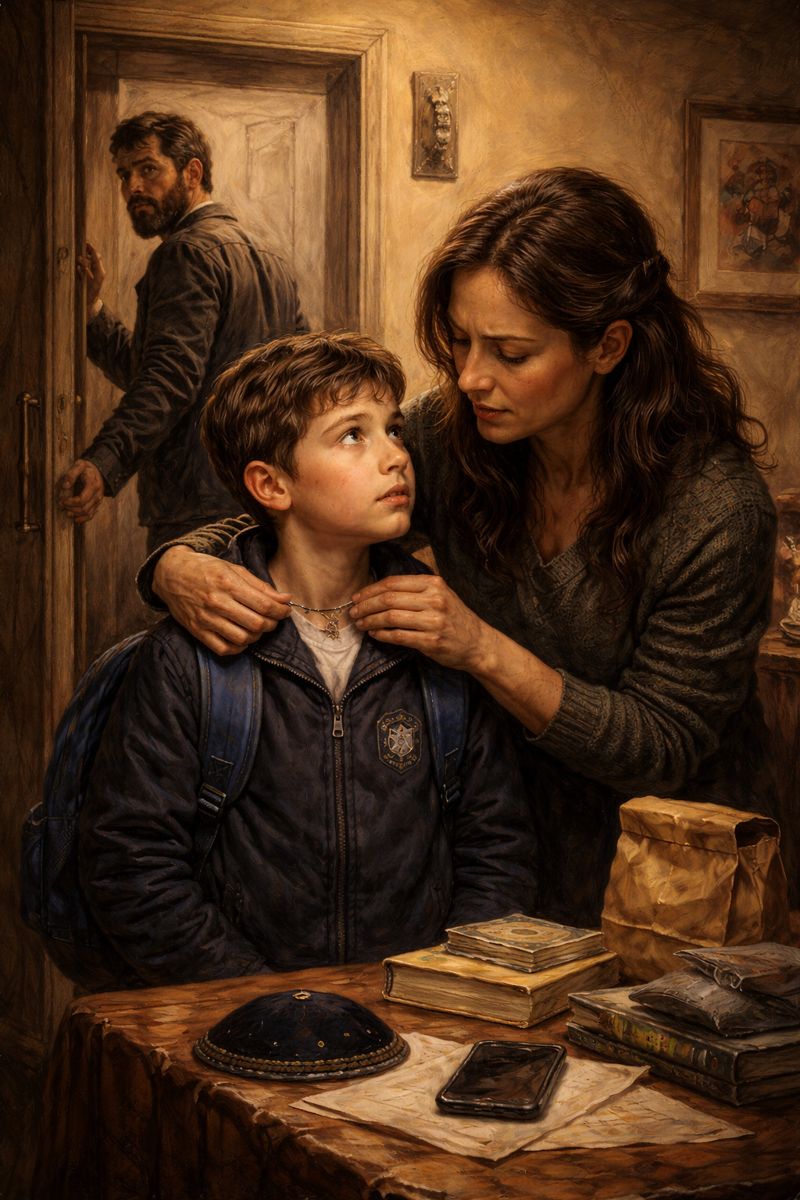
So you start small. You tell them to keep the necklace under their shirt. You suggest they don’t wear the school jumper with Hebrew on it on the train. You say – casually, too casually – “Maybe don’t mention synagogue to everyone.” You hate yourself as you say it, because it tastes like surrender. And yet you say it, because your job is not to win an argument about pride. Your job is to get your child home.
And then the “small” rules become a way of life.
You teach them the difference between a question and an interrogation. You teach them to hear the tone that turns curiosity into accusation. You teach them how to exit a conversation without provoking it. You teach them to lower their voice when they say the word “Jewish,” as if their identity were a match in a room full of petrol. You teach them where to stand on a platform if a crowd is rowdy. You teach them to notice who is behind them on the pavement. You teach them which streets to avoid after school. You teach them that the safest response to a threat is not to respond.
Imagine having to teach that to an eight-year-old.
Imagine watching a child practise being smaller.
This is the part the commentators do not see when they talk about antisemitism as a “social phenomenon,” as though it were a regrettable mood, like a slump in consumer confidence. Antisemitism is not a debate; it is a pressure applied to the body. It is the tightening of life. It is the conversion of the everyday into contingency. It is the way a Jewish parent learns to scan a room while pretending not to scan it, to smile at the school gate while silently counting exits.
And it is, above all, the theft of innocence.
For a Jewish child learns very early what other children are spared: that there is a category in the world for them. A category that can, on the wrong day, in the wrong place, make them a target. They learn that some people will hate them without ever meeting them. They learn that a symbol on a necklace can summon cruelty from strangers. They learn that a word – “Zionist” – can be thrown like a stone at their face, and that the adult world will sometimes insist the stone was merely an “opinion.”
Then comes the deeper injury: the moment you realise your child is doing your work for you.
They begin to self-censor. They stop asking to wear the necklace. They stop mentioning Hebrew class. They stop bringing friends home, because friends ask questions, and questions can become trouble. They start measuring rooms the way you measure them. They start calculating, instinctively, what can be said and what must be swallowed. They begin to carry a private map of risk that you never wanted to draw.
This is how antisemitism reproduces itself: not only through the vulgar hooligan and the ideological fanatic, but through the quiet, everyday intimidation that makes a minority negotiate its existence. It is an assault on dignity as much as safety. It does not merely threaten the body; it humiliates the spirit. It tells the Jewish child: you may remain here, but only if you are less visible, less audible, less yourself.
And when parents speak of it, they are met with the second cruelty: the alibis.
“It’s not about Jews.”
“It’s political.”
“It’s about Israel.”
“It’s just anger.”
“It’s complicated.”
Try saying that to a child who has been harassed on the bus because they look Jewish. Try saying it to a parent whose son was pushed in the corridor while someone hissed a slur they learned from the internet. Try saying it to the family that finds their place of worship defaced and is then advised to understand the “context.”
This is not context. It is cowardice dressed as sophistication.
The insistence that antisemitism is not antisemitism – only “anti-Zionism” – is a lie so brazen it can only survive in a culture that has decided Jews are an acceptable exception. “Zionist” becomes the modern substitute term, elastic enough to mean anything and therefore to license everything. It can mean an Israeli government. It can mean a Jewish student. It can mean a Jewish charity. It can mean your child. Once you allow that substitution, you have granted the antisemite the ability to persecute with plausible deniability. You have made hate respectable by teaching it a new vocabulary.
Meanwhile, in Jewish homes, the lessons continue.
Parents keep a charged phone by the door. They exchange numbers with other parents “just in case.” They learn which teachers can be trusted and which will minimise. They rehearse the right words for the headmaster and the wrong words for the press. They join community security briefings the way other parents join football clubs. They become, without ever consenting, custodians of a private emergency service.
And they do it while trying to preserve a child’s sense that the world is good.
That is the agonising contradiction. You want your child to love humanity. And humanity keeps issuing reminders that it has not loved Jews very much.
Then, inevitably, your child asks the question that has broken Jewish hearts for centuries: “Why do they hate us?”
There is no answer that is fair. There is only a truth that is bleak in its simplicity: they hate you because hatred needs an object, and Jews are the oldest object available. They hate you because conspiracy is easier than reality. They hate you because your existence embarrasses their fantasies. They hate you because you have survived.
And when you tell a child that, you feel something inside you crack – not because the child cannot bear it, but because they should never have had to hear it.
This is what antisemitism does. It does not only harm Jews; it forces Jews to parent differently. It turns the raising of children into a balancing act between pride and prudence, between visibility and safety, between dignity and survival. It presses itself into the domestic sphere, into the bedtime story and the school run, and it asks you to trade a piece of your child’s freedom for the privilege of getting them home unscathed.
And this is why any society that tolerates antisemitism is not merely failing a minority. It is failing the definition of a free society. Because a society is not judged by what it proclaims at conferences. It is judged by whether a Jewish parent can send a child to school without teaching them how to hide.
So I will pose the question that our leaders and institutions keep dodging. If a Jewish family must teach its children the tactics of concealment in order to remain safe, what, exactly, is the West proud of? What becomes of equality before the law, of the promise of citizenship, of the claim that minorities are protected, when Jewish parents are forced to raise their children as if they were living in hostile territory?
Antisemitism is not a “social phenomenon.” It is a theft: of childhood, of ease, of belonging. It is a pressure that forces families to shrink. And when a society demands that Jews become smaller in order to be safe, it is not Jews who have failed to integrate.
It is the society that has failed to be civilised.