Author, essayist, historical researcher
The Hidden Room That Saved Menachem Begin
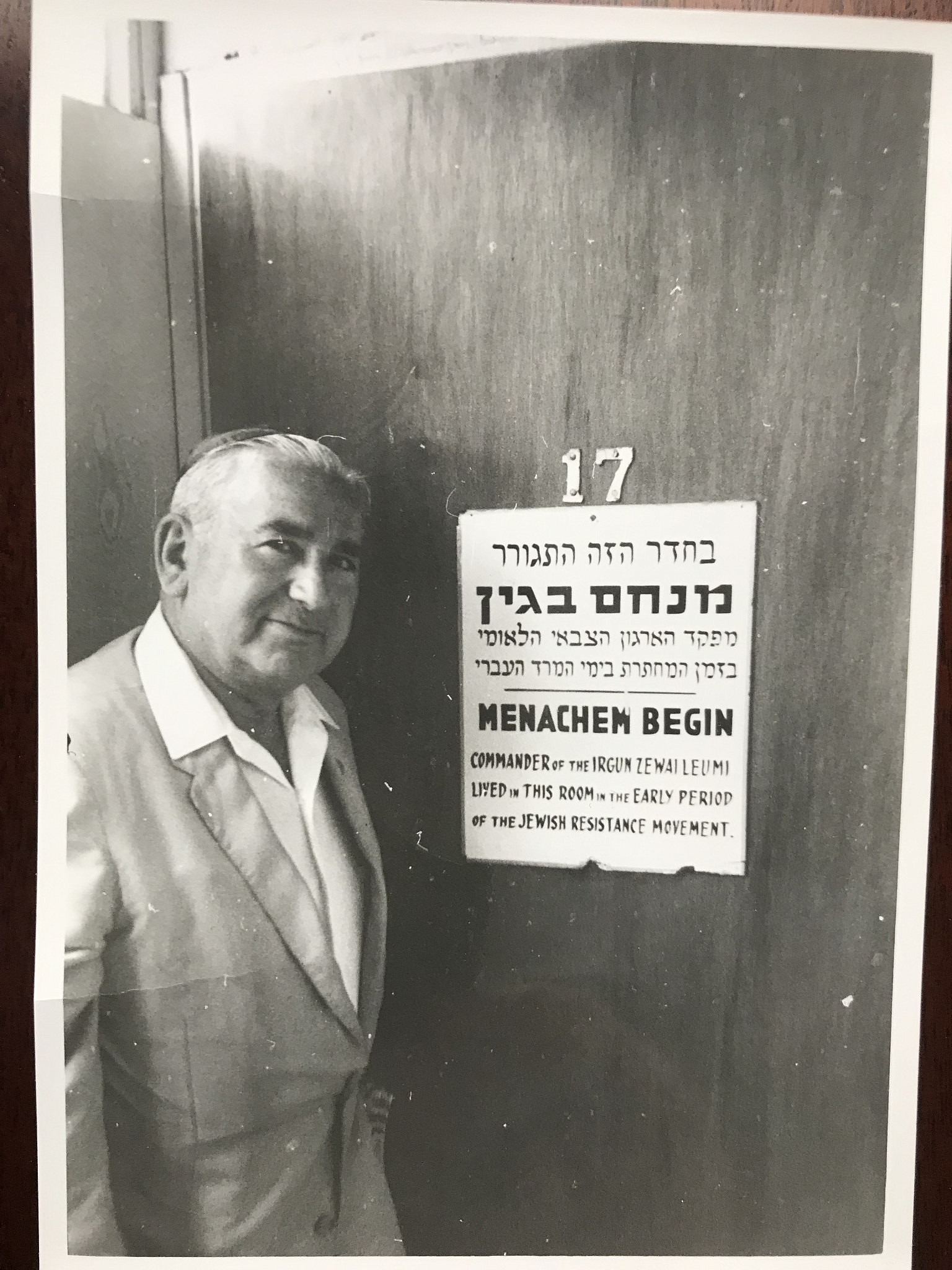
UN Press Correspondent David Horowitz at Room 17 of The Savoy Hotel in 1965 (World Union Press)
For who hath despised the day of small things? Zechariah 4:10
I knew that the late UN correspondent David Horowitz and former Israeli Prime Minister Menachem Begin shared a close friendship. Their letters, preserved in the UN archives, testify to a bond between two men deeply committed to Israel’s future. I also knew that Nan Reilly—later Horowitz’s wife—was an active supporter of the pro-Irgun “American Committee for a Free Israel” when she first met and befriended the young Irgun leader, Begin.
Horowitz and Begin often exchanged views on Israel’s political affairs. As the Jewish voice of the UN Press Corps, Horowitz covered every development that touched Israel and its standing among nations. When in Israel, he occasionally met with Begin in person.
One record stands out: in January 1980, Horowitz and Nan spent Motzei Shabbat at the home of Prime Minister Begin and his wife, Aliza. Begin, fresh from signing the historic peace agreement with Egypt and sharing a Nobel Peace Prize with Anwar Sadat, spoke candidly about his faith. He revealed that during his underground years, he always carried a copy of the Tanach—his guide and textbook.
What I hadn’t known was an extraordinary episode from those turbulent days: how a quiet Tel Aviv hotel keeper saved Begin’s life.
It was the early phase of the Jewish revolt against the British. The Mandate authorities had placed a high bounty on Begin—dead or alive. He was hunted relentlessly. Without disguise, Begin rented Room 17 on the second floor of the Savoy Hotel, just two blocks from Allenby Street and steps from the seashore. The owner, an Orthodox Jew named Ben-Zvi, didn’t know his guest’s true identity, though the name “Ben-Zeev” on the register raised his suspicions.
One morning, British troops stormed the hotel, searching for Begin, whom they branded a terrorist. Room 17 was tucked away beyond a small decline leading to a porch at the far end of the corridor. Its number was invisible unless one stepped down onto the porch and faced the door directly.
Ben-Zvi, now certain who his guest might be, led the British officers along the corridor, showing them every room. When they reached the porch, he gestured casually: “That’s it. Are you satisfied?” From their vantage point, the soldiers saw only an empty porch. They left, unaware that Begin—the British’s most wanted man—was just a few steps away.
Outside, Irgun fighters waited on rooftops and street corners, weapons hidden, ready to attack if Begin was discovered. Thanks to Ben-Zvi’s quick thinking, disaster was averted. Begin’s wife and child, asleep in the room, were spared as well.
The Savoy later became a landmark, and Ben-Zvi one of Israel’s proudest citizens. A plaque on Room 17 read: “Menachem Begin, Commander of the Irgun Zvai Leumi, lived in this room in the early period of the Jewish Resistance Movement.” In his book The Revolt, Begin devoted several pages to the episode, praising Ben-Zvi for risking his freedom and livelihood to thwart the British.
But the Savoy’s story did not end there. On March 5, 1975, eight PLO terrorists landed on Tel Aviv’s beach and seized the hotel, taking guests hostage. At dawn, Israel’s elite Sayeret Matkal unit stormed the building. Seven terrorists were killed, one captured. Colonel Uzi Yairi fell in the operation. Five hostages were freed; five others lost their lives.
The attack left the Savoy in ruins. It was demolished and rebuilt, reopening in 1987. Today, a memorial plaque at its entrance bears the names of those killed in the assault—a silent reminder of two very different battles fought within its walls. And though the original building is gone, the story of Room 17 endures—a small, hidden space that once sheltered a man who would change the course of Israel’s history.
Related Topics
Related Posts