
Where history exposes power and moral failure
The Holocaust and the Erasure of Europe’s Regional Jewish Foodways
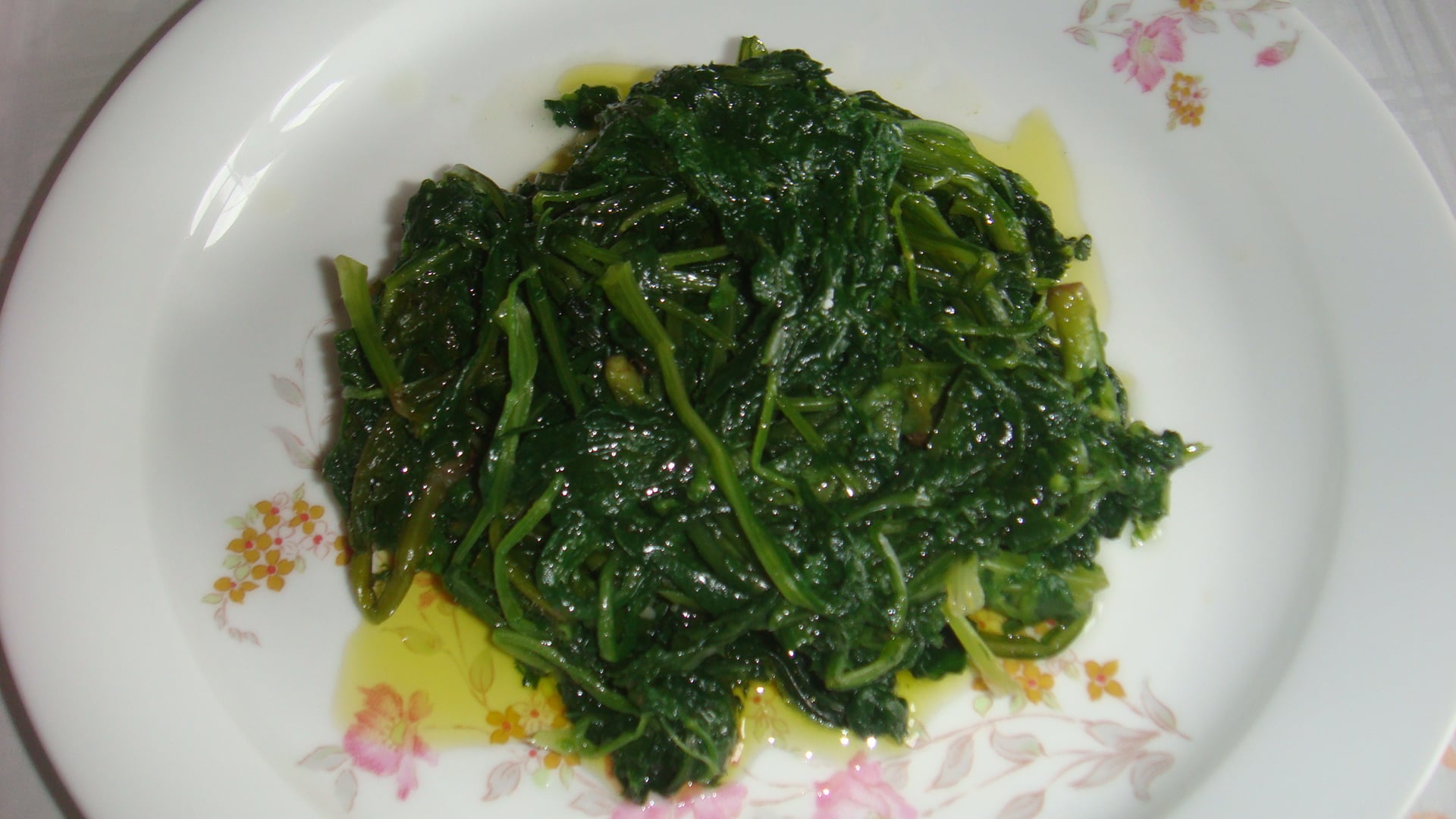
"Horta, boiled wild greens, Greek cuisine" by ProjectManhattan, licensed under CC BY-SA 4.0 via Wikimedia Commons.
Before the Second World War, Europe possessed no singular Jewish cuisine. It possessed a dense culinary geography whose boundaries often corresponded as closely to rivers, ports, mountain ranges, agricultural regions, and commercial routes as they did to political frontiers. Jewish households in Vilna did not eat as Jewish households in Salonica did. The markets of Kraków stocked different fish, grains, fruits, and fats from those available in Amsterdam or Strasbourg.
Venetian Jews cooked within the rhythms of a lagoon city whose commerce reached across the Adriatic and eastern Mediterranean. In Lithuania, long winters, rye cultivation, freshwater fish, mushrooms, berries, dairy production, and the surrounding forests shaped daily cooking in ways that could not be reproduced in the olive-growing regions of the Balkans or along the Mediterranean coast. Salonica’s Sephardic population inherited culinary traditions carried from the Iberian Peninsula after the expulsions of the late fifteenth century, then transformed them over centuries within an Ottoman port connected to North Africa, Anatolia, the Levant, and Italy. Alsatian Jewish cooking reflected the agricultural and commercial life of the Rhine Valley, where goose husbandry, vineyards, orchards, and Central European baking traditions entered Jewish kitchens through the ordinary business of everyday life rather than through any conscious attempt to create a regional cuisine.
Historians generally have little difficulty accepting that architecture, dialects, clothing, music, and local religious practice differ from one region to another. Cuisine develops through the same historical processes. Climate determines which crops can be grown economically. Rivers and coastlines influence the availability of fish. Trade introduces spices, sugar, citrus, wine, coffee, and preserved foods at different moments and in different quantities. Political frontiers alter taxation, transport, and commercial regulation. Jewish dietary law established a common legal framework across Europe, yet the contents of Jewish kitchens remained deeply local because Jewish communities lived within local economies.
Bakers purchased flour from nearby mills. Butchers worked with the livestock raised in surrounding districts. Housewives planned meals around the produce available in neighborhood markets rather than around abstract ideas of national or religious cuisine. The result was a mosaic of regional Jewish foodways that developed gradually through ordinary repetition. Families adjusted recipes to changing prices, poor harvests, new ingredients, improved ovens, migration between nearby towns, marriages that joined neighboring communities, and the practical knowledge accumulated in thousands of kitchens over centuries.
This regional diversity did not depend upon the existence of famous recipes. It depended upon continuity. A cuisine survives because the same neighborhoods continue producing bakers, butchers, millers, cheesemakers, pickle makers, merchants, market sellers, and households familiar with one another’s expectations. Children absorb techniques that rarely appear in written recipes: how dough should feel before baking, which cabbage keeps best through winter, which mushroom varieties are worth gathering after autumn rain, how long a particular variety of onion softens over a wood fire, when a local fish is at its best, which substitutions remain acceptable when a market runs short.
Regional cuisines remain alive because each generation inherits not simply instructions but an environment in which those instructions continue to make practical sense. A handwritten recipe preserved in a notebook records only a fraction of that world. The remainder exists in the relationships between people, place, commerce, agriculture, language, and memory that allow a regional cuisine to continue evolving instead of becoming a historical artifact.
The Holocaust shattered that continuity across much of Europe. Deportation removed Jewish families from neighborhoods where some had lived for centuries. Murder erased successive generations within the same household, breaking the ordinary chain through which culinary knowledge had passed from grandparents to parents to children. The loss extended far beyond family kitchens. Jewish bakeries closed. Kosher butcher shops disappeared. Dairies, grocery stores, pickle merchants, wine importers, restaurants, market stalls, flour merchants, and small commercial enterprises that had supplied local communities ceased operating under Jewish ownership or ceased operating altogether.
Municipal markets often continued after the war, but they no longer served the same populations, sold to the same customers, or reflected the same commercial relationships. Streets that had once contained dense networks of Jewish daily life remained physically present while the people who had animated them had been deported, murdered, or scattered across several continents.
This distinction becomes clearer when viewed geographically rather than nationally. Nineteenth-century Jewish cooking in Vilna was not interchangeable with Jewish cooking in Kaunas simply because both lay within the same broad cultural world. Kraków differed from Lublin. Amsterdam differed from Rotterdam. Salonica differed from Rhodes. Those differences reflected long local histories that continued to evolve as long as the communities themselves remained rooted in place. Once those communities disappeared, so did the ordinary process through which regional cuisines changed over time. A recipe copied into a family notebook might survive. A community cookbook might survive. An elderly survivor might remember how a particular holiday dish had been prepared before the war.
None of those sources can reproduce a functioning culinary region populated by thousands of households adapting similar traditions to the same markets, harvests, prices, neighborhoods, and local expectations. Historians regularly distinguish between a surviving building and the urban society that once gave it purpose. Regional cuisine deserves the same distinction. Surviving recipes document what people once cooked. They do not, by themselves, preserve the living culinary geography within which those recipes developed.
The Jewish communities that survived the Holocaust rebuilt their lives under fundamentally different demographic conditions. Few returned to towns whose Jewish populations had been almost entirely exterminated. Many found their homes occupied, their businesses confiscated, their synagogues destroyed, and their extended families reduced to a handful of survivors or none at all.
Displaced Persons camps briefly became places where people from dozens of different regions of Europe lived together before beginning new lives elsewhere. Israel received immigrants from across Europe alongside Jews from North Africa and the Middle East. New York, Montreal, London, Paris, Melbourne, Buenos Aires, Johannesburg, and Toronto became homes to communities whose members had been born hundreds or thousands of miles apart but now shared schools, synagogues, neighborhoods, and holiday tables.
Under those conditions, regional cuisines did not simply resume where they had left off. They encountered one another in entirely new settings. A family from Vilna might share a congregation with families from Budapest, Thessaloniki, Warsaw, Bucharest, or Antwerp. Children grew up eating foods that their grandparents would never have encountered within a single Jewish neighborhood before the war.
Home cooks adapted recipes to unfamiliar climates and agricultural systems. Olive oil became easier to obtain in some countries and harder in others. Fish species changed. Flour milled from North American wheat behaved differently from flour milled from European grain. Fruit, vegetables, dairy products, and preserved foods reflected local agriculture rather than the landscapes from which many families had come. Immigration did not erase regional traditions, but it changed the environments in which those traditions were practiced.
The postwar cookbook illustrates this transformation particularly well. Collections published before the war often assumed readers who already shared a common regional vocabulary of ingredients, techniques, and seasonal rhythms. Many postwar Jewish cookbooks addressed audiences whose family histories stretched across multiple countries and whose kitchens no longer occupied a single regional tradition. Recipes circulated more widely than they ever had before. Dishes once associated with particular cities, provinces, or linguistic communities entered a broader Jewish repertoire through publishers, community organizations, restaurants, delicatessens, food writers, and later television and the internet.
Some traditions flourished because large surviving communities continued to prepare them regularly. Others became increasingly difficult to encounter outside individual families or specialist historical research. The postwar Jewish table became richer in many respects, bringing together culinary traditions that had previously existed at considerable geographic distance from one another. It also reflected a Europe whose regional Jewish culinary map had been permanently altered by genocide, forced migration, and reconstruction rather than by the gradual historical processes through which regional cuisines normally develop.
Modern Jewish cuisine is therefore as much an archive of absence as of survival. Historians have long treated churches, synagogues, cemeteries, schools, businesses, neighborhoods, property records, and census returns as evidence for reconstructing communities that no longer exist. Food deserves the same treatment. A regional cuisine is not merely a collection of dishes. It is the accumulated record of a population living in a particular place over time, purchasing food from particular markets, adapting to particular harvests, speaking particular languages, celebrating holidays within local customs, and passing practical knowledge through successive generations. When that population disappears, the cuisine changes even if many of its recipes survive.
This distinction helps explain why discussions of Jewish food sometimes produce an unexpected historical flattening. It is common to speak of “Ashkenazi cuisine” or “Sephardic cuisine” as though each represents a coherent culinary tradition stretching across an entire continent. Those categories remain useful for many purposes, but they are too broad to recover the regional landscape that existed before the Holocaust. The distance between Vilna and Strasbourg was not simply measured in miles. It appeared in markets, agriculture, climate, language, trade, and household practice. The distance between Salonica and Amsterdam was greater still. Before the war, those differences formed part of the ordinary texture of Jewish life. Today they are more often encountered through memoirs, archival collections, ethnographic recordings, community cookbooks, museum exhibitions, and the memories preserved by descendants than through continuous regional communities preparing those foods in the places where they developed.
For historians of modern Europe, this suggests another way of understanding cultural destruction. The Holocaust did not erase only populations, institutions, religious life, or family lineages. It also erased historical variation within European Jewish life. The disappearance of hundreds of local communities compressed an extraordinarily diverse regional landscape into a smaller number of surviving demographic centers scattered across the world. The cuisines that survived remain remarkable achievements of continuity under catastrophic circumstances. At the same time, they preserve the outlines of a map that no longer exists.
Europe still contains the rivers, ports, forests, vineyards, fields, and city streets in which those regional Jewish cuisines developed. What disappeared was the dense network of communities that transformed those landscapes into living culinary traditions over generations. That loss belongs within the history of the Holocaust no less than the destruction of synagogues, schools, libraries, businesses, and neighborhoods, because cuisine, like language or architecture, records the long relationship between a people and a place.
Selected Bibliography
Abrahams, Israel. Jewish Life in the Middle Ages. London: Macmillan & Co., 1896.
Bahloul, Joëlle. The Architecture of Memory: A Jewish-Muslim Household in Colonial Algeria, 1937–1962. Translated by Catherine du Peloux Menagé. Cambridge: Cambridge University Press, 1996.
Bauman, Zygmunt. Modernity and the Holocaust. Ithaca, NY: Cornell University Press, 1989.
Beker, Sonia Pressman. I Used to Live There: A Return to Vilnius. London: Vallentine Mitchell, 2004.
Braudel, Fernand. The Mediterranean and the Mediterranean World in the Age of Philip II. 2 vols. Translated by Siân Reynolds. London: Collins, 1972–1973.
Cinotto, Simone, and Hasia R. Diner, eds. Global Jewish Foodways: A History. Lincoln: University of Nebraska Press, 2018.
Diner, Hasia R. Hungering for America: Italian, Irish, and Jewish Foodways in the Age of Migration. Cambridge, MA: Harvard University Press, 2001.
Dobroszycki, Lucjan, and Barbara Kirshenblatt-Gimblett. Image Before My Eyes: A Photographic History of Jewish Life in Poland, 1864–1939. New York: Schocken Books in cooperation with YIVO Institute for Jewish Research, 1977.
Feingold, Henry L. A Time for Searching: Entering the Mainstream, 1920–1945. The Jewish People in America 4. Baltimore: Johns Hopkins University Press, 1992.
Gelber, Yoav. New Palestine: The Immigration of German Jews and Their Contribution to Eretz Israel. Jerusalem: Yad Izhak Ben-Zvi, 1990. [Israeli Source]
Goldstein, Darra. Beyond the Borsch Belt: The Hidden Foodways of Eastern Europe. London: Reaktion Books, 2020.
Heinze, Andrew R. Adapting to Abundance: Jewish Immigrants, Mass Consumption, and American Identity, 1880–1930. New York: Columbia University Press, 1990.
Kirshenblatt-Gimblett, Barbara. “Food Mall: Culture and Commerce in the East European Shtetl.” Yiddish 11, no. 1–2 (1998): 101–114.
Kirshenblatt-Gimblett, Barbara. “Kitchen Judaism.” In Getting Comfortable in New York: The American Jewish Home, 1880–1950, edited by Susan L. Braunstein and Jenna Weissman Joselit, 75–105. New York: The Jewish Museum, 1990.
Klor, Sebastian. Between Exile and Exodus: Argentinian Jewish Immigration to Israel, 1948–1967. Detroit: Wayne State University Press, 2017.
Molho, Rena. “The Judeo-Spanish Community of Salonica: Investment and Loss.” The Mediterranean Historical Review 19, no. 2 (2004): 37–48.
Nathan, Joan. Quiches, Kugels, and Couscous: My Search for Jewish Cooking in France. New York: Alfred A. Knopf, 2010.
Roden, Claudia. The Book of Jewish Food: An Odyssey from Samarkand to New York. London: Viking, 1996.
Roskies, David G. Against the Apocalypse: Responses to Catastrophe in Modern Hebrew Culture. Cambridge, MA: Harvard University Press, 1984.
Trigano, Shmuel, ed. Le Monde sépharade. 2 vols. Paris: Éditions du Seuil, 2006.
Wasserstein, Bernard. On the Eve: The Jews of Europe Before the Second World War. London: Profile Books, 2012.
Yad Vashem. The Encyclopedia of Jewish Life Before and During the Holocaust. 3 vols. Edited by Shmuel Spector and Geoffrey Wigoder. Jerusalem: Yad Vashem; New York: NYU Press, 2001.
Related Topics
Related Posts