


The Holocaust Survivor Who Dressed Presidents
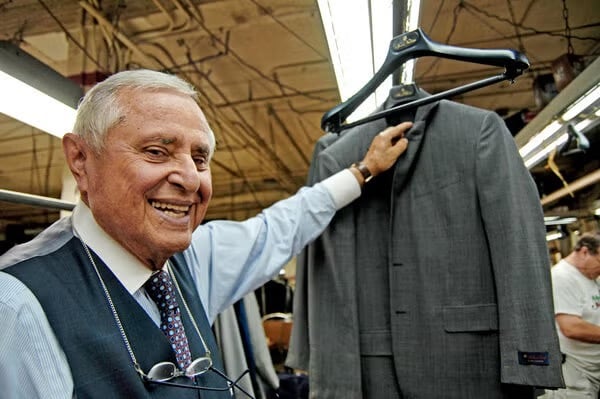
As the midterm elections approach, I’ve been thinking about a man who stood quietly behind some of the most powerful people in America, not at a podium or on a ballot, but with a needle and thread.
His name was Martin Greenfield.
Before he became known as the “Presidents’ Tailor,” Greenfield was Maxmilian Grünfeld, a Jewish teenager from Czechoslovakia who was deported to Auschwitz with his family. He was the only member of his immediate family to survive the Holocaust.
In an extraordinary twist of history, his journey toward becoming America’s most celebrated tailor began there.
Greenfield was assigned to wash Nazi uniforms. One day, he scrubbed an SS soldier’s shirt so hard that he ripped its collar. The soldier beat him and threw the torn shirt in his face. Greenfield kept it, and another prisoner taught him how to repair it.
Then he wore the Nazi shirt underneath his prisoner uniform.
Greenfield noticed that people began treating him differently. The shirt gave him the appearance of status and authority. Realizing the power that clothing could have, he deliberately damaged another Nazi shirt so that he could have two.
“The day I first wore that shirt was the day I learned clothes possess power,” he wrote in his memoir.
That idea stayed with Greenfield for the rest of his life.
After surviving Auschwitz and Buchenwald, Greenfield immigrated to the United States in 1947. He eventually found work as a floor boy at a Brooklyn clothing factory, learned the craft of tailoring and, in 1977, purchased the factory and renamed it Martin Greenfield Clothiers.
Years later, he reflected on the strange path his life had taken:
“Strangely enough, two ripped Nazi shirts helped this Jew build America’s most famous and successful custom suit company.”
“God has a wonderful sense of humor.”
The Jewish teenager who learned his first stitches repairing a Nazi uniform eventually made suits for presidents of the United States.
Among them was Dwight D. Eisenhower, whom Greenfield recalled encountering after the liberation of Buchenwald and regarded as a hero.
But Greenfield didn’t just make Eisenhower’s three-piece suits. He slipped handwritten notes expressing his opinions about foreign policy into the president’s pockets.
Greenfield had lived under a government determined to murder him because he was Jewish. He had lost his entire immediate family. Yet after surviving and coming to America, he decided that the president of the United States should hear what he had to say.
Years later, when Greenfield made suits for Bill Clinton, he recalled that Clinton had heard about the notes and told him not to put them in his pockets. Instead, Clinton gave him a fax number.
Greenfield used it.
He would go on to make suits for political leaders across parties and generations, including Barack Obama. Martin Greenfield Clothiers made Obama’s famous tan suit.
With another election approaching, I’ve been thinking about Greenfield’s story differently, not just as a Holocaust story or a fashion story, but as a story about what it meant for him to finally have a political voice.
He knew what it meant to live under a government that sought to erase Jews entirely. Then he came to a country where he could become a citizen, build a business, express his political opinions and even send those opinions directly to the president.
As Americans prepare to exercise their political voices at the ballot box, I find myself thinking about a man who once had no rights at all, but who eventually felt free to offer advice to the leader of his adopted country.
And somehow, clothing runs through the entire story.
A Nazi shirt helped Greenfield survive Auschwitz. An American suit carried his words into the pockets of presidents.
The same hands that learned their first stitches repairing the uniform of an oppressor eventually tailored the clothes worn by the leaders of his adopted country.
There may be no better symbol of the life he rebuilt.
A Jewish teenager entered Auschwitz wearing a number.
Decades later, presidents of the United States wore his name