
The House of Meeting
From slavery to freedom and from thirst to hunger, the people still complained. The chains were gone, miracles surrounded them, and yet something essential was missing. Freedom had answered the needs of their bodies, but it had not yet reached their inner lives. They were free from the burden of the Egyptians, but they had not yet found the burden of a purpose.
In this week’s parashah, Terumah, a quiet but revolutionary turning point appears. For the first time, G-d does not command action in response to a crisis. Instead, He invites contribution: “Take for Me an offering.” The Mishkan (Tabernacle) was to be built not by Divine decree or miraculous intervention, but by willing hearts. This marked the moment a former slave people began to move from being objects of G-d’s miracles to subjects of their own destiny.
This was more than a construction project; it was the birth of an interior life. The Sages describe the Mishkan as a microcosm of the world—a place where life is re-ordered and intention is focused. In the middle of the wilderness, the people were given a center. This was not because G-d needs a home, but because human beings need a place that reminds them who they are and what they are meant to serve.
They shall make for Me a sanctuary, and I will dwell among them
וְעָשׂוּ לִי מִקְדָּשׁ וְשָׁכַנְתִּי בְּתוֹכָם
(Exodus 25:8)
As many commentators note, the verse does not say that G-d will dwell in it—in the building—but among them, within the people. By using their own hands to build, the Israelites restored their sense of worth. They learned that their effort could produce meaning, not just survival.
To enter the Mishkan was to step into a different rhythm of existence. The noise of the camp faded; movement slowed, time felt different, and attention sharpened. A person arrived carrying something—an offering, a burden, a hope—and encountered a space designed to focus the heart. There were boundaries and stages, moments of waiting and watching. The scent of incense lingered. Sacrifice was not a mere ceremonial act; it was an act of alignment. Something of oneself was offered in order to realign with something higher. The Mishkan taught the nation that closeness to G-d is not accidental; it is cultivated. One does not wander into holiness; one prepares, approaches, and responds.
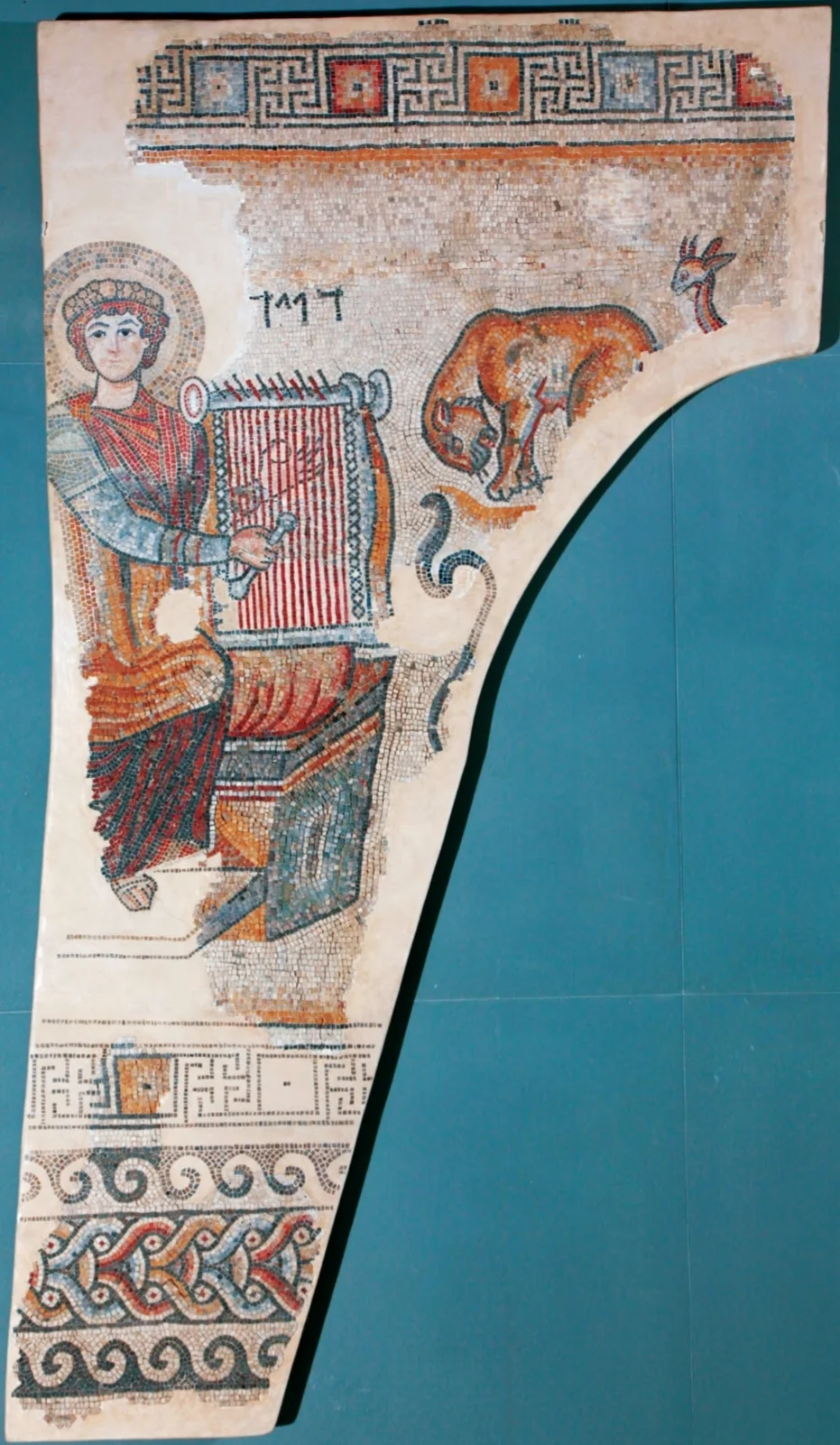
This ancient reflex—to create a center of gravity amidst chaos—can still be seen today, even in the most unlikely of places. During the fighting in Gaza, Israeli soldiers came upon the remains of the Maiumas synagogue—a Byzantine-era house of Jewish prayer on the Gaza coast dating to the sixth century. Amid dust and ruined stone, on a floor once adorned with a mosaic of King David playing the lyre, they encountered a quiet mirror of their own history.
In the midst of active operations, the soldiers cleared a small area and treated it, briefly and quietly, as a place of tefillah (prayer). There was no permanence and no ceremony—only soldiers, one keeping watch while others prayed. Yet the space was handled differently; attention was concentrated. What took place there was not an attempt to re-enact the past, but a deeply human response: under pressure and uncertainty, to set aside a corner of the world for meaning. Even temporarily, even imperfectly, it became a house of meeting.
The Mishkan teaches that freedom alone is not enough for the human spirit. Dignity comes from purpose, and purpose often needs walls—not to contain G-d, but to help human beings realign themselves in service of Him.
The greatest legacy of the Mishkan was not a structure of gold and acacia wood, but the realization that when we choose to build a space for meaning, G-d finds room to dwell among us. When we set aside a corner of the world for the eternal, we discover that He has been waiting there all along.
שבת שלום
שמואל