The Husk, the Spark, and the Critic’s Shadow, Part II
FRUM: Fil Rishes un Veynik Mitsves
V. Owning Holiness
If I had to name in one phrase the moment piety becomes frumkeit, I would say: it is the moment piety begins to own what it serves.
Frumkeit relates to holiness as a possession. It holds its merit, its purity, its stringencies, and its standing as acquisitions. Like all possessions, they must be guarded, counted, and protected from loss. The father on the ramp is guarding a possession. The perush who asks what more he must do is taking inventory. Even God becomes a possession of this kind: the God of my community, my practice, my certainty about what He requires.
Antigonos of Sokho saw this at the very beginning of the Mishnah’s chain of tradition: “Do not be like servants who serve the master in order to receive a reward” (Pirkei Avot 1:3) [23]. Reward is the simplest form of possession. But the subtler forms are harder to see. One can serve without wanting a reward and still want to be the righteous one.
Hasidic tradition has a name for this figure: the tzaddik in peltz, the righteous man in a fur coat. On a freezing night there are two ways to get warm. One can light the stove, or one can put on a fur coat. The stove warms the room; the coat warms only the one who wears it. The saying does not accuse the man in the fur of pretending. He is genuinely warm, and genuinely righteous. The room around him simply stays cold.
The tradition fastened the phrase on Noah. Scripture calls him “a righteous man, perfect in his generations” (Gen. 6:9) [11], and the rabbis divided over whether “in his generations” is praise or qualification: righteous even in a corrupt age, or righteous only by comparison with it (Sanhedrin 108a) [24]. The Zohar is less divided. Warned of the flood, Noah built an ark for himself and his household and did not pray for his generation, and so the flood bears his name: “the waters of Noah” (Isa. 54:9; Zohar I:67b–68a) [11,22]. Set him beside Abraham at Sodom, bargaining with God for strangers who were nothing to him, and the difference between the fur coat and the stove is the whole difference between frumkeit and vrum. Noah’s piety was real, and it saved exactly as many people as fit in the ark.
The alternative is not detachment. It is what I have called elsewhere attraction without possession: a union, a yichud, that does not swallow its object. The lover is drawn toward the beloved without needing to hold, define, or consume. Devekut, cleaving, in its truest sense is this kind of joining. It is real closeness, and it is closeness to what remains other.
This is also where frumkeit and apophatic theology part ways. Frumkeit knows too much. It knows exactly what God wants, at every hour, in every detail, and it knows it with a confidence that leaves no room for the person in front of it. The apophatic tradition begins elsewhere. “No one can see My face and live” (Ex. 33:20) [11]. Maimonides insists that we can say only what God is not (Guide I:58–59) [25]. The rabbis read “To You silence is praise” (Ps. 65:2) [11] as the highest form of praise (Megillah 18a) [26]. A piety rooted in not-knowing cannot be possessed. It holds its practice with both hands and its certainty with an open palm.
The mussar tradition reached the same conclusion from the side of ethics. Ramchal, in Mesillat Yesharim (chapters 18–20) [27], complains that the masses think chasidut consists of many fasts, immersions, and supplications. True chasidut, he says, means asking what would bring pleasure to one’s Creator. He adds a principle that frumkeit cannot tolerate: mishkal hachasidut, weighing a pious act by its consequences, because some stringencies do harm to others and to God’s name.
Rabbi Yisrael Salanter, the founder of the mussar movement, is remembered for saying that people tend to worry about their own bodies and other people’s souls, when they should worry about their own souls and other people’s bodies [28]. The Kotzker Rebbe is remembered for a sharper line still: do not make an idol even out of a mitzvah [29]. Both sayings describe the same turn. Piety stops looking at its own reflection and looks outward again.
VI. The Same Structure in Other Tongues
What the rabbis diagnosed is not a Jewish peculiarity. Every tradition that binds the holy to practice discovers the same danger, usually in the same three stages: the form is given, the form is idolized, and a reformer calls the form back to its purpose.
Islam has the clearest vocabulary for it. Fiqh, jurisprudence, governs the outer act. Taqwa is God-consciousness. Ihsan, in the famous Hadith of Gabriel, is “to worship God as though you see Him, and if you do not see Him, He sees you.” [30] The foundational hadith of Islamic ethics states that actions are judged only by their intentions [31]. And the tradition names the disease directly: riya’, ostentatious piety, is called “the hidden shirk,” a secret idolatry in which the worshipper’s own image stands where God should be [32]. That is the Kotzker’s idol of the mitzvah in another language.
Al-Ghazali lived the crisis [33]. At the height of his fame as a jurist in Baghdad he broke down, lost the ability to teach, and left his post to follow the Sufi path. He returned to write The Revival of the Religious Sciences, a work whose very title concedes that the sciences of religion had died in the hands of their experts [34]. He never abandoned the shari’a. He wanted to give it back its interior. Bachya ibn Pakuda, writing Duties of the Heart in Muslim Spain under Sufi influence, made the same protest in the same decades: Jews attended to the duties of the limbs and neglected the duties of the heart [35].
The legend of Rabi’a al-’Adawiyya carries the purest image. She is seen running through Basra with a torch in one hand and a bucket of water in the other. She means to burn Paradise and drown Hell, so that people will worship God for God alone and not from hope or fear [36]. It is Antigonos of Sokho, set on fire.
The hadith literature even has its own Bava Metzia 83a [12]. A woman who prayed and fasted abundantly but harmed her neighbors with her tongue is in the Fire [37]. A prostitute who drew water from a well in her shoe to give to a thirsty dog is forgiven [38]. The test, again, is outward.
Christianity built part of its identity on a polemic against “the Pharisees,” and that polemic was historically unjust: Matthew 23’s critique of display piety [39] is largely a critique the rabbis had already made against their own. Even “the Sabbath was made for man” (Mark 2:27) [39] has its rabbinic twin: “the Sabbath is given to you, not you to the Sabbath” (Mekhilta DeRabbi Yishmael, Ki Tisa; Yoma 85b) [40,41]. Yet Christianity then repeated the whole cycle inside itself. Augustine wrote, “Love, and do what you will.” [42] Catholic moral theology came to recognize scrupulosity as a spiritual affliction to be treated, not a sign of holiness [43]. Pietism, launched by Spener’s Pia Desideria in 1675 [44], rose against a dead Lutheran orthodoxy and then hardened into a moralism of its own.
Two later voices complete the picture from opposite sides. Kant called every act a person performs to please God, apart from a morally good life, Afterdienst, pseudo-service [45]. Bonhoeffer, facing the opposite danger, attacked “cheap grace”: a spirituality that costs nothing and changes nothing [46]. Between them they name both failures Luria described. Kant warns against the rigid vessel. Bonhoeffer warns against light that has no vessel at all.
VII. The Critic’s Shadow
Here the essay must turn on its author. If Neumann is right, frumkeit is where the pious project their shadow. But the critic of frumkeit can do the same thing.
The frum Jew is an ideal screen for projection. He is visible, uniform, easy to caricature. Onto him the critic can place everything he has not resolved in himself: his own old rigidity, his religious anxiety, his unlived longing for a certainty he no longer permits himself, even his envy of a world that still seems whole. Then he can despise it at a safe distance. That is the old ethic again, wearing the robes of enlightenment.
Jewish history has staged this before. The assimilated Jews of Vienna looked at the caftans and earlocks of the Eastern Jews arriving from Galicia and felt something close to disgust [47,48]. Part of that disgust was fear: these were the Jews the surrounding world would see when it looked at them. The pious Ostjude became the bearer of what the assimilated Jew could not afford to be. The scapegoat was inside the family.
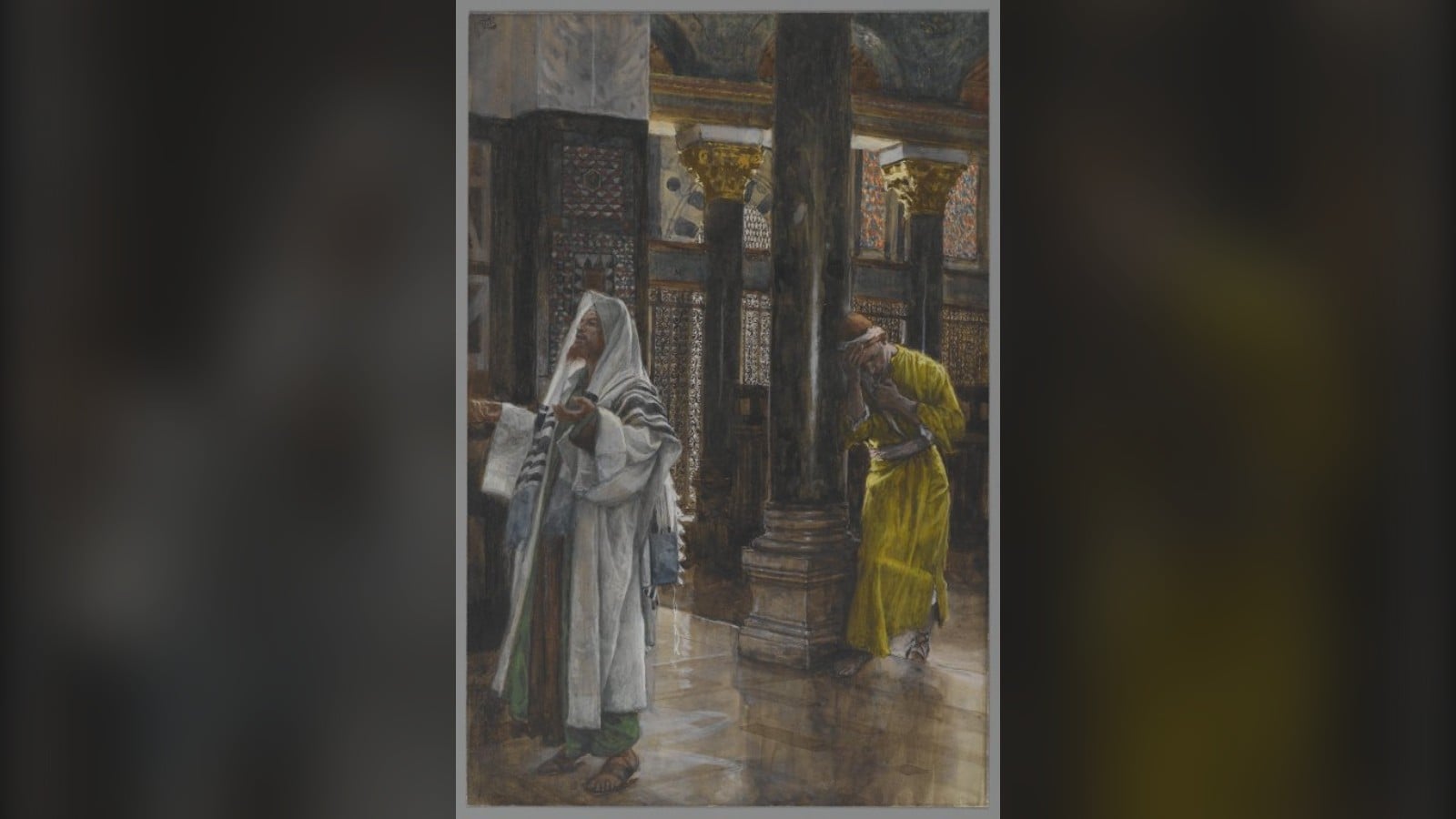
The Gospel of Luke contains a parable that should unsettle every critic of piety. A Pharisee prays, “God, I thank You that I am not like other men,” while a tax collector beats his breast and asks only for mercy (Luke 18:9–14) [39]. Generations of readers have finished that parable by thinking, “Thank God I am not like that Pharisee.” In that thought the reader has become the Pharisee. The critique of frumkeit carries the same trap. One can be frum about one’s freedom from frumkeit. A critique of frumkeit can be its own fur coat: it keeps the critic warm and heats no one.
The Talmud has a terse warning for this moment: kol haposel bemumo posel, whoever disqualifies others does so with his own blemish (Kiddushin 70a) [49]. It does not mean the critic is wrong. It means his critique tells you something about him.
So I must ask what my discomfort is made of. Some of it is moral, and the Talmud stands behind it: Yoma 23a [5] is not a matter of taste. But some of it may be mine. Some of it may be the residue of a world I came from, perhaps a stringency once held, a judgment I fear in others because I recognize its voice. Neumann’s new ethic does not ask me to silence the discomfort. It asks me to carry my share of it.
This is the difference between a critique and a scapegoating. A critique says: this is what happens to piety, and it can happen to me. A scapegoating says: this is what happens to them. Only the first can lead anywhere.
VIII. A Second Naiveté
Is there a piety on the far side of all this? Paul Ricoeur [50] described a movement in three stages. First comes the naive faith that simply believes. Then comes the hermeneutics of suspicion, which unmasks belief as projection, interest, or defense. And then, for some, a “second naiveté”: a faith that has passed through the critique and can listen again, knowingly, to the symbol.
Frumkeit, seen this way, is a first naiveté that defends itself against suspicion. My discomfort is the work of suspicion. The essay’s real question is whether a second naiveté is possible: a piety that has seen everything the Talmud saw on the altar ramp and can still lay tefillin.
The rabbis left room for it. “A person should always engage in Torah and commandments even not for their own sake, for from not-for-its-own-sake comes for-its-own-sake” (Pesachim 50b) [51]. They knew that the outer form shapes the inner life, and that waiting for perfectly pure motives is its own vanity. Discipline is not the enemy of devotion. It is often its school.
Franz Rosenzweig gave this a modern shape in “The Builders” (1923) [52], his open letter to Martin Buber. He distinguished Gesetz, law as external statute, from Gebot, commandment as personally addressed. The same act can be either. Asked whether he laid tefillin, Rosenzweig is remembered as answering, “Not yet.” [53] The answer refuses both mechanical compliance and dismissal. It holds the law open as a summons.
Abraham Joshua Heschel, in his early essay “An Analysis of Piety” (1942) [54], defined piety as a mind attentive to God’s presence and turned toward God’s concerns rather than its own. Later he warned against “pan-halakhism” and “religious behaviorism,” the reduction of Judaism to compliance [55]. Yet he also insisted on the deed: Judaism asks for a leap of action, not only a leap of thought. For Heschel the commandment is where wonder learns to act.
Emmanuel Levinas completes the circle from the other side. In “To Love the Torah More Than God” [56], he values the law precisely because it protects against a God of pure feeling who would excuse anything. For Levinas, God is met in the face of the other person, and the law is the discipline that keeps that face in view. He defends halakha against spirituality and ethics against frumkeit in the same breath.
I think of the cello. Correct intonation is not music, and anyone who has drawn a bow across a string knows how indispensable technique is and how little it guarantees. The notes are given. What makes them music lives in the interval between them and in what resonates when they sound. Halakha gives the notes. Piety lives in the interval between law and conscience, in the space the rabbis called lifnim mishurat hadin. Frumkeit is perfect intonation with nothing resonating.
Micah’s summary of what God requires ends with the words hatzne’a lechet im Elohecha, “walk modestly with your God” (Micah 6:8) [11]. Hatzne’a also means hiddenly. The Talmud reads the phrase as escorting the dead and bringing a bride beneath the canopy (Sukkah 49b) [57]: kindnesses done quietly, for someone else. That is the opposite of the shikhmi who carries his commandments on his shoulder.
And so the word comes home. Vrum meant good for another. A second naiveté would restore that meaning without abandoning the form that carries it. Piety is the discipline. Spirituality is the direction. Morality is the evidence. When any one of them claims to replace the others, it becomes a counterfeit of itself. When they turn and stand face to face, the husk falls away, and the spark that was always inside frumkeit is finally free to be what the word once meant.
Part II of a three-part series. References appear at the end of Part III.