
Using science background to write rationally about Israel, Jews and Academia
The Ideology Behind Anti-Zionism: A Critical Reading of Adam Louis-Klein
Attempts to understand the origins of militant anti-Zionism, which has gone mainstream since October 7, 2023 are ubiquitous. Canadian anthropologist Adam Louis-Klein has emerged as one of the leading voices attempting to explain this phenomenon. I admire his intellectual rigor and his courage to express unpopular opinions within the often-hostile climate of Canadian (and international) academia..
At the same time, I believe a broader perspective is needed—one that examines anti-Zionism not only through the Jewish lens, but as part of a wider ideological transformation in Western thought.
Below is my friendly yet critical review of his recent essay, “What Anti-Zionism Really Is.”
Adam Louis-Klein’s essay “What Anti-Zionism Really Is” published by Free Press confronts one of the most perplexing features of the post–October 7 world: why a tragedy inflicted on Jews evoked only fleeting sympathy before giving way to a global surge of hostility toward Israel and Jews alike. His prose is lucid and impassioned, his fusion of personal anthropological experience with broader critique of academic culture lending the essay unusual moral and intellectual authority. Louis-Klein’s central insight is that modern academic discourse has transformed the rational discussion of Zionism into a system of anti-Zionist myths and rituals detached from historical and political reality is compelling and powerfully argued. Yet beneath this brilliance lie conceptual fault lines.
Louis-Klein’s approach is formed by his anthropological expertise, which is his greatest strength and also his greatest weakness. It equips him to see anti-Zionism as a cultural rather than intellectual or political phenomenon, but it prevents him from recognizing that this system is only one manifestation of a far larger ideological trend within Western thought. His genealogy of anti-Zionism conflates two distinct traditions: the Soviet anti-Zionism, which was political and utilitarian, and post-colonial anti-Zionism of Western academia, which is ideological and moral. To grasp the power of anti-Zionism in today’s intellectual climate, one must look beyond Israel-Palestine debate to the deeper foundations of Western thought shaped by Foucault, Derrida, Fanon, and Said.
Louis-Klein is right that anti-Zionism is not simply “criticism of Israel.” It is a symbolic system, a moral ritual through which believers affirm their purity by casting out a chosen villain. What is missing however, is that anti-Zionism is not a uniform phenomenon: its multiple strands draw on different motivations and intellectual sources.
The first is religious Jewish anti-Zionism represented today by such figures like Rabbi Shaul Magid, recently appointed to Harvard Divinity School. Magid’s opposition to Jewish nationalism is theological: he argues that Jews should return to Judaism rather than build a nation-state. His perspective echoes the pre-Zionist rabbinic attitudes that only began to shift when Rabbi Abraham Isaac Kook, the first Ashkenazi Chief Rabbi of Mandatory Palestine, reconciled traditional Judaism with Jewish nationalism, laying the groundwork for the religious Zionism movement.
The second is liberal-academic anti-Zionism. Consider Professor Bruce Robbins of Columbia University, who recently declared in the Chronicle of Higher Education:
“I’m one of these crazy, pathological, militant radical faculty members who should be shut down. Why? Because I believe in democracy and equality. That means I don’t believe that Israel has a right to exist as a Jewish state with second-class citizens. I believe it has a right to exist as a democratic state. If it chooses to be a democratic state and offer equal rights to everybody within its borders, I’m for it. Otherwise, I’m a crazy, pathological, militant, radical extremist. American values: Democracy and equality.”
The implication is unmistakable: Israel’s Jewish character is incompatible with democracy. This line of reasoning mirrors the rhetoric of those who casually label Israel an “apartheid state,” a claim unsupported by the social realities of Israeli life. Inequalities exist, as they do in every multiethnic democracy, but to ascribe them solely to the Jewish nature of the state is both intellectually shallow and misleading.
To understand the ideological roots of such thinking, one must look not to the Middle East but to American debates on race. In progressive academic circles, the persistence of racial disparities, despite decades of civil-rights reform, is attributed to an invisible, omnipresent “systemic racism.” The same epistemic move is applied to Israel: disparities among citizens are treated as evidence of an invisible, totalizing system of ethnic domination. What is being imported into the Israeli context is not evidence but ideology—the logic of critical race theory transposed onto the Middle East.
The third calls for so-called one-state solution, exemplified by the 2007 One-State Declaration signed by academics such as Ilan Pappé. It calls for a single, binational state in which all “expelled or exiled” Palestinians and their descendants would have an equal right of return. If realized this project would transform Jews into a minority effectively erasing their sovereignty and restoring Arab rule over all of the historic Palestine. This is not a “solution”, it is subjugation of Jewish national inspirations in favor of Arab nationalism. Its ideological foundation is explicitly post-colonial. While Frantz Fanon and Edward Said differed in method—Fanon grounded his approach in Marxism and called for revolutionary violence, while Said reinterpreted anticolonial discourse through Foucault’s notion of power—they converged on a moral narrative that renders all Western national projects illegitimate. Israel, viewed by proponents of the postcolonial framework, as both Western and powerful, becomes the ultimate embodiment of “colonial sin.”. While the notion of Israel as an European project contains a partial historical truth, it remains profoundly limited. It disregards the millennia-long Jewish connection to the land and the demographic reality that more than half of Israel’s population is of non-European origin.. Labeling Israel a colonial project collapses under even minimal scrutiny: there was no imperial metropole that dispatched Jews to colonize Palestine, and since the 1930s the Yishuv’s struggle was directed not only against local Arab forces but also against British imperial rule. To forestall any confusion, equating that struggle with the American Revolution is not a serious comparison—it obscures more than it explains.
The fourth and most virulent form is populist anti-Zionism of the street, recognizable in chants such as “From the river to the sea” and “Globalize the intifada.” This strand, most accurately captured by Louis-Klein’s “cosmology” metaphor, descends from post-colonial theory degraded to the level of street politics — stripped of intellectual content and transformed into a ritual of the religious fervor.
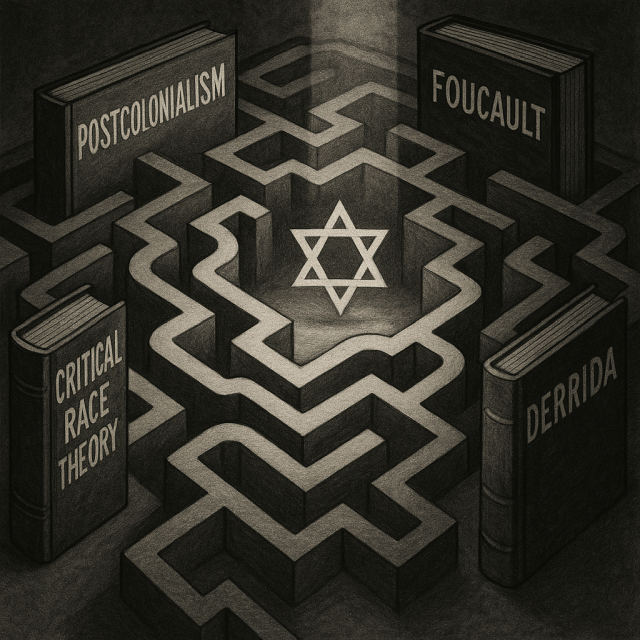
However, all strands of anti-Zionism can be traced to decolonial and critical race theories, which through the concept of intersectionality links to a wider ecosystem of “critical theories” that dominate academic discourse on power and identity in US and Europe. These frameworks share a single premise that truth, reason, and universal values are masks for power. Their collective outcome is an inversion of Enlightenment ethics: the moral worth of an idea is judged not by its reasonableness but by the victimhood of its speaker.
In this framework, Israel, Jewish, Western-aligned, and militarily strong can only appear as the villain. Anti-Zionism thus fits seamlessly into the post-Foucauldian moral order. To dismantle it, one cannot simply expose its factual errors, one must confront the entire intellectual system that sacralizes victimhood and criminalizes power.
Directing his gaze squarely at anti-Zionism and looking exclusively through the Jewish lens Louis-Klein loses a bigger picture. To succeed in dismantling anti-Zionist framework, focus shall be on its broad ideological foundations and critically examine, deconstruct and discredit the entire system of postmodernist critical theories. The issue is not just antisemitism masquerading as anti-Zionism, it is the larger network of ideological narratives that reduce human experience to simplistic hierarchies of race, power, and inherited guilt.
By looking at the anti-Zionism more broadly, Louis-Klein could have recognized that the religious character of postmodern moralism, the transformation of critical theory into a kind of secular faith has already been identified by several thinkers, most notably by John McWhorter, the Columbia University linguist. In Woke Racism (2021), McWhorter argued that the new moral orthodoxy functions as a religion: it has original sin (privilege), rituals of confession (self-critique), and heresy trials (cancellation). Its adherents are bound not by logic but by faith. Louis-Klein’s description of anti-Zionism as a “cosmology” comes close to McWhorter’s insight, yet he treats this cosmology as uniquely anti-Jewish in its object rather than as a universal moral structure into which Jews have been cast as scapegoats. The real phenomenon is broader: the rise of a “post-religious” religion within Western institutions, a moral absolutism that demands conformity under the guise of empathy. Anti-Zionism is simply one of its sacraments.
Another limitation of Louis-Klein’s essay lies in its attribution of contemporary Western anti-Zionism to Soviet “Zionology,” the propaganda campaigns of the 1950s–1980s that portrayed Zionism as racist and Israel as a colonial outpost. The notion that contemporary academic anti-Zionism descends directly from Soviet propaganda remains popular, especially among Russian-speaking émigré Jews who believe that the whole Palestinian national movement is just one of the departments of KGB. This rhetoric may be emotionally satisfying, providing simple and familiar explanation to a complex problem, but it does not hold under serious historical examination.
The Soviet campaign was indeed virulent. As Izabella Tabarovsky of the Wilson Center, quoted by Louis-Klein, has documented, Soviet propaganda globalized anti-Jewish narratives by recasting them in the moral language of anti-imperialism. Moscow’s diplomats and media operatives popularized the formulas that still echo today—“Zionism is racism,” “Israel is an apartheid state,” “Palestine is the victim of Western colonialism.” Yet Tabarovsky’s scholarship also shows the limits of this influence. She traces the diffusion of rhetoric, not the transmission of ideas. The Soviet campaign was never a coherent intellectual project; it was a tactical instrument in Cold War. Soviet anti-Zionism was political, not philosophical. It sought to secure Arab alliances, suppress Jewish identity at home, and weaken American influence in the Middle East. It recycled antisemitic tropes, but it did so for reasons of “realpolitik, not out of ideological conviction. It was, in essence, pure show, a tactical discourse masquerading as principle.
By contrast, the anti-Zionism of Western academia is ideological rather than political. It emerged from the postmodern intellectual framework, from the conviction that all knowledge is power, all universality is domination, and all Western achievements are colonial constructs. In this framework, Israel becomes not a geopolitical irritant but a symbolic embodiment of Western modernity itself: white, settler, colonial, oppressive.
These two traditions, Soviet and postmodern, may have intersected linguistically, but they do not share a genealogy. The former sought to defend socialism by delegitimizing Israel, the latter seeks to dismantle Western rationality by moralizing oppression. Their overlap, visible at the 2001 Durban Conference and in the NGO world that emerged from it, represents merely a convergence of vocabulary, not continuity of thought. To conflate them, as Louis-Klein does, obscures the fundamental cause of Western academic anti-Zionism – its blind devotion to postmodern theories resulting in the intellectual collapse of the Western intelligentsia.
Louis-Klein’s “What Anti-Zionism Really Is” is a courageous act of intellectual dissent. It exposes how anti-Zionism has become a moral ritual of exclusion and how Jewish peoplehood is once again recast as an affront to universal justice. But to grasp the full magnitude of the crisis he describes, we must widen the frame. Anti-Zionism is not the disease – it is a symptom. The real pathology is the postmodern pseudo-intellectual regime that has rejected rationality in favor of a secular theology. The battle for Israel’s legitimacy is inseparable from the battle for reason itself. The question is not merely whether Israel has a right to exist, but whether truth itself still does.
Related Topics
Related Posts