The views expressed herein are solely mine.
The IDF Must Make Hebrew a Weapon, Not a Barrier
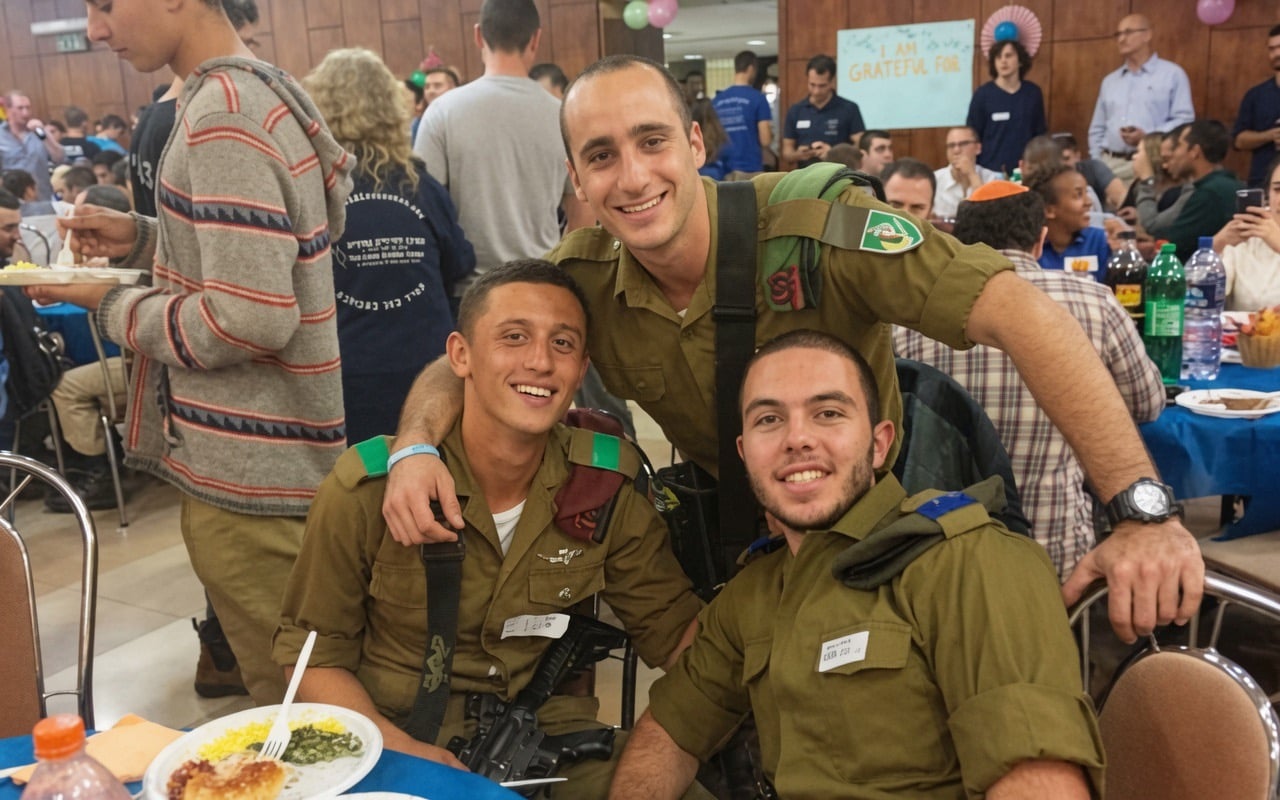
IDF lone soldiers from the US enjoy a Thanksgiving dinner on November 26, 2015. (Simona Weinglass/Times of Israel).
The IDF faces a shortfall of approximately 12,000 soldiers, including 7,000 combat troops. Military leaders warn that shorter service terms and mounting reserve exhaustion will only widen the manpower gap. Yet Israel is overlooking an answer in plain sight: new immigrants eager to serve but too often sidelined by language barriers.
Many ‘olim chadashim’ are arriving in our country with professional expertise, multilingual skills, and determination to serve in the military. The IDF must harness that manpower without sacrificing operational cohesion. Hebrew must remain as the sole language of command, but fluency should be the culmination of military integration—not the price of admission to meaningful service.
In 2025, Western Aliyah rose even as overall immigration declined. Up 25 percent from 2024, the Aliyah and Integration Ministry’s final report counted 8,499 arrivals, mainly from the United States, France, Britain, and Canada. Nearly 40 percent of Western olim were between the ages of 18 and 35, and 3,165 new immigrants enlisted in the IDF. The same wave included 541 physicians and more than 2,000 technology and engineering professionals. These numbers cannot erase the shortage, but they make wasting even one qualified recruit indefensible.
Today, several programs address only fragments of the problem. Michve Alon provides low-Hebrew recruits with a three-month language course and basic training. Mahal enables eligible overseas Jewish volunteers to enlist, while lone-soldier organizations help them navigate military life. Olim Al Bet places immigrants over 26 into skilled reserve positions but still requires basic Hebrew knowledge. None of these initiatives combine native-language assessment, credential recognition, military placement, and continuous operational Hebrew in a single coherent system.
In the 1990s, Israel faced a larger integration test when nearly one million Jews arrived from the former Soviet Union. Many brought technical, medical, scientific, or military expertise. Bureaucracy left too many serving far below their abilities, yet the eventual recognition of their credentials transformed that wave into a pillar of Israeli chutzpah. The lesson here is not to recreate Russian-speaking enclaves but to adapt before the Western diaspora Jews that Israel needs lose patience and return to their countries of origin or move to places where they can comfortably use their maternal languages and skills.
As a result, the IDF should establish a Multilingual Accession Track within the Manpower Directorate and expand Michve Alon as its central gateway. The track must create neither permanent language units nor a foreign legion. Instead, soldiers should be assigned from day one into regular IDF units and complete their full term of service operating primarily in their maternal language.
Before enlistment, eligible Olim and Mahal volunteers would submit their credentials, undergo screening in their strongest language, and begin AI familiarization plus social ulpan remotely. Once in uniform, bilingual teams would verify qualifications, complete security screening, and match each recruit to an actual vacancy through a secure registry linking proven skills to shortages in medicine, intelligence, cyber, logistics, and technical fields.
Indeed, this initiative will never substitute for aptitude testing or the ability to achieve a security clearance; current standards remain intact. The only change here will be that the army stops delaying useful manpower while waiting for an Oleh to learn Hebrew.
Yes, our language must remain the sole language of command, formal orders, and the official record. Nevertheless, any Oleh who prefers to use their mother tongue to produce all of their professional output—medical notes, cyber reports, intelligence assessments, or logistics plans—must have the right to do so. A secure, air-gapped, military-grade AI system could translate—in real time—every input from the Oleh soldier into Hebrew while returning every order, radio transmission, and safety instruction in the soldier’s mother tongue.
In parallel, social ulpan must run throughout the entire service solely for cultural integration and unit belonging. Soldiers will live, train, and serve inside regular formations with Israeli peers; the language difference should be individual and technical, never organizational. With this in mind, bilingual commanders will be able to enforce IDF standards from day one while the AI layer ensures that every official initiative remains in Hebrew.
Under this proposal, English speakers can immediately bolster open-source intelligence, Western media monitoring, and allied liaison. French speakers would diachronically enhance Francophone and Sahel coverage. Russian speakers will be able to perform technical and Eurasian analyses at a more competent level than native Israelis. Licensed Jewish physicians, computer scientists, engineers, and logistics managers can be directly assigned to their military equivalents. A recruit’s expertise should determine where it serves; their native language, supported by AI, should allow it to contribute to our society while mastering Hebrew throughout their service.
That said, this approach must focus on non-combat and support positions, where the manpower dividend is immediate, and risk exposure is lower. Combat-related specialties would be filled with the certified Oleh in due time, according to the specificities of each area. Every Hebrew-proficient Oleh who occupies a support position enables the deployment of at least one native Hebrew speaker as a combat soldier or reservist. Ergo, the most cost-effective way to upgrade combat readiness is to cease wasting certified workforce on rear logistical and support duties.
The IDF faces a crushing manpower deficit that no amount of political horse-trading can obscure. No system of sectoral exemptions absolves Jerusalem of its core duty to enforce equitable conscription, extend service terms, and protect an exhausted reserve force. Expecting Western olim chadashim to single-handedly plug this gap is a strategic delusion. However, in a multi-front war of survival, mobilization must be total. For defense bureaucrats to turn away highly skilled, ideologically committed Zionists over imperfect Hebrew is more than institutional inertia—it is a self-inflicted wound to national security.
In my view, a clear route to meaningful service would also strengthen the whole concept of making Aliyah and serving in the IDF. A young Jewish physician in Paris, a Jewish engineer in London, or a Jewish cybersecurity graduate in New York should see an army prepared to use that expertise effectively and willing to help them join the Israeli society the right way. Every immigrant placed according to their abilities becomes an ambassador for the next wave. Every professional sidelined by bureaucracy becomes a warning against Jews coming to their ancestral homeland.
Israel cannot determine when antisemitism or instability abroad will send the next great wave of Jews home. But it can decide whether those who arrive find a country ready to absorb them and a military able to use their talents.
In the 1990s, Israel thrived because it transformed its institutions according to the needs of the Soviet Aliyah. As a new Western wave crests, we cannot afford to force today’s Olim to wait while bureaucracy relearns a lesson mastered thirty years ago. By leveraging AI, we can bridge the language gap—preserving Hebrew as the unifying tongue of Israeli society and the IDF while immediately deploying Western talent where the nation needs it most.
Related Topics
Related Posts