
The Indisputable Zionism of the Black Panther Party and Why it Matters Now
(Part I: The Jew boy fight, the JDL, Zionists, and the Black Power Party’s Zionist-inspired platform)
I was introduced to the Black Panthers in the eighth grade by my friend Gene—I think that was his name. We were walking to the train station from Shallow Junior High School in Bensonhurst, Brooklyn. I’d been in a fist fight with an Italian the week before (Shallow was about eighty percent Italian). This Italian called me a Jew boy. It was a traumatizing encounter, not so much by the actual fight as from the blinding speed at which my gut overrode any sense of retreat. Before I knew it, I was planting my fist on this Italian’s face (to be fair, he got his licks in too). The fight was the talk of my class. We all had our view of who won, and Gene was consoling me.
Gene told me that the black panther avoids confrontation and attacks only when threatened or in self-defense. That’s how Gene explained the Black Panther Party to me, and my reaction to the Italian. “Welcome to the oppressed,” I remember Gene saying. As soon as the words left his mouth, Gene and I were struck by how much the Jewish and Black experiences overlap. Thus began my fascination with the Black Panthers and the Black struggle.
Back in my Boro Park neighborhood, I saw Jews as weak. Then, when I was fifteen, I took karate lessons from a bearded, payos-wearing, muscle-bound Jew in a karate gi. He was from the Jewish Defense League. I had no trouble seeing the ideological overlap between the JDL and the Black Panthers. Yet, it was a Black Power fist medallion I wore around my neck, and not a Magen David. I carry that fist with me to this day. But instead of a Magen David around my neck, I made Aliyah to Israel from Oakland, California, ten months ago. As a Zionist, I wanted to be with Jews who were proud of their identity and had the courage to do what it takes to deal with Jew hatred.
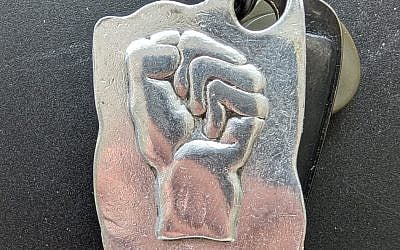
The medalion I’ve carried with me since high school.
I had recalled what Gene told me while researching for an article on Jewish Americans who were carrying guns as a defensive response to violent Jew hatred. So, I revisited the Black Panthers and came across the Party’s 1966 Ten Point Platform. I read the very first point and thought, “Wow. That’s a page out of Herzl”: “We Want Freedom. We Want Power to Determine the Destiny of Our Black Community. We believe that Black people will not be free until we are able to determine our destiny.”
Just substitute “Jewish” for “Black,” and you have Zionism. Far out, right? Was the Black liberation movement, and the Black Panther Party (“BPP”), inspired by Zionism and the Jewish experience? That would be a mindblower to those married to the antizionist settler-colonist ideology. I had to know. It would be like informing a Ku Klux Klansman that he’s been half black all his life and didn’t know it.
Zionism as Self-Determination (“We Want Power to Determine the Destiny of Our Black Community”)
First, I had to nail down what Zionism meant before it was hijacked by the left and made into a dirty word. Educator, novelist, and author of People Love Dead Jews, Dara Horn, in her 2024 Atlantic article, “Why the Most Educated People in America Fall for Anti-Semitic Lies,” offered a good starting point by her observation that “Jewish civilization has been centered for thousands of years, in ways large and small, on its homeland in Israel, where Jews have had a continuous presence since ancient times. The modern political idea of Zionism as Jewish self-determination in this homeland emerged in the late 19th and early 20th centuries amid many other anticolonial movements around the world,…” Sounds like the BPP’s self-determination to me.
Birnbaum’s call for a reawakening of Jewish national consciousness (the BPP’s call for self-awareness and education—Black consciousness by any other name)
Jewish nationalist Nathan Birnbaum was the first to employ the term “Zionism” in his 1890 German-language journal, Selbstemanzipation! (Self-Emancipation!), which he founded and edited in Vienna. According to historian Robert Wistich, Birnbaum believed that assimilation as well as antisemitism posed a threat to Jews. Assimilation, Birnbaum argued, was an attack on Jewish identity, a weakness, an admission of inferiority, and he called German assimilation suicidal. The remedy for these ills was a reawakening of Jewish national consciousness and a return to the land of Israel. As Wistich put it, Birnbaum believed that “Jews must seek national equality as a group in order to regain their inner balance and respect of other nations.”
As the BPP’s fifth point of their ten-point platform puts it, “We want education that teaches us our true history and our role in the present-day society. We believe in an educational system that will give to our people a knowledge of self. If a man does not have knowledge of himself and his position in society and the world, then he has little chance to relate to anything else.” For the Panthers, it’s about Black consciousness-raising as a means of liberation, which mirrors Birnbaum’s reawakening of Jewish national consciousness to achieve inner balance.
Pinsker and Herzl’s call for a Jewish homeland to establish equality, and remedy Jew hatred (the BPP’s call for land, forty acres, and two mules, and to separate as a distinct political entity)
A major influence on Birnbaum was his contemporary, Leo Pinsker, who in 1882 penned “Auto-Emancipation: AN APPEAL TO HIS PEOPLE By a Russian Jew.” In this monumental document, Pinsker argued that “Jews comprise a distinctive element among the nations under which they dwell, and as such can neither assimilate nor be readily digested by any nation.”
Pinsker described in detail how Jews of Europe are victims of systematic Jew hatred and that “No matter how much the nations are at variance in their relations with one another, however diverse their instincts and aims, they join hands in their hatred of the Jews; on this one matter all are agreed.” To remedy such intractable hate, Pinsker argued, Jews are “bound by duty to devote all our remaining moral force to re-establishing ourselves as a living nation, so that we may ultimately assume a more fitting and dignified role among the family of the nations…[and] as long as we lack a home of our own, such as the other nations have, we must resign forever the noble hope of becoming the equals of our fellow-men.” To Pinsker, Jewish liberation comes only through coming together as a living nation.
While Pinsker did not use the word “Zionism,” he described it in its essence: Jews are the victims of oppression, and liberation lies in taking control of their destiny by reconstituting themselves as a nation physically and spiritually.
Under the influence of Pinsker and Birnbaum, on February 16, 1896, Theodor Herzl published “The Jewish State.” In this eighty-eight-page manifesto of Jewish liberation, Herzl observed that “We are a people, one people,” and as a people, over the course of history, we as Jews “have honestly endeavored everywhere to merge ourselves in the social life of surrounding communities and to preserve the faith of our fathers. We are not permitted to do so,…but I think we shall not be left in peace.” The reason: undeniable antisemitism. “No one can deny the gravity of the situation of the Jews. Wherever they live in perceptible numbers, they are more or less persecuted. Their equality before the law, granted by statute, has become practically a dead letter.” But oppression, antisemitism, “binds us together, and, thus united, we suddenly discover our strength. Yes, we are strong enough to form a State, and, indeed, a model State.” Thus, to Herzl, the only way for Jews to liberate themselves from historic Jew hatred that has proven never to go away and to determine their own destiny is by forming their own state. That is Zionism in a nutshell.
Corresponding to Pinsker and Herzl’s call for land is the BPP’s point three, where they “believe that this racist government has robbed us, and now we are demanding the overdue debt of forty acres and two mules” and point ten, where they demand that “We Want Land, Bread, Housing, Education, Clothing, Justice And Peace.” Point three also refers to the history of robbery, slavery, and oppression of the Black people, which corresponds to how Pinsker and Herzl detailed the history of Jewish hatred throughout the millennium.
In support of point three, the BPP goes so far as to draw support from the Jewish Holocaust as parallel to the Black American experience and how “The Germans are now aiding the Jews in Israel for the genocide of the Jewish people. The Germans murdered six million Jews. The American racist has taken part in the slaughter of over fifty million Black people; therefore, we feel that this is a modest demand that we make.”
The Zionist themes in point ten (“we want land…”) of the BPP platform jump out when its key provisions are read alongside Pinsker and Herzl’s Zionist pronouncements:
HOW POINT TEN OF THE BPP PLATFORM MIRRORS ZIONISM
|
ZIONISM |
THE BPP POINT TEN |
| A Jewish State as a remedy
To remedy intractable Jew hatred, Jews are “bound by duty to devote all our remaining moral force to re-establishing ourselves as a living nation.” (Pinsker) “But oppression, antisemitism, “binds us together, and, thus united, we suddenly discover our strength. Yes, we are strong enough to form a State, and, indeed, a model State.” (Herzl)
Zionism understands that Jews have tried to live in the diaspora, but the hate is systematic, and Jews have never been left to live in peace. “We are a people, one people,” and as a people, over the course of history, we as Jews, “have honestly endeavored everywhere to merge ourselves in the social life of surrounding communities and to preserve the faith of our fathers. We are not permitted to do so,…but I think we shall not be left in peace.” (Herzl)
Jew hatred is intractable. A Jewish homeland is the only remedy. “No matter how much the nations are at variance in their relations with one another, however diverse their instincts and aims, they join hands in their hatred of the Jews; on this one matter all are agreed.” To remedy such intractable hate, Jews are “bound by duty to devote all our remaining moral force to re-establishing ourselves as a living nation, so that we may ultimately assume a more fitting and dignified role among the family of the nations…[and] as long as we lack a home of our own, such as the other nations have, we must resign forever the noble hope of becoming the equals of our fellow-men.” (Pinsker) But oppression, antisemitism, “binds us together, and, thus united, we suddenly discover our strength. Yes, we are strong enough to form a State,”(Herzl)
|
Land and Separation as the remedy for Injustice
“We Want Land, Bread, Housing, Education, Clothing, Justice And Peace.” “When, in the course of human events, it becomes necessary for one people to dissolve the political bands which have connected them with another, and to assume, among the powers of the earth, the separate and equal station to which the laws of nature and nature’s God entitle them, a decent respect of the opinions of mankind requires that they should declare the causes which impel them to the separation.” The “long train of abuses” has shown that humankind is not inclined to right itself.
“All experience hath shown that mankind are more disposed to suffer, while evils are sufferable, than to right themselves by abolishing the forms to which they are accustomed. But, when a long train of abuses and usurpations, pursing invariably the same object, evinces a design to reduce them under absolute despotism, it is their right, it is their duty, to throw off such government, and to provide new guards for their future security.” In the face of intractable oppression, separation becomes necessary, along with the establishment of a new government to secure civil liberties and happiness. “When, in the course of human events, it becomes necessary for one people to dissolve the political bands which have connected them with another, and to assume, among the powers of the earth, the separate and equal station to which the laws of nature and nature’s God entitle them, a decent respect of the opinions of mankind requires that they should declare the causes which impel them to the separation.” “…all men are created equal; that they are endowed by their Creator with certain inalienable rights; that among these are life, liberty, and the pursuit of happiness… whenever any form of government becomes destructive of these ends, it is the right of the people to alter or abolish it, and to institute a new government, laying its foundation on such principles, and organizing its powers in such form, as to them shall seem most likely to effect their safety and happiness.” |
Zionism: A Jewish homeland. The Black Panthers: Land, compensation, justice.
Zionism: As long as Jews live in the diaspora, they cannot live in peace.
The Black Panthers: “The long train of abuses” teach that society is not likely to change.
Zionism: Jew hatred in the diaspora is intractable. A Jewish homeland is the remedy to secure safety and freedom.
The Black Panthers: When in the course of human events, it becomes necessary to separate, it is the right, the obligation of Black Americans to do so and set up a new government to secure their safety and freedoms.
There are too many similarities between late nineteenth-century Zionism and the 1966 BPP Ten-Point Program to call it a coincidence. So, how did Zionist principles wind up as an ideological underpinning to the Black Panther Party platform well over half a century later? I address this question next week in Part II, by turning to Black nationalist and civil rights leaders during the early period of Zionism, as well as BPP leader Huey Newton and former Nation of Islam leader Malcolm X, who we will see was a closeted Zionist admirer. But the more important question is, “Why does this all matter now more than ever?” Tune in to part II next week for the answer. Okay, a hint. It’s about storytelling.