Part Two of a Three Part Series describing the emotional events of the gathering of the descendants from the prewar Jewish population in Mszana Dolna in 2022. They came to observe the first ever Yahrzeit (memorial) commemorating exactly eighty years of the liquidation of the Jews of that village by the Nazis and their Polish collaborators.
SNAPSHOT #2: The Jewish Cultural Festival.
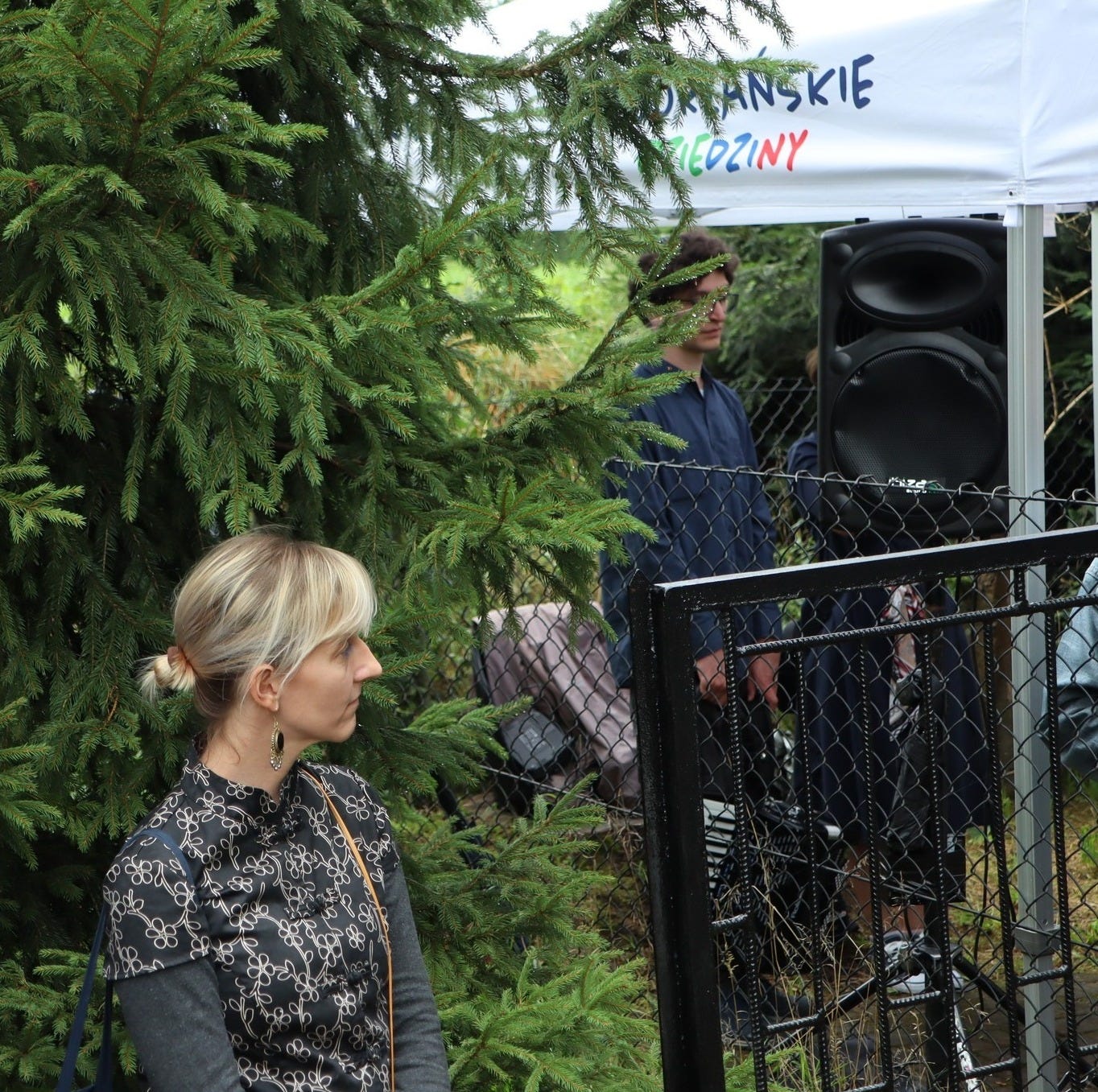
It was the first day of the commemoration. Urszula arranged a Jewish Cultural Festival to take place under a large open shed near the village center. Urszula believed that while it is important to remember what and who was lost, it is even more paramount that the Mszankas get to know the customs and traditions of their former neighbors.
Attending were the Mszankas, with their children, as well as the descendants, politicians and members of the local press.
For the descendants, we were beginning to know each other. For me, I was acquainted with some of the town people having visited Mszana Dolna on previous occasions, but not any of the descendants.
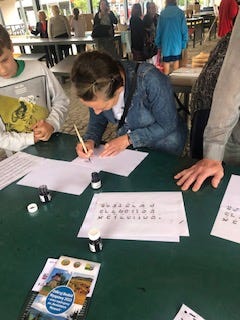
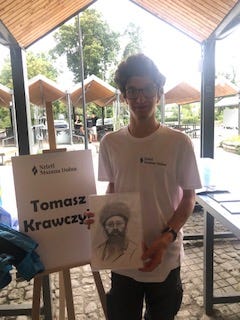
Art classes were provided. Jewish calligraphy was offered. Lectures on various Jewish topics was given. Jewish art was displayed, especially the beautiful drawings and paintings of Tomasz Krawczyk. The village enthusiastically participated. The descendants, at the same time, were getting to know each other at this setting.
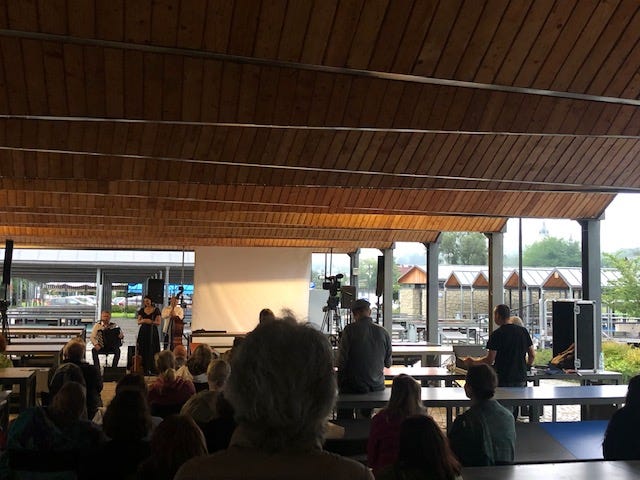
At sundown, a Klezmer concert was provided by a talented trio. As I was listening, the spire of St. Michel was on the horizon. St. Michel, the church where, across the street, my Mother, uncles, family and cousins lived. I was in my own world for a long moment realizing that this is the first time in over eighty years that Jewish music permeated through the atmosphere of Mszana Dolna.
Hebrew Calligraphy being taught at the Jewish Cultural Festival.
Tomasz Krawczyk, PHD displaying his drawings and paintings. Pictured is the second Bobover Rebbe, Ben Zion Halberstam ZT”L (1874-1941). My great grandfather was a notable in his court..
An evening of Klezmer music. The Spire of St. Michel can be see on the horizon to the right, between the first and second pillar.
SNAPSHOT #3: The Mszankas, August 22, 2024
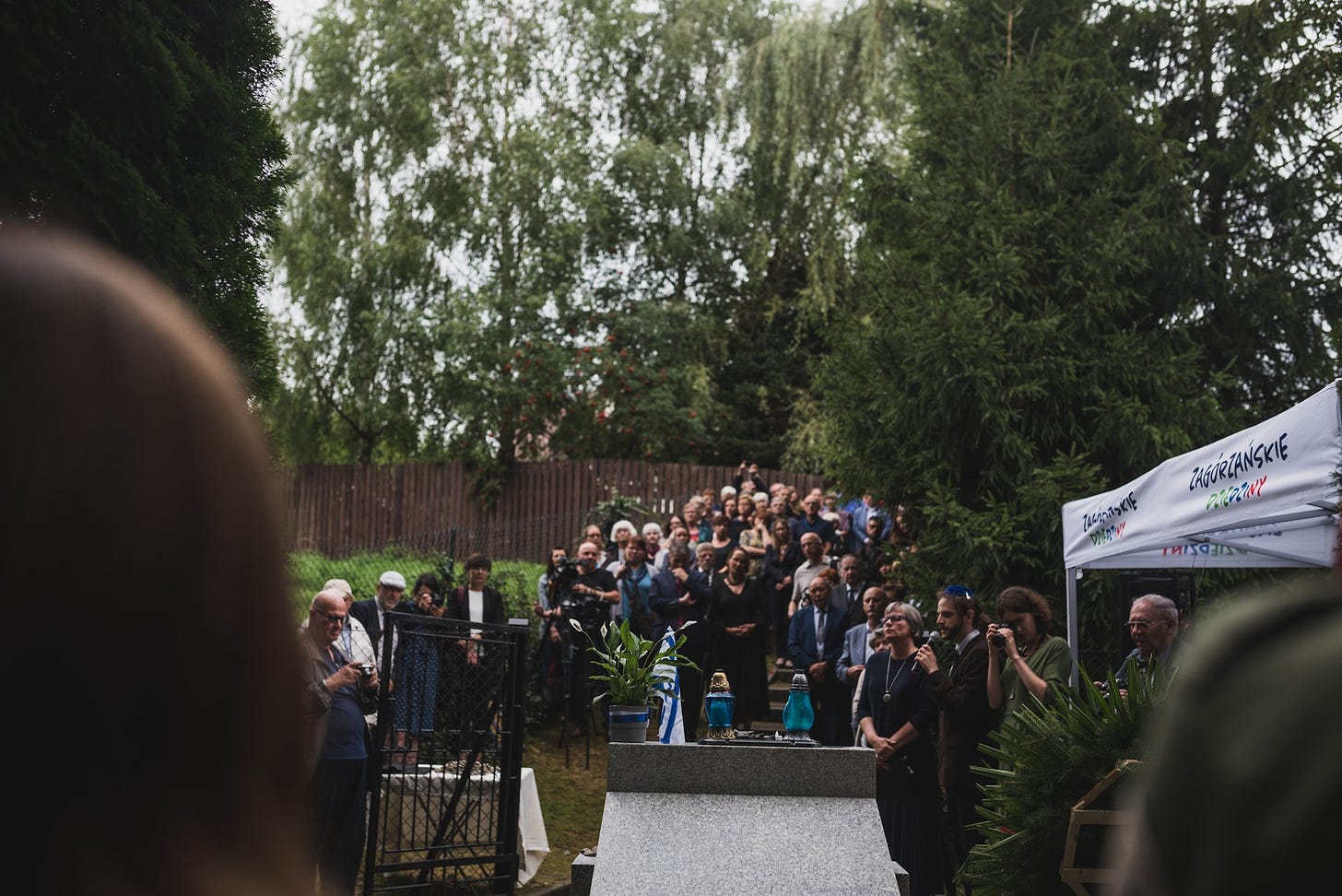
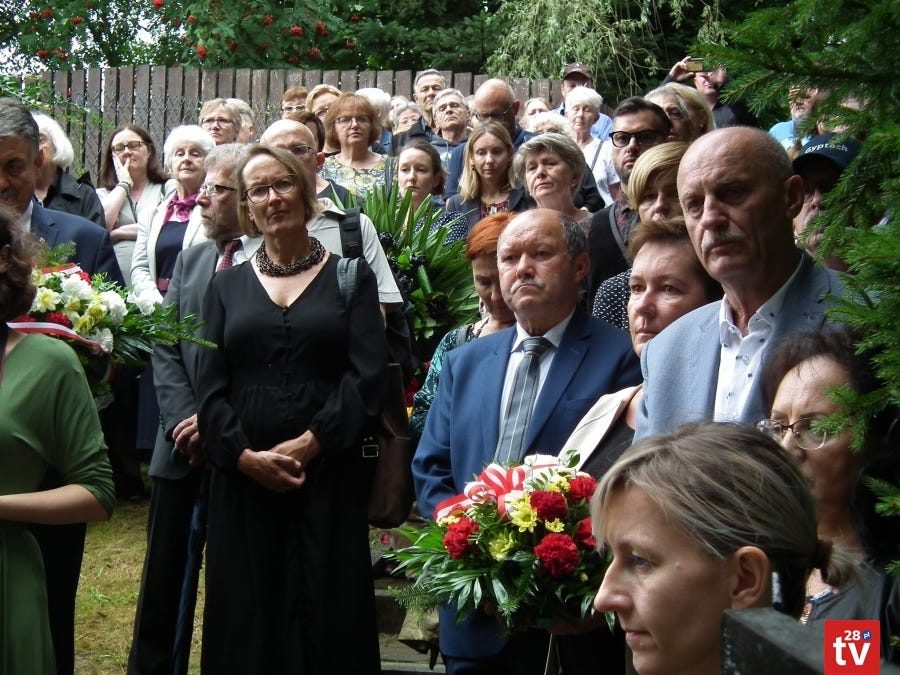
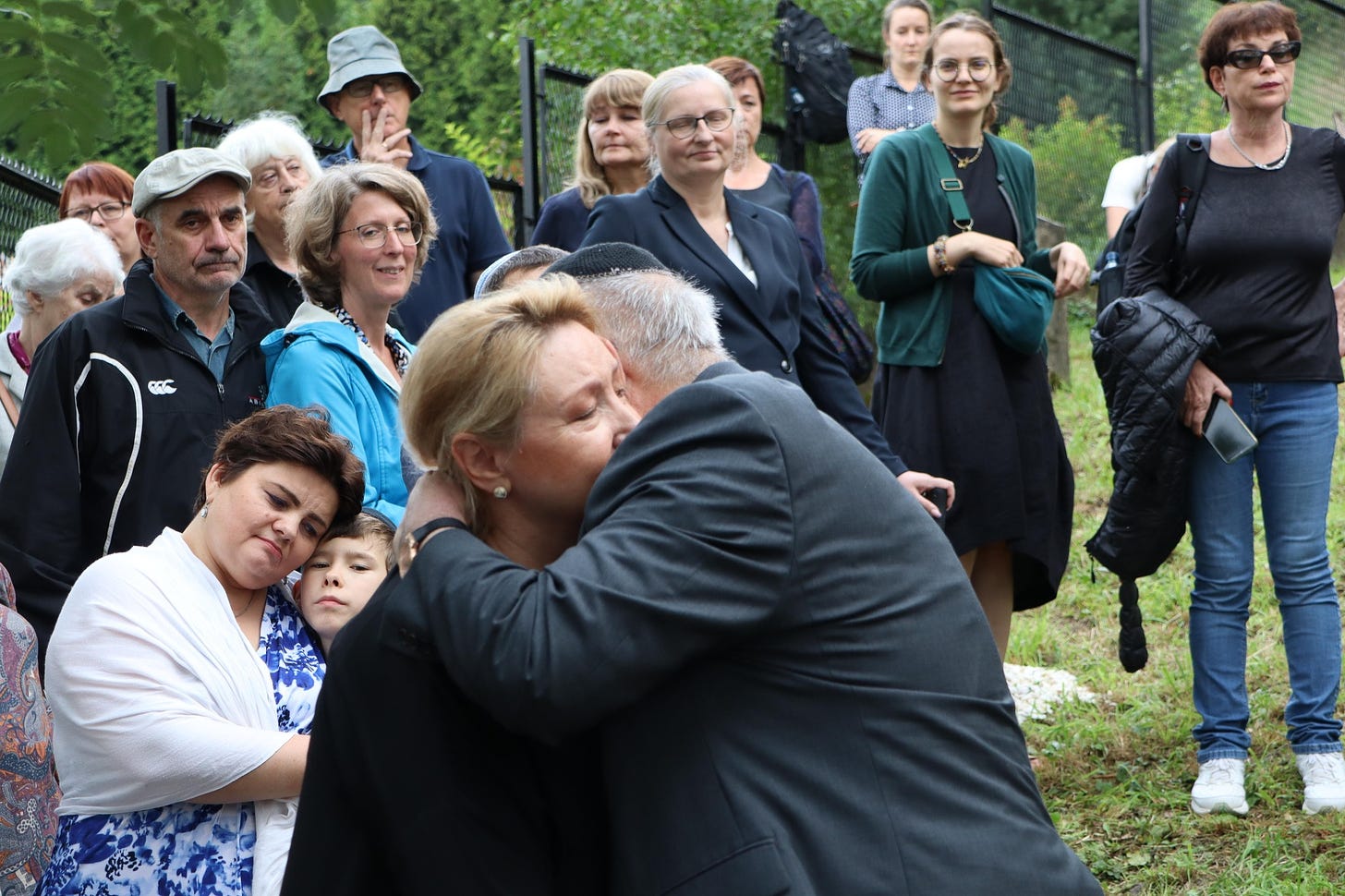
A town that for years was not enthused about learning about their former neighbors and their demise. Yet, today they came down in numbers to pay their respects, to remember, and to witness.
We, the descendants and notables were inside the sight of the main and second mass graves. The town, mostly students and scouts cleaned up the memorial and the surrounding garden. The Mszankas stood outside the perimeter, the fence. They stood in silence, listening to the tributes, and yes, a number of them were crying.
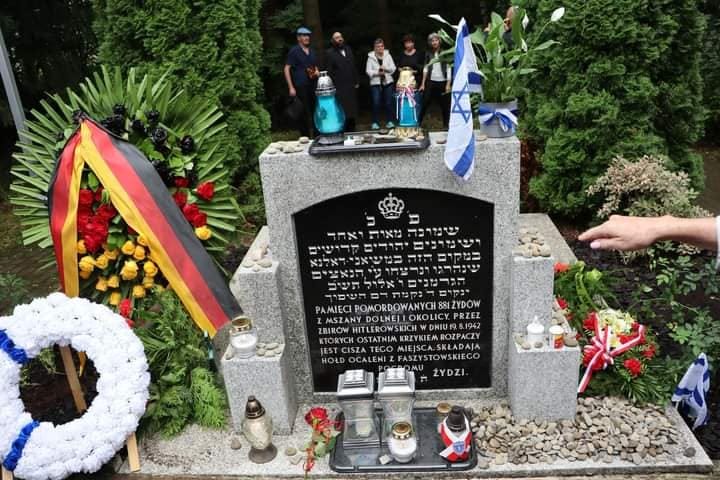
Afterwards, as per Jewish tradition, they picked up stones that were prepared for the attendees and laid them on top of the Memorial.
All in silence.
The Mszankas showing their respect at the site of the mass grave.
A close up of the Mszankas
Note the stones being laid on the second mass grave by the Mszankas to show respect.
SNAPSHOT #4: Father Jerzy Razny, Parish Priest of St. Michels
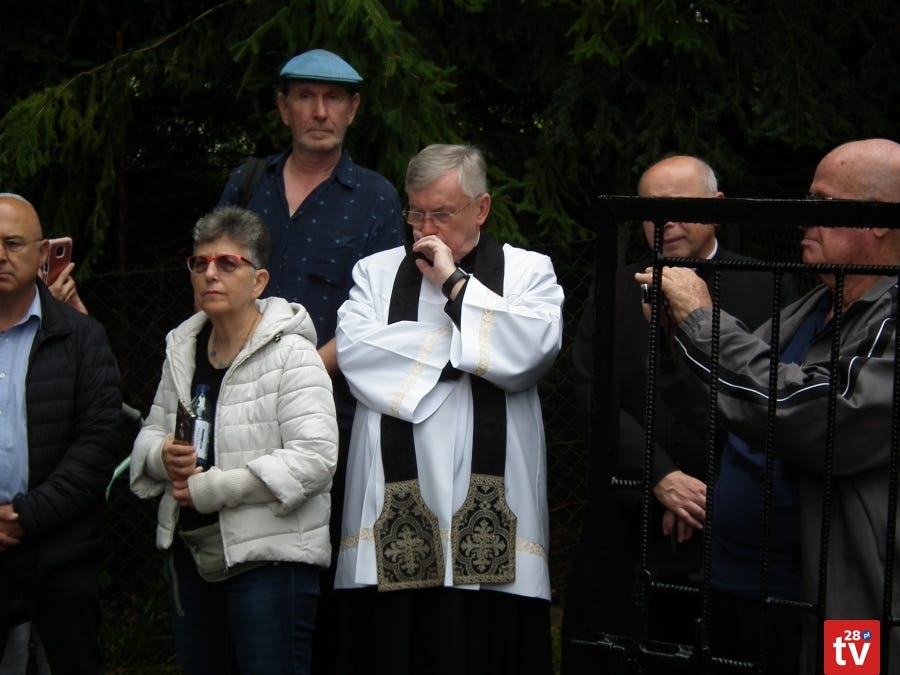
There were a couple of priests who appeared and paid their respects. Father Jerzy Razny spoke on behalf of the parish. He spoke eloquently. He spoke of Mszankas who were helping the Jews, and of the then Parish Priest, perhaps the one who was friends with my great father, who opposed the Nazis and was sent to Auschwitz.What was most poignant was towards the end was when Father Razny confessed that there were many among the Mszankas at the time who acted wrongfully and horrifically. This latter point went against the policy of the Polish government at the time. They wanted to suppress any expression that the Poles, too, were willing collaborators.
After the ceremony, Father Razny went to every descendant, shook their hands and engaged with them.
Father Jerzy Razny among the descendants. To his left is Father Tadeusz Mrowiec of the second Parish.
SNAPSHOT #5: Forum for Dialogue, Hanna Gospodarcyzk and Jagoda Szkarlat
The unsung hero during this three-day happening, was Forum for Dialogue (dialog.org.pl) Forum for Dialog (FfD) is a pure NGO dedicated to improve Jewish Polish relations.
By “pure” I mean that this NGO does not accept any funding from the Polish government. Taking money from the Polish government basically means this NGO will have to follow the government’s revisionist version of the Holocaust. Not an easy task since they are under a lot of pressure to comply.
This has been an especially busy summer for them since hundreds of towns around Poland were liquidated around the Jewish fast day of Tisha B’Av in August of 1942. This holiday marks the saddest day of the Jewish year, and the Nazis cynically scheduled the liquidations at that time.
Many towns took advantage of FfD support, financial assistance, and guidance in setting up anniversaries and searching for survivors.
They were an invaluable resource and support to Urszula Rekucka.
Other towns were hoodwinked by crypto NGOs, that were supported by the government. They were forced to present the revisionist version of events, which basically laid entire blame on the Nazis and made no mention of Polish collaborators.
Hanna Gospodarczyk, Piotr Banasik, and Jagoda Szkarlat of the FfD were present during the three days. During that time, they made a film documentary about the Recukas.
Jagoda Szkarlat from the Forum for Dialogue (Missing: Hanna Gospodarczyk and Piotr Banasik). To view FfD video about Urszula and Marek Rekuccy, link on to //youtu.be/8vsW6tbisak?t=77
SNAPSHOT #6. The Consulate of Germany in Krakow
The German government sent a delegation from the German Consul to Poland, Frau Dr. Ursula Maier. A wreath was laid by the scouts on behalf of the German government.
The delegations faces were full of emotion. I had the microphone and made mention of how honored we should be at the presence of the delegation and spoke briefly how Germany since the 1950s made overt attempts to come to terms with the most horrendous act of human history.
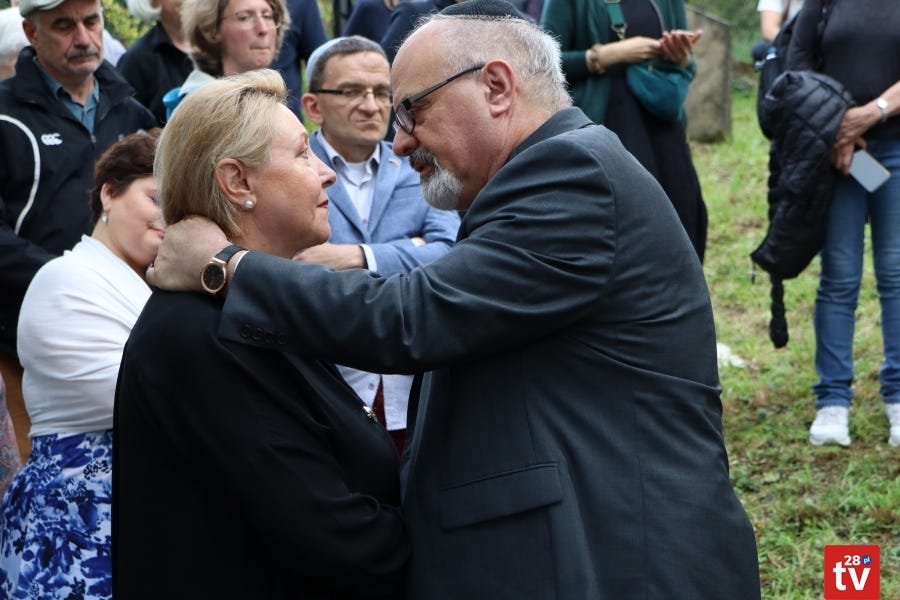
I then approached Frau Dr. Ursula Maier. She was sobbing:
“I am so sorry.”
” It is not my role to respond to that, I cannot speak on behalf of the victims.”
“I know (pause), I know.”
With that we embraced, I kissed her forehead, and remained for a couple of seconds, but seemed like eternity.
Without my being aware, months later Urszula told me the entire crowd was in tears.
SNAPSHOT #7: The Institute of National Remembrance
The Institute of National Remembrance is a government sponsored crypto NGO. A wreath was presented on their behalf, but they did not send a representative.
They wanted to have a platform to speak at the memorial. The organizers agreed to it, only if the Institute presented a draft of what they were going to say beforehand1. A draft was never submitted.
Sadly, it is two years later, and the Institute is still creating terrible waves.
The final part of this series will appear on Sunday.
About the Author
Saul Chapnick was raised in an Orthodox home with deep familial Hasidic roots. Educated in yeshiva and later earning a Master of Social Work degree from Yeshiva University's Wurzweiler School of Social Work, Saul has continued throughout his life to embrace Jewish learning in many settings—from studying at Hebrew Union College–Jewish Institute of Religion to maintaining a weekly chavruta for ongoing Torah study. His lifelong journey has given him a deep appreciation for richness of Jewish tradition across the spectrum of Jewish life.
For more than thirty-five years, Saul has devoted himself to the study of Jewish history, with a particular focus on Jewish life in interwar Eastern Europe. Inspired by the mitzvah of Zachor (to remember), he has explored both the extraordinary vibrancy of the Jewish world that was destroyed in the Shoah and the enduring questions of Jewish memory, continuity, and identity. Through extensive travel, archival research, and conversations with survivors, scholars, communal leaders, and public figures, he has sought to understand not only what was lost, but also what those vanished communities continue to teach us today.
His writing explores the intersection of Jewish history, personal memory, Israel, and contemporary Jewish life, seeking to connect the voices of the past with the challenges of the present.
A gifted storyteller and engaging speaker, Saul has lectured throughout the United States and abroad on Jewish history, Yiddish language and culture, modern Poland, Israel, and post-Holocaust Jewish identity. His presentations blend scholarship with personal experience, inviting audiences to explore the enduring relevance of Jewish history to contemporary Jewish life. He has also prepared adult participants of the March of the Living by providing historical and cultural context that deepens their understanding of both Poland's Jewish past and its emerging Jewish present.
Saul is the author of a widely read weekly Substack newsletter and a contributor to The Times of Israel, where he reflects on Jewish life, history, Israel, memory, and current events. His essays weave together personal experience, historical research, and contemporary issues, encouraging readers to reflect on the challenges and opportunities facing the Jewish people today.
For the past thirteen years, Saul has served as the Substitute Chaplain through the Greater Miami Jewish Federation Chaplaincy Program at Miami Jewish Health. During rabbinic transitions, he has served as the community's interim spiritual leader, leading Shabbat and holiday services, reading Torah, delivering Divrei Torah, teaching adult education classes and study groups, and providing pastoral care to residents and their families.
Professionally, Saul brings more than two decades of executive leadership in healthcare and human services. He specialized in turning around distressed assisted living and memory care communities by rebuilding staff morale, restoring occupancy, improving quality of care, ensuring regulatory compliance, and returning organizations to financial stability. Today, he draws upon that experience as an expert witness in legal matters involving senior care, assisted living, and long-term care communities.
Whether teaching Torah, leading prayer, writing, or speaking, Saul believes that Judaism is best experienced through learning, storytelling, meaningful relationships, and a deep respect for every individual's Jewish journey.
At the same time, Chapnick has witnessed a limited reawakening of Jewish life in his family’s ancestral homeland of Poland. He has spoken at numerous venues on the contemporary relevance of Yiddish and Yiddish culture, the significance of the 19th- and 20th-century Jewish world to modern life, and the shaping of post-Holocaust Jewish identity. He also prepares adult participants of the March of the Living to engage meaningfully with modern-day Jewish Poland.
Chapnick shares his insights and reflections in weekly blogs on https://saulchapnick.substack.com, where readers are welcome to subscribe.