The Inheritance of Silence
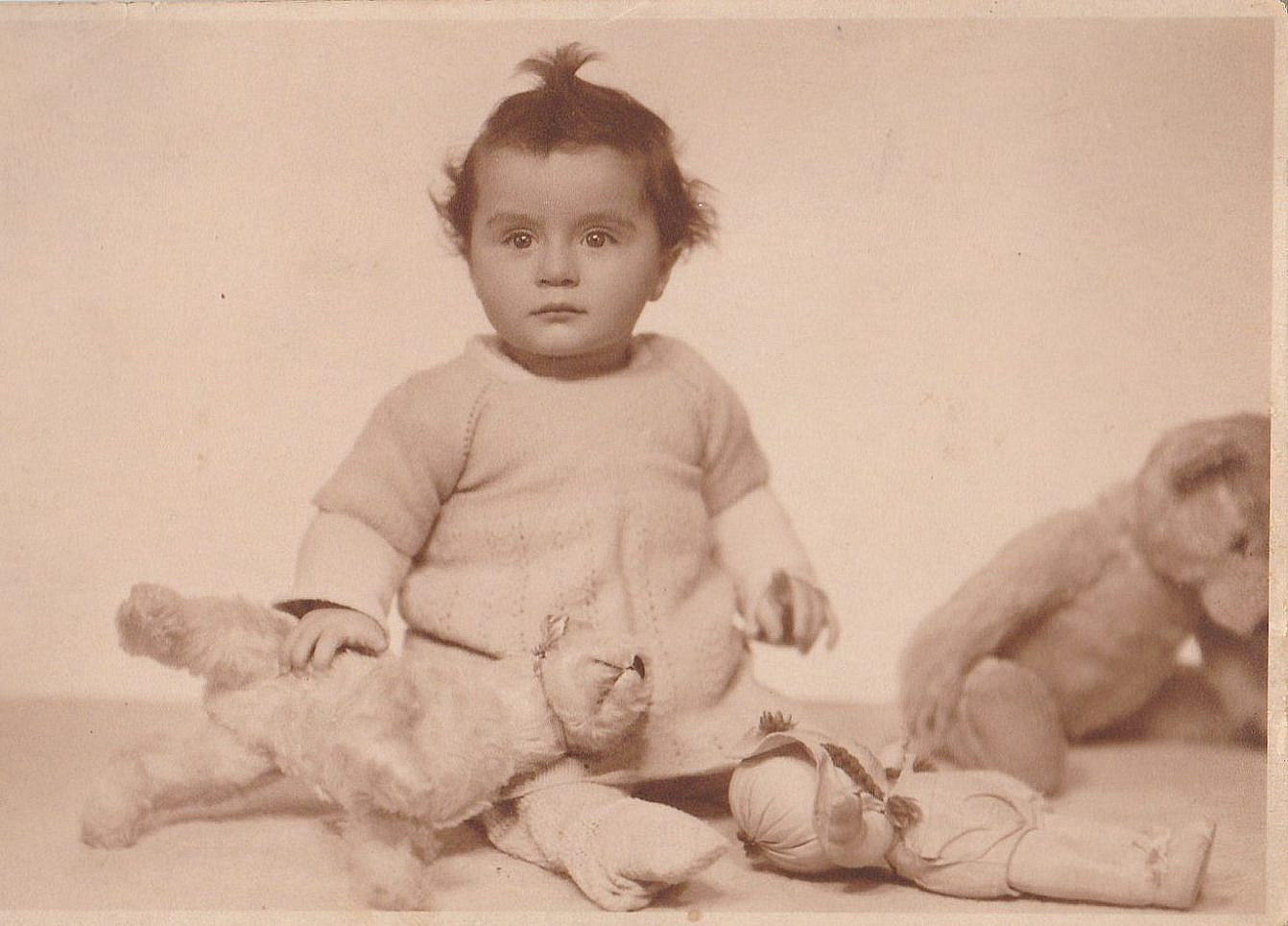
Pardubice station, June 1942. A young Jewish couple, seconds from arrest, place their baby on a bench and walk away—hoping a stranger will save what they cannot. That baby was my relative. I found her 81 years later.
A train station in eastern Bohemia, June 1942. Martha and Alexander Knapp are fleeing Prague with their infant daughter. At Pardubice, Nazi soldiers board the train. In the minutes they have left, Martha and Alexander make a choice no parent should ever have to make. They place their baby on a bench. They walk away from her. They hope—with everything they have—that someone will find her, that someone will save her.
They never see their daughter again. They are arrested, sent to Theresienstadt, and later murdered at Auschwitz.
The baby survived.
Her name was Alice.
For 81 years, Alice Grusová lived in Prague. She married Miroslav. She raised three sons. She welcomed grandchildren and great-grandchildren. She built a life, a real and full one—but where her roots were supposed to be, there was only a blank. No parents. No history. No family beyond the one she had created herself.
She didn’t know we existed. And we didn’t know her name. But we felt her—a presence at the edge of our family tree, an absence that had weight. Because no one had ever spoken about her.
During the COVID lockdowns, I began tracing our family tree on MyHeritage—first with curiosity, then with growing urgency. What I uncovered was staggering: 120 relatives, murdered in the Holocaust. An entire constellation of lives, erased. Names we had never spoken. Faces we had never seen.
And among the dead, one unlikely thread of survival—Alice.
With the help of a professional genealogist in Slovakia, I found her. And in 2022, we held a family reunion in Israel—Alice’s first time visiting. The reunion was overwhelming—not only as a personal reckoning, but as something larger. Alice met her first cousin Yossi Weiss for the first time, reconnected with her Jewish heritage and recorded her testimony at Yad Vashem, ensuring that what had been silenced for eight decades would finally be preserved.
But this piece is not only about Alice. It is about what led me to her—and what I discovered along the way about the cost of silence, and the possibility of its undoing.
As I immersed myself in our genealogy—uncovering the names of the living and the murdered—I felt something I had not expected: anger. Not only at what had been done, but at what had not been said. My grandfather Moshe, never spoke about the family we lost. The silence had not protected us. It had severed us—from Alice, from 120 names, from an entire branch of our history.
I decided to embark on a family constellation session—a therapeutic practice in which unspoken dynamics within a family system are brought to the surface, often revealing how grief, trauma, and silence pass invisibly from one generation to the next. My intention was simple, though far from easy: to forgive him for the silence.
On the long drive back to Johannesburg from the Western Cape, we planned to spend the night in the Karoo so I could do the session—near the quiet village of Nieu-Bethesda.
It is a place that carries a certain stillness. On a previous visit, I had spent time at The Owl House, created by Helen Martins—a haunting environment of sculptures and mirrors, born from one woman’s inner world. Her work reflects what happens when something deep within remains unspoken: it does not disappear. It transforms, finding expression in other ways.
That understanding would return to me in an unexpected way.
That evening, at a small café in the village, I met a woman I will call Ingrid.
We began, almost immediately, to speak about secrets.
Not in the abstract, but in the way they live within families—how they settle into the body, how they create dis-ease, how they move quietly but persistently from one generation to the next.
I shared my story—the genealogical research, the 120 names, the anger at my grandfather’s silence, the baby left on a bench.
And then Ingrid shared hers.
She told me she was the granddaughter of a high-ranking Nazi official. And more than that—she told me this was a secret she had never revealed. Not to her husband. Not to his family. Not to her own children. She had carried it alone.
In that moment, the distance between us collapsed.
We were two granddaughters, shaped by histories on opposite sides of one of humanity’s darkest chapters—yet bound by something strikingly similar: the inheritance of silence.
What unfolded was not resolution, nor reconciliation in any grand sense. It was something quieter, and perhaps more rare. We spoke honestly. She said what she had never said. I spoke what I had long held in anger and grief.
And something shifted.
Not erased. Not undone. But seen.
And in being seen, something loosened.
We both left that encounter in tears—not of despair, but of recognition. And perhaps, in some small way, release.
There is a temptation to believe that what is hidden will fade with time. That silence protects, or at least contains.
But Alice’s life is proof that it does not.
For 81 years, silence kept her from her family. It kept us from her. It kept an entire network of belonging buried—not destroyed, but suspended, waiting for someone to speak, for someone to search, for someone to refuse to accept the void.
And Ingrid’s secret is proof from the other direction: silence on the side of the perpetrators carries its own unresolved weight, its own inherited burden, passed down just as surely as it is on ours.
Silence does not dissolve the past. It carries it forward—into bodies, into relationships, into future generations.
Until, somehow, it is spoken.
Alice passed away on October 5, 2023.
Two days later, the unimaginable happened.
Her daughter-in-law, Petra, shared with me in her grief that Alice would have been shattered by the events of October 7. A woman who survived the Holocaust as an infant—hidden behind a wall, told to stay quiet or be killed—would have witnessed, 81 years later, the return of that darkness to the Jewish people.
Perhaps there is mercy in the timing. I do not know.
What I do know is this: Alice’s return to our family, after all those decades of silence, convinced us of something we might otherwise have lost sight of—that God still exists in our story. That even after 120 relatives were erased, a thread remained. That even after 81 years of not knowing, a family could be restored. That what was meant to be destroyed can still be found.
Tonight, as the torches are lit at Yad Vashem, and tomorrow morning, as the siren stills an entire nation, I find myself holding three truths.
The first is Alice—a baby left on a bench, a woman who lived a full life in silence, a testimony now preserved so that what was hidden may never be lost again.
The second is Ingrid—a stranger in a Karoo café, who for the first time in her life spoke the truth of her inheritance to someone who could truly hear it.
And the third is this: silence is not neutral. It is a choice that echoes across generations. The Holocaust did not end when the camps were liberated. It continued—in the things we did not say, in the families we did not find, in the truths we did not speak. It continues still.
But so does the possibility of breaking through.
Two granddaughters. Two silences. Two moments of choosing, at last, to speak.
Ingrid, wherever you are: I see you. I still see you.
And Alice—you are no longer forgotten. You never will be.