
Rabbi in the Heartland of the USA
The International Scapegoat
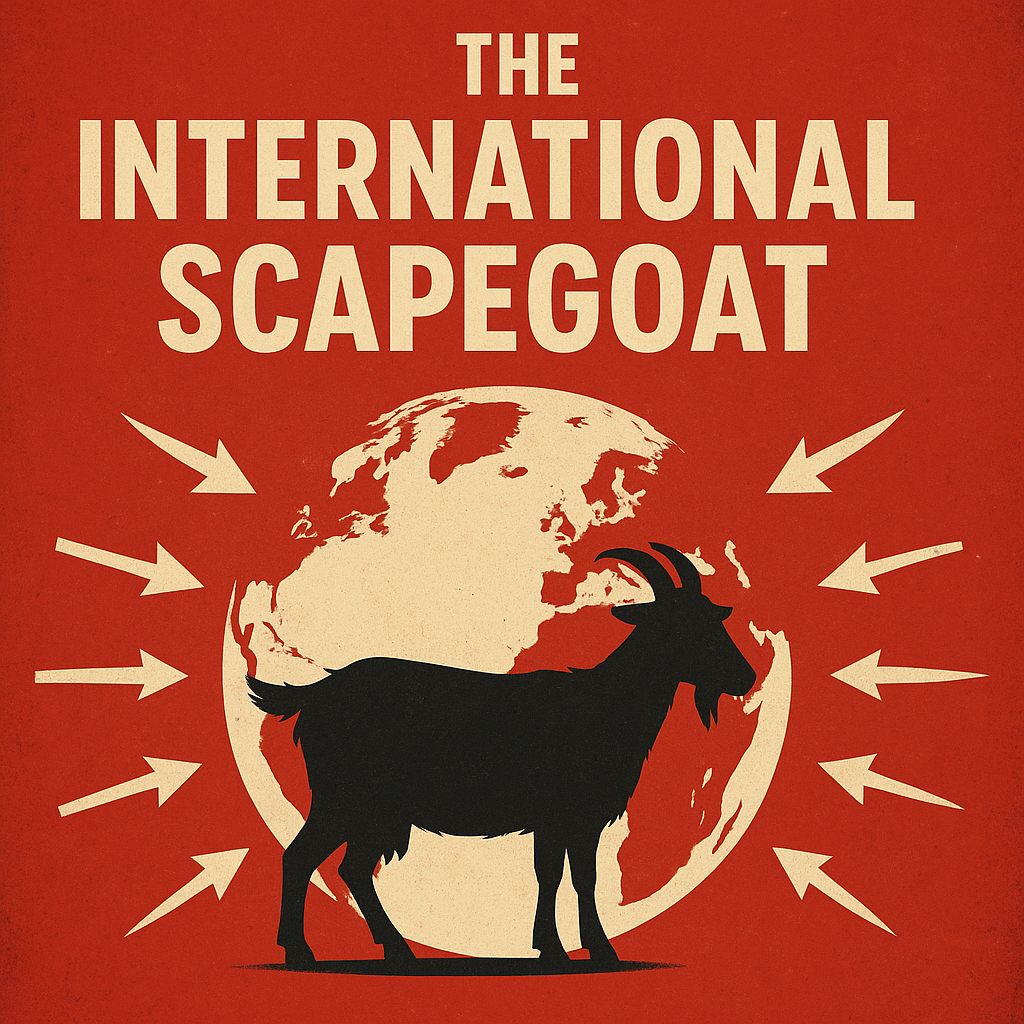
Created by Sam Stern using ChatGPT
The easiest way to avoid repentance is to blame someone else. The very first people were the very first example of this, when Adam HaRishon blamed Chava for giving him fruit from the Tree of Knowledge. If all my troubles are your fault, then I don’t have to change. Abraham Joshua Heschel put it more sharply: “Some are guilty, but all are responsible.” The danger of scapegoating, whether in our personal lives or in the life of nations, is that it spares us from the hard work of self-examination. We unload our failures onto another, drive them away, and imagine that we are clean. But in truth, we remain untransformed.
On Yom HaKippurim, when the High Priest entered the Holy of Holies, a unique ritual took place. Leviticus 16 tells us:
“Aaron shall place lots upon the two goats: one lot for God and one lot for Azazel. Aaron shall bring forward the goat designated for the Lord and offer it as a sin offering; but the goat designated for Azazel shall be left standing alive before God, to make atonement with it, and it shall be sent off to the wilderness” (Leviticus 16:8-10).
The High Priest would confess the sins of Israel over the head of this goat, symbolically transferring the people’s failures onto it, before sending it into the wilderness. The Mishnah (Yoma 6:4) describes how a scarlet thread was tied to its horns. Tradition tells us that when the goat perished in the wilderness, the thread turned white, a sign that Israel had been cleansed.
Nachmanides notes that the goat sent away represents our sins removed to a desolate place—an image of God’s mercy in distancing us from our transgressions. The ritual speaks to the deepest yearning of Yom Kippur: that our failings not define us forever, that they can be carried away, leaving us free to begin again.
But the image of the scapegoat has never belonged only to Yom Kippur. Over centuries, societies have adopted it as a strategy of survival. Unable or unwilling to face their own sins, they place blame on others and drive them into the wilderness. It is no accident that “scapegoating” is now part of our common vocabulary.
And as Jews, we know all too well what it means to be that goat.
When the Black Death swept through Europe in the 14th century, Jews were accused of poisoning wells. When Russia’s economy faltered in the 19th century, pogroms broke out in Odessa and Kiev. When Germany collapsed after World War I, the Nazis told the world that the Jews were the source of every national humiliation.
Today, antisemitism has returned in forms both ancient and modern. It masquerades as critique of Jewish influence, of Zionism, of Israel’s right to exist. The same scapegoating mechanism is at work. The most grievous sins of the world—colonialism, slavery, apartheid, genocide—are real and persist to this day. But too often, the world does not confront its own failures to stop genocides in China and Nigeria or slavery in Yemen or apartheid in Myanmar. Instead, it declares that Jews are the colonizers, that Israel is the apartheid state, that Zionism is genocide.
Consider the bitter irony: Qatar, a country whose wealth and influence in American institutions dwarfs anything Jewish philanthropists could dream of, accuses American Jews of “buying” influence. Nations whose hands are drenched in the blood of Uyghurs and Arabs and Ukrainians accuse Israel of genocide. Israel is not being subjected to honest critique. This is scapegoating. It is the same old story of expelling our people into the wilderness of accusation and hate.
The Prophet Isaiah saw this long ago. In chapter 53, he describes a servant who is “despised and rejected, a man of suffering, acquainted with grief.” He writes that the nations shall come to Israel and say:
“Surely Israel has borne our griefs and carried our sorrows; yet we esteemed them stricken, smitten by God, and afflicted. But Israel was wounded for our transgressions, crushed for our iniquities… All we like sheep have gone astray, we have turned every person to their own way; and God has laid on Israel the iniquity of us all” (Isaiah 53:4–6).
Christians later claimed this passage for Jesus. But in Jewish tradition, Isaiah speaks of us, the people Israel as one body. For centuries, we have borne the burdens of others’ sins. We have been accused, exiled, massacred—not because of who we are, but because the nations could not face who they are.
And yet Isaiah’s vision does not end in despair. It ends with vindication. Not a military victory but a conversation that leads to teshuva and peace. Isaiah declares that one day the nations will see and understand. They will confess that the servant they mocked and crushed was in fact the one who absorbed their violence and their lies. One day, they will say: the Jews suffered because we could not face ourselves. That day has not yet come. But Isaiah’s words ring with hope.
Jews no longer perform the scapegoat ritual I described to you from the Torah. In the aftermath of the destruction of the Temple, we developed our process of Teshuvah. Jews today recognize that for sins between God and humanity, Yom Kippur atones. For sins between human beings, including nations, only we can make it right and it is out obligation to do so. No goat allowed. At first, we stopped because there was no Temple, but as we’ve come to see the danger of scapegoating, I believe God is pleased with our innovation.
Friends, we are living in a time when the scapegoat ritual is being replayed on the world stage. Israel and the Jewish people are cast into the wilderness of blame for the world’s sins. But unlike the goat of Leviticus, we do not vanish into the desert. We endure. We return. And we thrive.
Mark Twain, marveling at Jewish resilience, wrote: “All things are mortal but the Jew; all other forces pass, but he remains.” And Rabbi Jonathan Sacks put it this way: “To be a Jew is to be an agent of hope in a world serially threatened by despair.”
On this Yom Kippur, when we read of the scapegoat, let us also commit never to accept the scapegoat role the world tries to impose on us. We will name hatred for what it is. We will not apologize for existing. We will not apologize for Israel’s right to live in security as the homeland of the Jewish people.
And most importantly, we will not despair.
Because Yom Kippur is not about despair. It is about cleansing, renewal, and the promise of another chance. God does not leave us in the wilderness. God calls us back to begin again.
The nations will one day understand what Isaiah foresaw: that Israel’s story is not one of guilt but of witness, not of shame but of survival, not of defeat but of eternal life.
May that day come speedily in our lifetimes.
Related Topics
Related Posts