


The Invisible Architecture of Power
Abstract
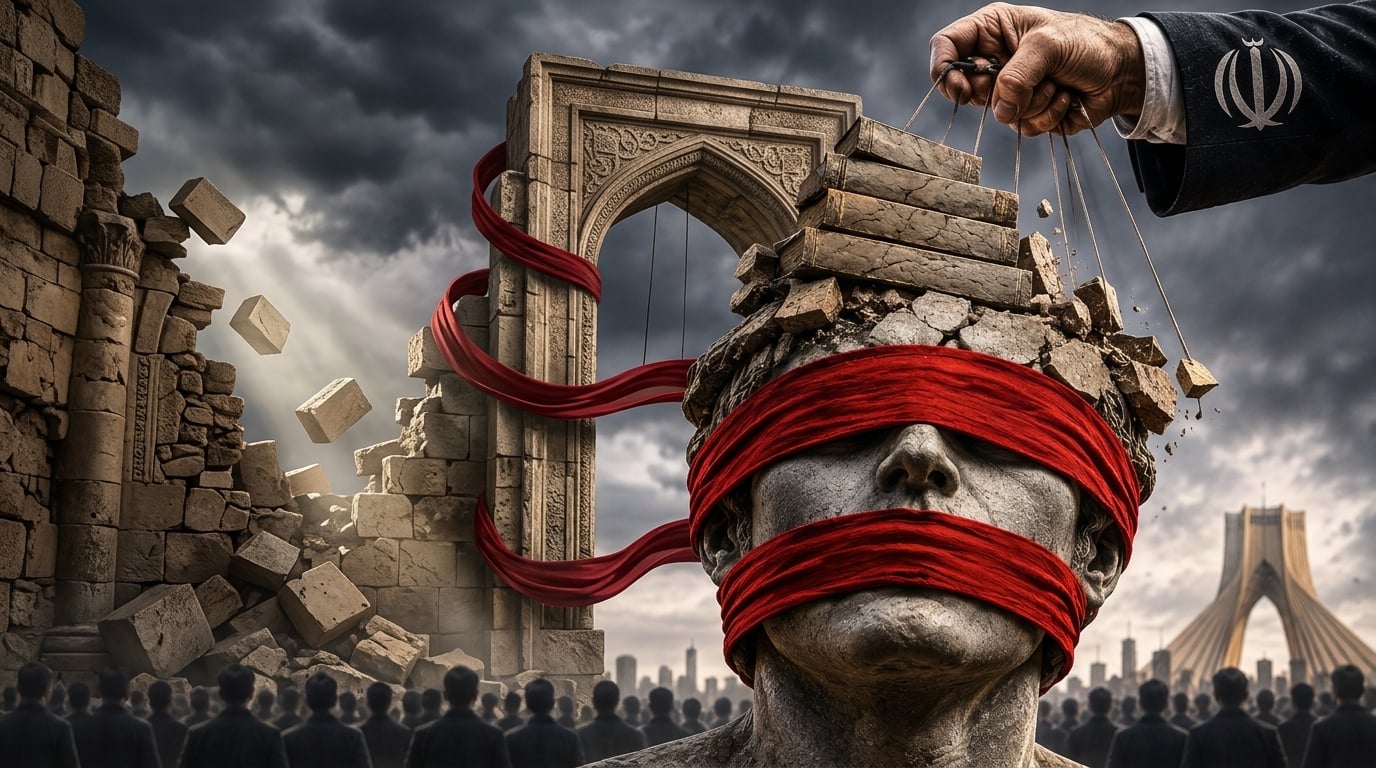
How do authoritarian regimes maintain power over time without relying solely on overt physical violence? Starting from a popular cultural summary of eight classic principles of mass control, this article examines the philosophical, psychological, and political science roots of authoritarian governance. By applying theories from thinkers such as Niccolò Machiavelli, Hannah Arendt, George Orwell, and Edward Bernays, the paper analyzes how these mechanisms—according to political scientists and critics—manifest within the power structure of the Islamic Republic of Iran.
1. Introduction: The Eight Principles of Psychological Control
In contemporary digital media, a stylized framework—often referred to as “The Eight-Page Handbook”—frequently circulates to illustrate how rulers govern populations through psychological and informational manipulation rather than force of arms alone. This model can be summarized into eight core principles:
- Creating an External or Internal Enemy (Scapegoating): Deflecting public discontent by directing collective anger toward a fabricated or exaggerated common enemy.
- Asymmetrical Resource Distribution: Depriving citizens of fundamental freedoms or economic resources, only to return a fraction of them later to appear as a generous benefactor.
- Systematic Repetition: Repeating a false or biased narrative relentlessly until it is accepted as an objective truth.
- Divide and Rule: Fragmenting society along social, ideological, or ethnic lines to prevent a unified opposition from emerging.
- Fear-Based Governance: Fostering existential fear (of war, chaos, or national collapse) so that citizens prioritize security over liberty.
- Distraction: Flooding the public sphere with superficial controversies and entertainment to divert attention away from structural issues.
- Control Over Language and Information: Monopolizing media channels and redefining the meaning of words to restrict what is possible to think and express.
- Normalization of Hopelessness: Cultivating a pervasive sense of apathy and isolation so that resistance appears futile before it even begins.
While this eight-point list represents a modern, pop-cultural synthesis, each individual mechanism is deeply anchored in established theories within political philosophy, sociology, and cognitive psychology.
2. Theoretical Framework: The Philosophy and Psychology of Power
Understanding how these mechanisms operate in practice requires grounding them in classical and modern analyses of power:
- Classical Statecraft (Machiavelli): In The Prince (1532), Niccolò Machiavelli outlined how a ruler best preserves power through a calculated balance of fear and strategic generosity. The ancient maxim divide et impera (divide and rule) serves here as a cornerstone for neutralizing internal threats before they coalesce.
- The Mechanisms of Totalitarianism (Arendt): In The Origins of Totalitarianism (1951), philosopher Hannah Arendt analyzed how authoritarian systems utilize ideological enemy images and the continuous rewriting of reality to atomize the individual. When the boundary between truth and falsehood is systematically eroded, a cynical apathy takes hold, causing citizens to abandon attempts to understand or alter their political reality.
- Linguistic Hegemony and Cognition (Orwell & Cognitive Psychology): George Orwell’s concept of Newspeak (1984) illustrates how state control over vocabulary restricts the capacity for critical thought. In modern cognitive psychology, this is complemented by research on the illusory truth effect (Hasher et al., 1977), which demonstrates that the brain’s processing fluency upon repeated exposure causes familiar statements to be automatically encoded as truthful, regardless of their factual validity.
- Mass Psychology and Media (Bernays & Chomsky): Edward Bernays (Propaganda, 1928) and later Noam Chomsky and Edward S. Herman (Manufacturing Consent, 1988) demonstrated how information ecosystems and emotional triggers—particularly fear—are engineered to manufacture consent and pacify the public.
3. Application: Authoritarian Governance in the Islamic Republic of Iran
Political scientists and Middle East scholars (such as Ervand Abrahamian and Mehrzad Boroujerdi) have noted in their analyses of post-1979 Iran how the ruling elite combines theocratic legitimacy with modern authoritarian survival strategies. The eight principles are clearly reflected in these scholarly assessments:
Enemy Images and the Politics of Fear (Principles 1 and 5)
A foundational pillar of Iranian state ideology is the continuous construction of external adversaries—primarily the United States (“The Great Satan”) and Israel—alongside internal “agitators” allegedly linked to foreign intelligence services. According to political analysts, this rhetoric serves a dual purpose: it deflects domestic criticism regarding economic mismanagement and corruption, while simultaneously activating a deep-seated fear of foreign invasion or civil war. By pointing to the instability in neighboring countries such as Syria and Iraq, the regime has historically marketed itself as the sole guarantor of national security and territorial integrity.
Information Monopoly, Repetition, and Linguistic Control (Principles 3 and 7)
The Islamic Republic of Iran Broadcasting (IRIB) holds a constitutional monopoly over domestic radio and television, which is reinforced by extensive internet censorship and the filtering of global digital platforms. Through this closed informational architecture, official state narratives are repeated incessantly. Simultaneously, a systematic linguistic redefinition occurs (reminiscent of Orwell): peaceful protesters are consistently labeled as ashoobgaran (“rioters” or “seditionists”), while violent state crackdowns are framed as “restoring order and safeguarding Islamic values.”
Divide and Rule and Economic Clientelism (Principles 2 and 4)
Iran is a multi-ethnic and deeply pluralistic society. Critics and researchers highlight that state authorities strategically exploit tensions between the Persian majority and ethnic minorities (such as Kurds, Balochis, and Arabs), as well as the cultural divide between secular urban populations and traditional, religious constituencies. Furthermore, through state subsidies and parastatal religious foundations (bonyads), the elite controls vast segments of the economy. When economic crises deepen—driven by international sanctions and domestic corruption—targeted cash handouts are distributed to loyalist demographics, fostering a cycle of dependency aligned with Machiavelli’s thesis of returning a fraction of what has been taken.
Distraction and Strategic Demoralization (Principles 6 and 8)
During periods of heightened social unrest, state-aligned media and coordinated cyber networks (often referred to as the “cyber army”) deploy disinformation and manufactured controversies to fracture and distract the opposition. The ultimate objective, echoing Hannah Arendt’s analysis, is to induce a state of learned helplessness. By convincing citizens that the opposition is hopelessly divided, that the international community is indifferent, and that the state’s surveillance apparatus is omnipotent, the regime seeks to extinguish the will to protest on a psychological level before it manifests in the streets.
4. Conclusion
The eight principles of the popular cultural “handbook” represent an accurate distillation of centuries of political philosophy and psychological research. The case of Iran illustrates how a modern authoritarian state does not rely exclusively on coercive instruments such as security forces and prisons, but wages a continuous campaign over its citizens’ perception of reality. By combining enemy construction, linguistic control, existential fear, and strategic demoralization, the ruling power attempts to render resistance unthinkable—or at least seemingly futile. However, as both Arendt and Orwell noted, this architecture of control carries an inherent vulnerability: the moment citizens see through the mechanics of the illusion, propaganda loses its coercive power.