London based entrepreneur, cybersecurity analyst doing a PhD in AI
The Invisible fabric holding humanity.
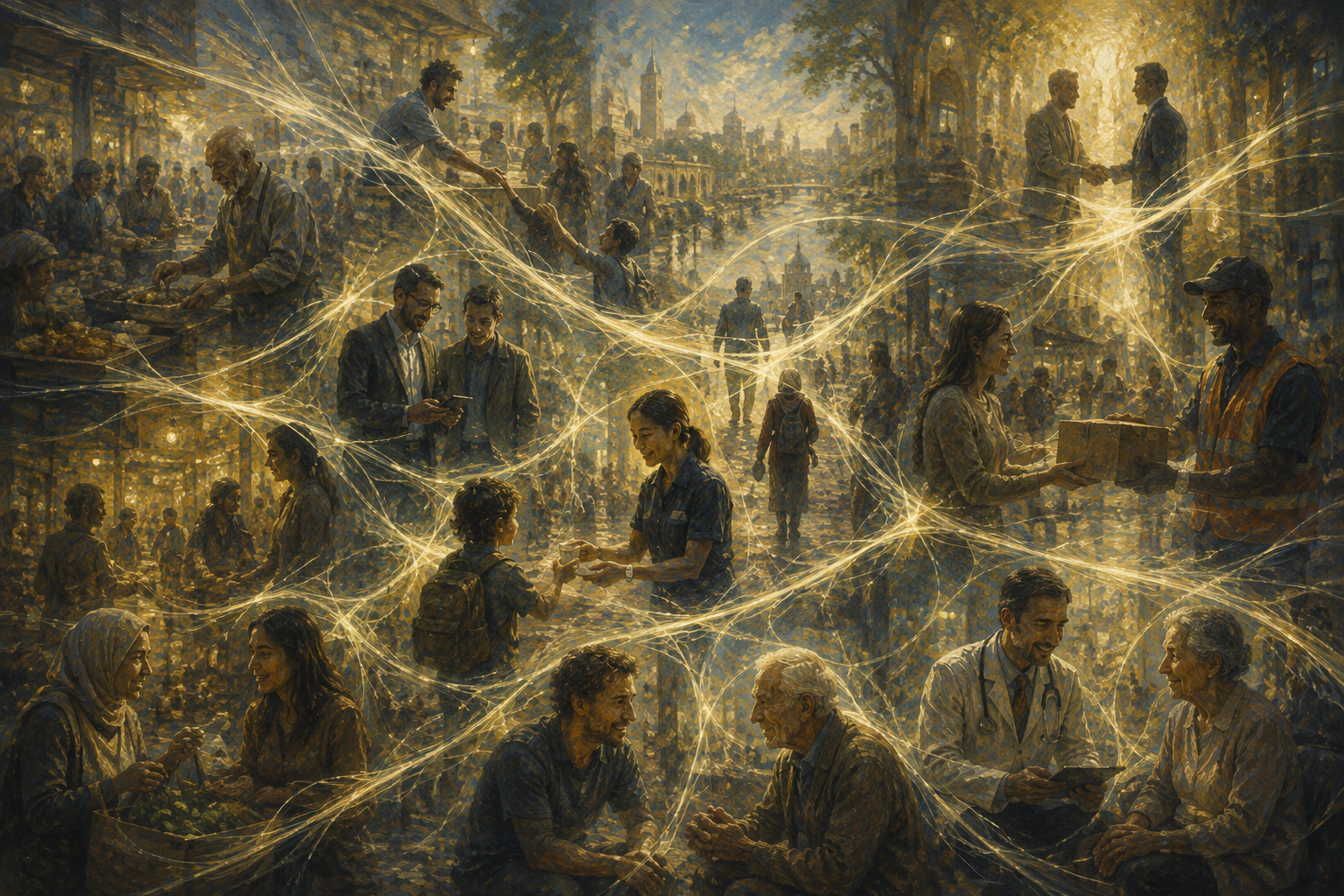
Civilisation is built from things we can see.
Roads. Houses. Hospitals. Schools. Markets. Courts. Governments. Families.
But underneath them is something we cannot see.
Trust.
You hand money to a shopkeeper because you trust that the product is what it claims to be. You enter an aircraft because you trust the engineers, pilots and regulators. You send your child to school because you trust the adults inside it. You sign a contract because you trust that words still mean something.
Remove trust and the visible structures remain.
But the society underneath them begins to fall apart.
Trust is the invisible thread in the fabric of humanity.
And perhaps two other threads run beside it:
compassion and mercy.
Trust makes cooperation possible
Human beings achieve extraordinary things because we cooperate with people we do not personally know.
The person who designed your phone probably never met the person who manufactured its processor. Neither knows the engineer maintaining the network carrying this sentence.
Yet their work fits together.
Modern civilisation is therefore an enormous network of distributed trust.
Economists and social scientists sometimes call part of this social capital: relationships, norms and trust that allow people to coordinate and cooperate.
Without it, everything becomes expensive.
Every transaction requires verification.
Every promise requires enforcement.
Every stranger becomes a possible threat.
Trust reduces that friction.
But trust is fragile.
One lie can damage years of credibility.
One corrupt institution can make people suspicious of an entire system.
One betrayal can alter how someone approaches every relationship afterwards.
Trust takes time to build and seconds to destroy.
The Qur’an begins with character
The Qur’an gives a beautiful description of the people associated with one of Allah’s Names: Ar-Raḥmān — The Most Merciful.
“The servants of the Most Merciful are those who walk on the earth humbly, and when the foolish address them improperly, they only respond with peace.”
— Qur’an 25:63
Notice where the description begins.
Not with power.
Not wealth.
Not intelligence.
Not status.
How they walk.
There is something profound about that.
Humility changes how we occupy space around other human beings.
The arrogant person enters every interaction asking:
How important am I here?
The humble person can ask:
What does this situation require from me?
That difference makes trust possible.
A society cannot remain cohesive if everybody must dominate everybody else.
Sometimes strength is simply the ability to walk gently.
Mercy changes the system
Then comes raḥmah — mercy.
The Prophet Muhammad ﷺ said:
“The merciful are shown mercy by the Most Merciful. Be merciful to those on the earth and the One above the heavens will have mercy upon you.”
— Jamiʿ at-Tirmidhi 1924 (Read the Full Hadith with exact wording here.)
Mercy is sometimes confused with weakness.
It is almost the opposite.
Mercy means possessing the ability to harm, punish, humiliate or ignore—and choosing a better response when justice permits it.
Parents need it.
Judges need it.
Employers need it.
Teachers need it.
Governments need it.
Even strangers need it from one another.
A purely transactional society asks:
What am I entitled to take?
A compassionate society also asks:
What does the other person need?
That additional question changes everything.
Compassion lets us cross distance
Compassion performs another function.
It allows one human being to imaginatively cross the distance between themselves and somebody else.
I am not hungry.
But you are.
My child is safe.
Yours is frightened.
I have somewhere to sleep tonight.
You do not.
Compassion says:
Your experience matters even though it is not happening to me.
That principle is essential to civilisation.
Without it, morality collapses into proximity.
We care only about our family.
Our tribe.
Our religion.
Our country.
Our suffering.
But human dignity cannot depend entirely on whether someone resembles us.
The Qur’an says:
“O humanity! Indeed, We created you from a male and a female, and made you into peoples and tribes so that you may know one another. Surely the most Noble amongst you in the sight of Allah are the most righteous amongst you. Allah is truly All Knowing All Aware.
— Qur’an 49:13 (Read the Full Ayat, here.)
Difference is therefore not necessarily a wall.
It can become an invitation:
know one another.
Then comes the rope
Human beings fragment easily.
Politics divides us.
Race divides us.
Class divides us.
Religion can be abused to divide us.
Even small disagreements can become identities.
The Qur’an gives a striking image:
And hold firmly together to the rope of Allah and do not be divided. Remember Allah’s favour upon you when you were enemies, then He united your hearts, so you—by His grace—became brothers. And you were at the brink of a fiery pit and He saved you from it. This is how Allah makes His revelations clear to you, so that you may be ˹rightly˺ guided.
— Qur’an 3:103 (Read the full Ayat here).
The wording is important. The verse says ḥabl Allāh — the rope of Allah; classical tafsīr includes interpretations connecting it with Allah’s covenant and the Qur’an, rather than simply wording the verse as “the Book of Allah.”
The metaphor is powerful.
Imagine people separated from one another, each pulling in a different direction.
Then give them one rope.
Suddenly cohesion becomes possible.
A society cannot remain united merely because politicians tell people to “come together.”
Unity requires something shared:
truth,
principles,
obligations,
justice,
and limits on what we are willing to do to one another.
Otherwise unity becomes a slogan.
Trust does not mean blindness
There is an important distinction.
Trust is not believing everything.
It is not abandoning verification.
It is not ignoring wrongdoing because maintaining harmony feels easier.
Real trust requires trustworthiness.
A trustworthy person keeps promises.
A trustworthy institution explains decisions.
A trustworthy government accepts scrutiny.
A trustworthy scientist shows evidence.
A trustworthy journalist corrects mistakes.
A trustworthy friend tells the truth even when the truth is uncomfortable.
Trust without accountability becomes gullibility.
Accountability without trust becomes permanent suspicion.
Healthy societies need both.
The fabric can tear
Imagine humanity as cloth.
Every person is a thread.
Families weave threads together.
Communities connect families.
Institutions connect communities.
Nations organise institutions.
But fabric survives only because individual threads remain connected.
Betrayal cuts them.
Dehumanisation cuts them.
Corruption cuts them.
Cruelty cuts them.
Lying cuts them.
Eventually enough threads break and something that looked strong begins to tear.
Repair therefore starts at a surprisingly human scale.
Keep your word.
Return what was entrusted to you.
Tell the truth.
Walk humbly.
Show mercy when you can.
Try to understand someone unlike yourself.
Judge fairly.
These actions appear small because they rarely make headlines.
But civilisation is mostly constructed from things that never make headlines.
What holds us together?
Perhaps humanity has spent too much time asking what makes us powerful.
Technology?
Money?
Military strength?
Artificial intelligence?
Institutions?
All matter.
But none can substitute for the invisible infrastructure beneath them.
A technologically advanced society without trust becomes frightened.
A wealthy society without compassion becomes cold.
A powerful society without mercy becomes dangerous.
The fabric requires all three.
Trust tells me your word has value.
Compassion tells me your suffering matters.
Mercy tells me that possessing power over you does not give me permission to forget your humanity.
And the Qur’an begins its portrait of the servants of Ar-Raḥmān with an extraordinarily quiet image:
They walk upon the earth humbly.
Perhaps holding humanity together begins there.
Not with everybody becoming identical.
Not with everybody agreeing.
But with enough people deciding that truth matters, promises matter, mercy matters, and the person standing opposite them still possesses dignity.
We rarely see the thread.
We notice it only when it breaks.
But trust, compassion and mercy may be precisely what keep the entire fabric from coming apart.
Footnote :- As again, I am not a religious scholar, refer to the correct theological position from people who have invested the required time to learn the Quran and become Hafiz, and Alim. Go to your local mosque and speak to the Imam for religious guidance. The ultimate guidance belongs to Allah, so ask him. As Allah says in the Quran :-
When My servants ask you ˹O Prophet˺ about Me: I am truly near. I respond to one’s prayer when they call upon Me. So let them respond ˹with obedience˺ to Me and believe in Me, perhaps they will be guided ˹to the Right Way˺. (Quran 2:186).
Any good in this article is from Allah, and any mistakes are my own. These are general “thought provoking” writings – exploring concepts which affect us all as a shared humanity, and should only be read as such. I am not a “bastion” of either religion, theology or morality, or qualified in Fiqh, Tafsir, Hadith – just another person on this forum sharing my views for public good. The amount of strife, bloodshed, warmongering is frankly “emotionally draining” and I believe the “majority” of people in the world would like our “elected leaders” to stop “showboating” – fix the economy, the environment, build civil infrastructure and let people “get on with their lives” and “build a better future”. If amongst all “elected leaders” – we have a handful of them working towards constructing peace rather than riling up “tribal loyalties” and championing “their people” – we could solve homelessness, world hunger, plastic pollution in the next 20-30 years I firmly believe. The world doesn’t have a “resource problem” – it has an “allocation problem” which comes from a “rotten mindset” which these articles aim to fix. 1/3rds of world food production is wasted every year – so why are people sleeping hungry?
Finally, I have no interest in “elected office” or becoming a “Imam” or “Mufti” – so if there are any mistakes I have made inadvertently, I sincerely apologise to everyone concerned reading and feel free to correct in comments for public good.
Related Topics