
Bridging faith. Defending truth. Confronting hate
The Iranian Revolution and the Politics of the End
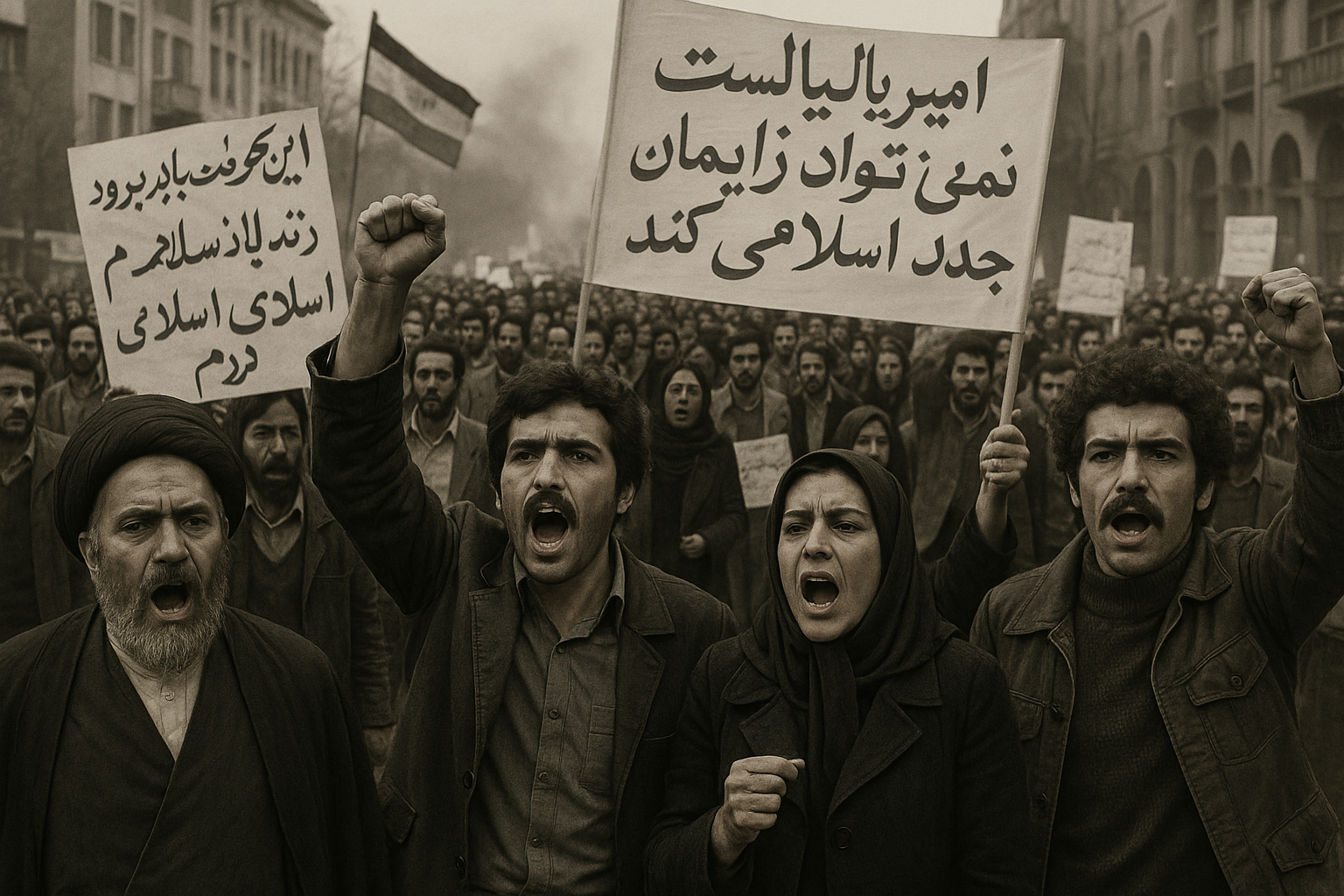
Image created by Tim Orr using GPT-5
This blog began as a reading of Abbas Amanat’s Apocalyptic Islam and Iranian Shi‘ism, but it became something more personal. Amanat’s study of faith and time enabled the interpretation of the Iranian Revolution as an element of a broader narrative commencing with loss and advancing toward redemption, rather than merely a political occurrence. The following is a contemplation of the rhythm of expectation that continues to influence Iran and, in more subdued ways, all of us, rather than a synopsis of his book.
A Revolution Written Before It Happened
The 1979 Iranian Revolution appeared to the majority of the world as the abrupt overthrow of a monarchy and the establishment of a theocracy. Amanat, however, challenges us to see things differently. Millions of Iranians saw the revolution as the realization of a promise that had been passed down through the generations, the telling of a pre-written tale. The street crowds were enacting a religious drama and demanding change. History no longer seemed neutral or random to them. It appeared as though time itself had awoken and was now imbued with divine intent.
Grief and hope have always coexisted in Shi‘i Islam. It communicates a profound awareness that the world is broken but not hopeless, from the belief in the Hidden Imam to Husayn‘s martyrdom at Karbala. The Imam’s absence is a sign of hope that injustice will be righted and not of emptiness. This idea turns hopelessness into guidance. To wait becomes a way of resisting corruption, a quiet but unshakable act of faith.
The Long Memory of Rebellion
Amanat shows that the theology of waiting in Shi‘ism never led to silence but became its reason for rebellion. In the early centuries of Islam, the Zaydi and Isma‘ili branches arose as movements against corrupt rulers, inspired not by ambition but by devotion. Both held to the doctrine of the Imamate, the belief that divine authority rightfully belongs to the Prophet’s descendants. They saw rebellion as an expression of faith rather than disobedience. To rise up meant to stand beside the Prophet’s grandson Husayn ibn Ali, who was killed for resisting oppression, and to remember the tragedy of Karbala. According to this view, revolution was not a break with faith but rather a continuation of it. Through rebellion, believers turned their sadness into strength and their memories into a reason to live. Over many generations, revolution became a way to be reborn and keep faith alive even when things were hard or people died.
One of Amanat’s most important insights is encapsulated in this passage: Shi‘i identity is based on a cycle of mourning and rebirth, where resistance is sown in remembrance. This tradition teaches that faith is movement, not stillness. It is the refusal to accept injustice as the final word, not retreat. The tragedy of Karbala becomes both a moral compass and a spiritual spark, transforming pain into a language of protest. By framing rebellion as devotion, Shi‘ism maintains a constant tension between fidelity to divine authority and opposition to temporal power. This tension keeps the tradition alive: it can serve the state and still challenge it, obey the law and still remember how to resist. In this way, faith is never static; it moves forward, turning suffering into strength and defeat into renewal. In Amanat’s telling, this restless faith explains why Shi‘ism could survive centuries of defeat and repression — because every loss was understood as a call to begin again.
The Safavids turned political power into religious power when they made Shi’ism the official religion. However, within the bounds of the law, that action maintained the protest spirit. The struggle between obedience and disobedience continued because the state-employed clergy continued to believe they were answerable to heaven. Even when Shi’ism was in power, it was unable to quell its restlessness. It had both the desire to rule and the desire to save, the need to keep things in order and the need to fight against it.
The Restless Cosmos
This restless faith was given a philosophical expression in the writings of Mulla Sadra during the Safavid era. Sadra taught that existence itself is never still, that everything in creation is in motion and returning continuously toward the divine. This idea, known as substantial motion, turns change and decay into sacred processes. Every loss carries the seed of rebirth, and every end is a hidden beginning. In this vision, life is dynamic and unfinished, its movement a kind of pilgrimage back to God.
Amanat argues that this philosophy became more than theology, it shaped the Iranian imagination. To see the world as an “unfinished road toward justice” is to believe that history itself is alive, always transforming, never resolved. This worldview offers a sense of endurance, where Iran’s struggles, collapses, and revivals all fit into a cosmic rhythm of decay and renewal. Hardship, in this sense, becomes meaningful, a sign that the divine plan is still unfolding.
The idea is both lovely and unsettling. If all life is in motion, then history cannot halt, and even corruption and collapse become part of the divine process, not its conclusion. What looks like ruin may be understood as purification. This gives Iranian culture its unusual resilience, the ability to absorb crisis and reinterpret it as renewal, but it also carries a cost. A nation that believes in endless rebirth may never find rest in the ordinary. The world, in this view, never truly ends. It simply changes shape as it searches for its source.
By the nineteenth century, that rhythm began to quicken. The belief in the Hidden Imam, the twelfth and final Imam in Shi‘i tradition, who is said to have withdrawn from the world and will one day return to establish justice — gained new intensity. Out of this expectation grew the Shaykhi and Babi movements that spread across Iran. These followers were not simply waiting for the end of the world, they were responding to a society that had lost its moral center. The idea of the Imam’s return offered a framework for renewal, a promise that the disorder of the age could be turned toward redemption. Their movements carried immense energy, even in defeat, as if failure itself confirmed the nearness of salvation.
When the clerical establishment suppressed these movements, it did not destroy their spirit. Instead, the ulama absorbed that revolutionary fervor and reshaped it into something quieter but more enduring. The same passion that once led to rebellion was turned inward and made into a discipline of faith. Amanat shows how strange and profound this transformation was. What had been despair became patience, waiting itself was redefined as a form of action. The faithful were taught that justice’s failure was not the end of hope but another sign that redemption was approaching.
Waiting was no longer passive in this vision. It evolved into a method of leading a purposeful life and getting ready for an ever-imminent but never fully realized future. Living faithfully meant pretending that history were always about to be revealed. Silently, the fire raged on, and patience became a spark. Even though it was invisible, the spirit’s revolution persisted, burning beneath the surface and sustaining the belief that renewal was unavoidable.
This ancient current entered the modern era with the arrival of Ayatollah Khomeini. According to Amanat, it was Khomeini who transformed apocalyptic faith into political rhetoric. Using cassette tapes and sermons, he persuaded Iranians who felt exiled in their own nation that their suffering was not in vain. He said it was proof that the world had reached its breaking point and that history itself was ready for judgment.
The revolution was not simply a struggle against tyranny, and its aftermath, found reckoning, Wilayat al-Faqih, which translates to “the guardianship of the jurist.” It provided structure to that belief after the fall of the Shah. According to this theory, which was most thoroughly developed by Ayatollah Khomeini, a competent Islamic jurist has the power to rule and protect society until the Imam returns if the Hidden Imam is not present. The new state would govern in the Imam’s absence, preparing the ground for his eventual return. Amanat calls this transformation “the bureaucratization of the apocalypse,” the moment when waiting became a political system. The apocalyptic imagination, once spiritual and expectant, was institutionalized. Every crisis, every decision, every act of survival was treated as a rehearsal for divine judgment. The end of the world had entered everyday life.
Living Inside Sacred Time
Amanat’s perspective is different from many other political or economic interpretations of the Iranian Revolution, as he concentrates on the spiritual structure of time and expectation within Shi‘i thought. Others like historians like Ervand Abrahamian, Nikki Keddie, and Asef Bayat highlight class conflict, modernization, or popular mobilization. His contribution is to show how ideas of waiting and redemption provided a durable emotional framework for political action. In doing so, he invites readers to see Iran’s revolution not only as a sociopolitical upheaval but as a chapter in a much longer religious narrative.
According to Amanat, Iran still adheres to this holy cadence. Its politics and imagination are still shaped by the language of endurance and struggle. The faithful and the corrupt, the oppressed and the haughty, make up the world. Every internal struggle and every encounter with the West naturally fit into a narrative that dates back hundreds of years. For many Iranians, the apocalypse is not an event to come but a condition of the present, a pattern that repeats through every era.
This belief gives suffering a kind of dignity. It transforms pain into meaning and loss into proof. Every defeat becomes a test, every victory a sign of divine favor. Yet this faith can also be perilous. When politics takes on sacred weight, compromise begins to feel like betrayal. A nation that lives for redemption can lose sight of the present, unable to rest in the ordinary or accept a world that is simply imperfect. It must always remain alert, ready for both hope and crisis, waiting for the world to become whole.
The Endless Threshold
The Islamic Republic exists within that tension. It must continue to promise salvation without ever fulfilling it. It must constantly move and strive for an unachievable goal in order to survive. Its fragility and strength stem from this. The revolution is poised between God’s promise and human limitations, between prophecy and power. It endures by keeping the future unresolved, by living inside a story that never concludes.
According to Amanat, this is design rather than failure. Since the goal of the revolution is to maintain belief rather than to fully establish it, it was never intended to end. It is an expectation-based system, a faith that demands waiting in order to survive. Beneath the institutions and the machinery of the modern state, there still beats the slow, steady pulse of sacred time, a rhythm of anticipation that keeps history open.
What Waiting Means
According to Amanat, this is design rather than failure. Since the goal of the revolution is to maintain belief rather than to fully establish it, it was never intended to end. It is an expectation-based system, a faith that demands waiting in order to survive. The slow, steady pulse of sacred time, a rhythm of expectation that keeps history open, continues to beat beneath the apparatus and institutions of the contemporary state.
The power of waiting itself is what I remember most from reading Amanat. According to him, waiting is a sign of strength rather than weakness and a means of holding the world responsible for the justice it has yet to attain. Living as though redemption is still possible, even when it seems far off, is what it means to wait with faith. It is an assertion that history is not yet complete and a rejection of hopelessness.
This view holds that the Iranian Revolution was never merely a political occurrence. It served as a reminder of how a people can turn hardship into meaning and hope into tenacity, as well as the revival of an old story that had never truly died. This story speaks to a universal human need—the belief that even the most tragic pasts have meaning—despite its Iranian historical roots. Living as though redemption is still possible while waiting with faith is a silent act of defiance against hopelessness. However, Amanat’s vision raises an unanswered question: can a people ever stop waiting, or does faith’s perseverance always have to come at the expense of relaxation? Maybe, if we are lucky, the old vision will give way to something new.
Works Cited
Amanat, Abbas. Apocalyptic Islam and Iranian Shi‘ism. New Haven: Yale University Press, 2017. Kindle Edition.
Related Topics