


Critiquing Ireland's "anti-Zionist" mindset
The Irish / Palestinian political revolutionary romance.
Rising of the Sinn Feiners in Ireland. O’Connell bridge with Dublin city, 1916 (public domain)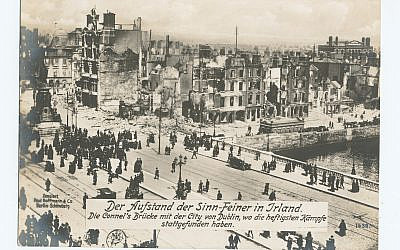
Ireland’s False Parallels with Palestine
Ireland’s sympathy for the Palestinian cause has become almost instinctive, repeated so often that it now passes for common sense. Yet beneath the surface lies a troubling mix of historical misremembering, political romanticism, and cultural appropriation that deserves a closer look.
For many Irish people, Palestine is seen through the lens of Ireland’s own colonial past. From the Great Famine to the Easter Rising of 1916, we remember what it meant to live under occupation and to struggle for self-determination. It is not surprising, then, that our hearts lean toward those we perceive as oppressed. But memory can also mislead.
The parallels often drawn between 1916 Dublin and Gaza today are more convenient than accurate. The Irish Volunteers fought openly and directly. They did not build tunnels under the streets, store weapons in schools or hospitals, or use civilians as shields. They wore their uniforms and showed their faces. Hamas does not. To equate the two is not solidarity but distortion, and it diminishes our own history by forcing it into someone else’s narrative.
Politics explains much of the rest. From Sinn Féin’s rhetoric to student and trade unions, Palestine has become a badge of left-wing identity and a way to differentiate Ireland from Anglo-American foreign policy. To many, criticism of Israel is not only about the Middle East — it is also about who we are, and who we are not. It provides a stage on which Ireland asserts independence of voice, even when that voice risks oversimplification.
Cultural Appropriation by Pro-Palestinian Activists
But what is harder to excuse is the recent trend of cultural appropriation. The Ireland-Palestine Solidarity Campaign (IPSC) has co-opted Valentine’s Day, distributing cards to TDs with the slogan “A Valentine for Palestine.” It is highly misappropriate to have a Gaza label attached to such a western romantic cultural event. In fact Valentine’s Day is actively “discouraged” by many Muslim clerics. Do those fundamentalist Islamic clerics “approve” of such cultural appropriation to “promote” Palestine?
The IPSC has also set its appropriation publicity sights on Ireland’s most recognisable national emblem: the shamrock of St. Patrick. According to Christian legend, St. Patrick used the shamrock, a small three-leafed plant, as a teaching tool. He showed that, just as the shamrock has three distinct leaves but one stem, the Christian God has three persons (Father, Son, Holy Spirit) but is one God.
For generations, the shamrock has stood as a unifying symbol of Irishness, instantly recognisable at home and abroad. To now rebrand it as a black emblem for a partisan campaign is more than clever marketing. It risks hollowing out the shamrock’s shared meaning, turning what was once a symbol of identity into a prop for propaganda.
Symbols Shape How We See Ourselves
This matters, because symbols shape how we see ourselves and how others see us. Ireland has long been proud of its reputation as a nation of fairness, hospitality, and empathy for the underdog. But empathy without discernment can be dangerous. When our symbols are enlisted to tell someone else’s story, we risk losing sight of our own.
There is also the question of balance. Ireland has been quick to criticise Israel — sometimes in strikingly moralistic terms — but slower to confront the darker realities of Hamas: the targeting of civilians, the glorification of violence, the suppression of dissent within Gaza itself. To remain silent about these realities while amplifying simplistic slogans is not moral leadership. It is selective outrage.
Here lies a challenge for Ireland’s civic and cultural leaders. Will they allow the shamrock to be stripped of its unifying power, or will they speak out against its misuse? In an era when symbols carry extraordinary weight, silence risks surrendering something truly ours to someone else’s agenda.
Ireland’s empathy for others should remain strong. But empathy must not blind us to false parallels, nor should it allow our heritage to be exploited.
The shamrock belongs to Ireland — not to pro Palestinian politics.
___________________________________________________________________
Saint Patrick and shamrock background https://en.wikipedia.org/wiki/Saint_Patrick