


Middle East Forum Fellow/North Africa Risk Consultant
Featured Post
The Israel of North Africa just declared independence – the West can’t ignore it
The newly-proclaimed Republic of Kabylia is an indigenous nation that survived centuries of Arab-Islamic conquest, preserving their language and identity against all odds
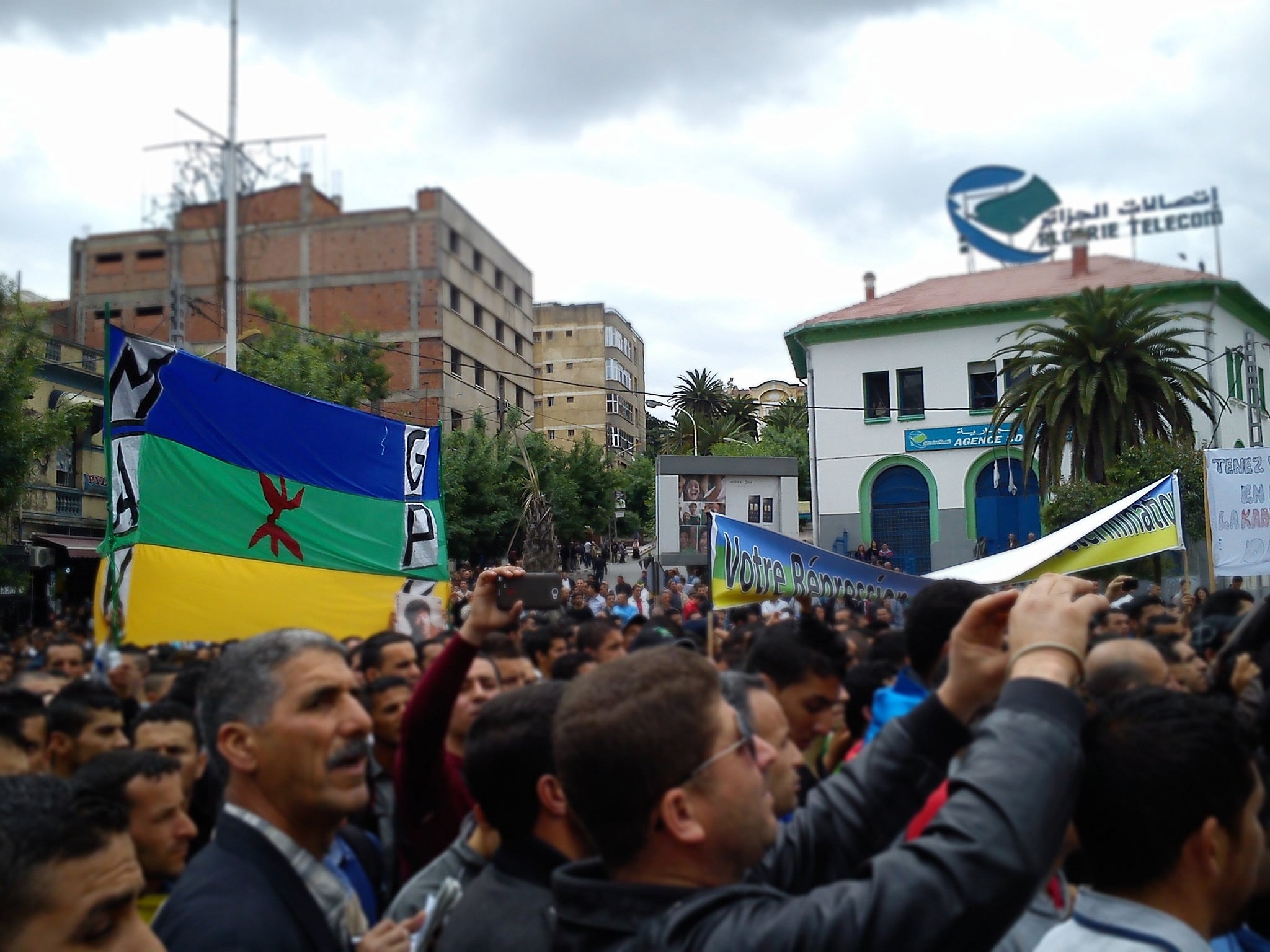
Demonstration by Kabyles in 2014 (Wikimedia)
On December 14, 2025, in the shadow of the Arc de Triomphe in Paris, a geopolitical earthquake struck the Mediterranean. It wasn’t a terrorist attack or a coup d’état, but an act of supreme democratic defiance. The Movement for the Self-Determination of Kabylia (MAK), led by President Ferhat Mehenni, formally proclaimed the birth of the Federal Republic of Kabylia.
While the mainstream media slept, or worse, looked away to appease the gas-rich junta in Algiers, a new nation was born—one that is unabashedly secular, pro-Western, and eager to join the community of free nations. For the United States, Israel, and Morocco, this is not just a niche ethnic grievance; it is the strategic miracle we have been waiting for.
The ‘anti-Algeria’: A strategic asset for America
To understand why Kabylia matters, you must understand what it is fighting against. The current Algerian regime is not merely a dictatorship; it is a forward operating base for America’s enemies. Algiers has transformed itself into a Mediterranean outpost for the Kremlin, becoming the first international client to deploy Russian Su-57 stealth fighters—weapons designed solely to challenge NATO and US naval dominance.
While Washington looks for reliable partners, Algiers opens its arms to the Wagner Group (now Africa Corps) to destabilize the Sahel. In stark contrast, the newly proclaimed Kabyle Republic offers a foothold of stability. The Kabyle constitution explicitly forbids foreign religious funding, insulating the state from the Islamist radicalism that plagues the region. An independent Kabylia, controlling the critical oil terminal of Bejaia, would break the Russian-backed junta’s energy blackmail over Europe.
Marco Rubio has rightly flagged the danger of Algeria’s unchecked militarization. A free Kabylia is the ultimate check on that threat—a democratic wedge driven deep into the heart of the Russia-Iran axis in North Africa.
The Israel of the Maghreb
The parallels between Kabylia and Israel are hauntingly precise. Like the Jewish people, the Kabyles are an indigenous nation that has survived centuries of Arab-Islamic conquest, preserving their language, culture, and identity against all odds. It is no coincidence that Israeli parliamentarians were present at the Paris ceremony, standing shoulder to shoulder with Kabyle leaders.
The Kabyle independence movement views Israel not as an enemy, but as a model of indigenous resilience. In a region drowning in virulent anti-Zionism—where the Algerian regime champions Hamas and criminalizes contact with Israelis—Kabylia stands apart as a beacon of reason. Ferhat Mehenni has visited Jerusalem and speaks of a shared destiny.
For Israel, supporting Kabylia is the revitalization of the “Periphery Doctrine.” It is an opportunity to cultivate an ally that shares its values and its enemies. If Israel is the lone democracy in the Middle East, Kabylia is poised to become the lone secular democracy in the Maghreb.
Morocco’s vindication and the end of hypocrisy
For decades, the Kingdom of Morocco has been the region’s only reliable pro-American hegemony, despite facing relentless aggression from Algiers via the Polisario Front separatist group. The proclamation of Kabyle independence exposes the Algerian regime’s terminal hypocrisy.
Algiers spends billions arming separatists to partition Morocco in the name of “self-determination,” yet brutally crushes the peaceful, democratic aspirations of the 9 million Kabyles within its own borders. You cannot demand independence for a phantom state in the Sahara while imprisoning a real nation in the mountains.
Morocco understands that a free Kabylia is a friendly neighbor, not a threat. It represents the dismantling of the hostile military state that has held the Maghreb hostage for sixty years.
The choice for the West
The December 14 declaration was originally banned from the Palais des Congrès in Versailles due to Algerian pressure—a shameful capitulation by French authorities. But the event went ahead, defiant and dignified.
The West faces a binary choice. We can continue to prop up a decaying, gerontocratic Algerian regime that buys Russian jets, funds anti-Western sentiment, and exports instability. Or, we can support the Federal Republic of Kabylia: a nation that writes women’s equality into its constitution, sings its anthem alongside Israeli allies and looks to Washington, not Moscow, for its future.
History has been written in Paris. It’s time for Washington and Jerusalem to read it. The map of North Africa is changing, and for once, it is changing in the West’s favor.
Related Topics
Related Posts

