
Writing as P. Mordechai on Faith and Israel
The Israeli Magic Wand Theory of Technology
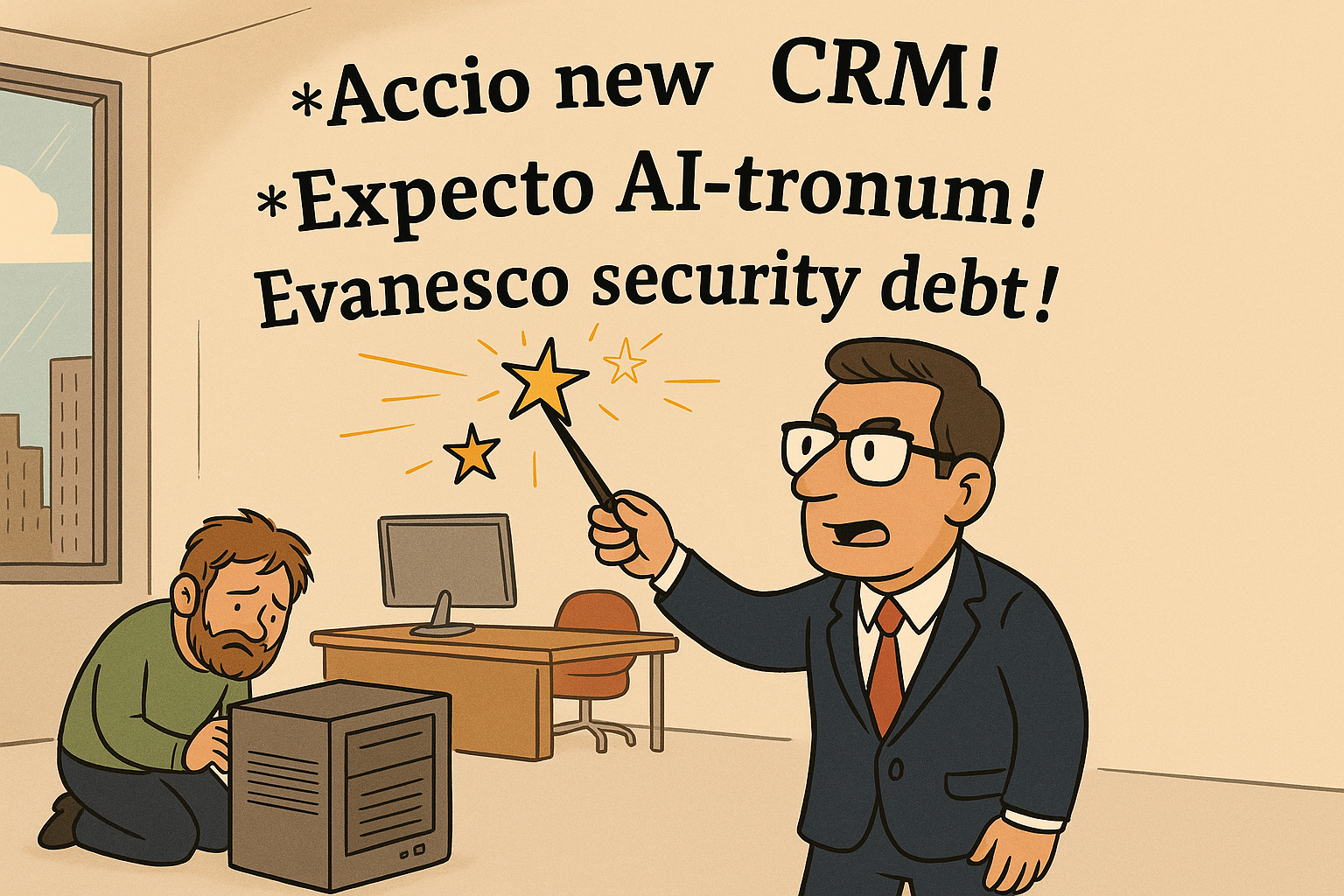
When your CEO thinks you're Gandalf with a keyboard. (Cartoon created with the assistance of ChatGPT.)
Executives love technology.
Not the real stuff, the sweaty, cable-infested beast that lives in a room no one enters willingly. I’m talking about Technology™, the kind that appears in a keynote surrounded by fog machines and synth music, causing a CEO to whisper:
“Why can’t we do that by next Tuesday?”
This is how the Magic Wand Syndrome begins.
The Great Illusion
In every company, at least once a quarter, the CEO sees a shiny dashboard at a conference and returns absolutely convinced the CTO is hiding a magic staff somewhere between the dev environment and the espresso machine.
Suddenly everything becomes a spell:
– Accio new CRM!
– Expecto AI-tronum!
– Evanesco security debt!
Meanwhile, IT is in the back, kneeling over a server from 2008 like it’s an archaeological artifact:
“Don’t touch it.”
“Don’t breathe on it.”
“Don’t even look at it.”
But the CEO, inflated with equal parts optimism and jet lag, insists this is the moment.
This is the transformation.
This is the dawn of a new digital era.
What they don’t realize is that any system that looks effortless on the outside is usually maintained by exhausted adults stitching together twenty years of technical decisions made by people who have since retired, moved abroad, or taken up organic beekeeping.
The Israeli Edition: Miracles as Milestones
Here in Israel, we’ve upgraded the fantasy.
We’ve all seen the impossible done:
A team deploys a hotfix in the middle of reserve duty.
Someone patches production during a siren.
Three engineers resurrect a dying system with nothing but Turkish coffee and trauma bonding.
It’s inspiring.
It’s also dangerous.
Because once you’ve seen miracles, you start expecting them.
And that’s how you get the national catchphrase of Israeli tech:
“Last time we built an MVP during a war, so obviously this global migration will be ready by Tuesday.”
We are a people who have lived through both the Red Sea and the Windows XP era.
Hope is our national superpower.
But even Nachshon didn’t walk into the sea because management set an impossible deadline.
The Conference Effect (Also Known as: “We Are Behind!”)
If you’ve ever worked in tech, you know the most dangerous moment in the corporate calendar is when the CEO returns from a conference.
There is something about being exposed to inspirational lighting, unlimited cappuccinos, and a keynote involving holograms that convinces otherwise reasonable adults that transformation is a matter of enthusiasm.
By the time the CEO lands back in Ben Gurion, they’ve experienced a spiritual awakening:
“We must innovate. We must be bold. Why can’t we do what that 27-year-old unicorn founder did?”
Nobody mentions that the unicorn founder’s entire stack consists of two microservices, an optimistic intern, and a dog named Pixel who guards the GitHub account.
Back home an emergency meeting is called.
Everyone with “cloud,” “data,” or “engineering” in their job title is summoned.
Visions are shared.
Timelines are promised.
Budgets are kept secret because hope is free.
It’s the closest thing Israeli tech has to a religious revival.
What IT Actually Looks Like (Behind the Curtain)
Behind the scenes, the real work is far less cinematic.
Technology is not magic.
It’s engineering.
It’s architecture diagrams, documentation, QA, backups, code reviews, security audits, and the collective trauma of accidentally deleting the production database that one time.
It’s discovering that your most critical business workflow is held together by a script named final_final_really_final_v3.py.
It’s realizing your expensive AI initiative can’t proceed because nobody can explain where half the customer data is stored or why the other half is formatted like someone sneezed into an Excel sheet.
When those things are neglected?
You don’t get a miracle.
You get an outage.
Usually at 3 a.m.
Usually when the CEO is on stage saying the word “robust.”
The cruel irony is that when you treat IT like sorcery, the results become unpredictable. When you treat it like engineering, the results often look magical.
Why the Magic Wand Lives On
If this syndrome were purely delusional, it would be easy to fix. But it persists for a simple reason:
Sometimes, the wand works.
Some Israeli teams really do pull off miracles.
Some engineers really can conjure solutions out of thin air.
Some tech groups deliver under impossible conditions.
And once a miracle happens once…
it becomes an expectation.
Then a precedent.
Then a KPI.
Suddenly the miracle is no longer an exception — it’s the plan.
From there, the logic becomes unstoppable:
“If we delivered that insane thing last quarter, why can’t we deliver this slightly different insane thing this quarter?”
Because last quarter was fueled by adrenaline, caffeine, and national existential dread.
Not a sustainable methodology.
The Twist
Every organization eventually reaches a crossroads:
– Double down on the wand
– Or invest in the foundation
The first path gives you drama, panic, heroics, burnout, and very interesting WhatsApp groups.
The second gives you systems that quietly, reliably work.
And nothing, absolutely nothing, looks more like magic to an executive than a system that simply works.
A miracle that arrives because you prepared for it is still a miracle.
It’s just one you can repeat.
—
This piece is adapted from Book 1 of my “Fire of Success” micro-series. Follow my TOI blog for upcoming installments.
Related Topics
Related Posts