The Jester Who Mocked Death
In the Warsaw Ghetto, one man chose to laugh
In the Warsaw Ghetto, where nearly 400,000 Jews were packed into 1.3 square miles, where the official ration was 184 calories a day, where bodies lay in the streets each morning waiting to be collected—
there was a man who made people laugh.
Nobody knew his first name.
Some said Moishele.
Others said Itzik.
Most didn’t care.
They called him Rubinstein.
In a place built to erase individuality, one man made himself impossible to ignore.
He was said to be a refugee from Łódź. Nothing else about his earlier life survived. Whatever he had been—a father, a tradesman, a scholar—was erased.
In the ghetto, he became something else.
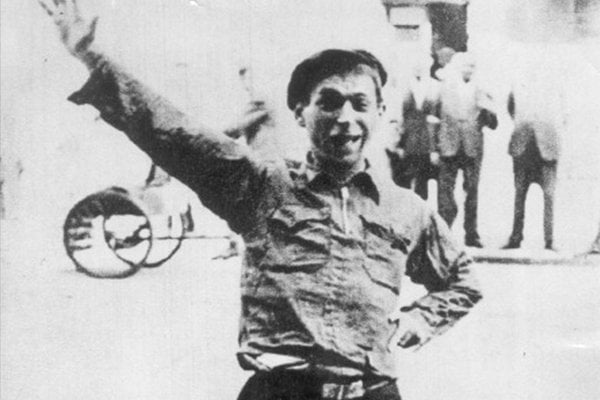
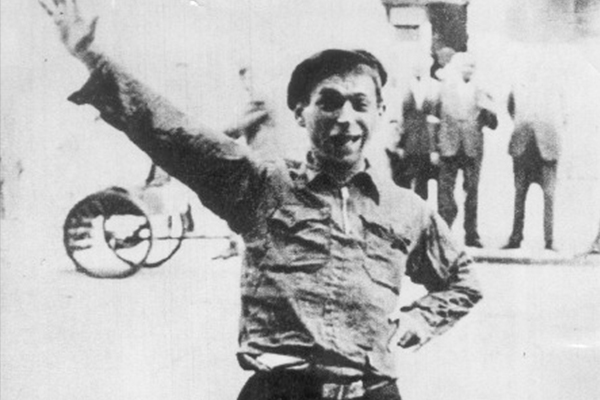
He roamed the streets in 1941 and 1942, dancing, leaping, sometimes climbing onto carts piled with the dead. He shouted jokes in every direction, demanded payment from passersby, mocked everyone equally.
A village idiot.
A trickster.
The ghetto’s street clown.
His phrases spread quickly. People repeated them. They entered the shared language of life behind the walls.
One line above all:
Alle gleich—urm un reich.
All are equal—poor and rich.
The Phrase That Named Their Pain
On the surface, it sounded like social satire: money no longer mattered when everyone was starving.
But it cut deeper.
Shortly after the ghetto was sealed, the diarist Chaim Kaplan stood on a balcony and looked down at the streets. He wrote of a sea of heads, of bodies packed together like birds in a cage, all dressed alike, all marked by the same sadness.
Rubinstein’s phrase captured what people felt but did not say aloud:
They were becoming indistinguishable.
Equality was not liberation.
It was erasure.
They were no longer seen as individuals.
Eventually, many stopped seeing themselves that way too.
Rubinstein named that loss—crudely, humorously, in public.
A Child Watching
My mother-in-law Edna was seven years old when Rubinstein was at his peak.
She was one of nearly 100,000 children trapped inside the ghetto.
She would have seen him: this strange, ragged man dancing through streets lined with the starving and the dead, joking as the world collapsed.
What would a child have made of him?
A lunatic?
A clown?
A prophet?
Perhaps all three.
Children in the ghetto learned early that madness and wisdom could look the same.
The Performance
Rubinstein’s body was weary and leaden, but his mouth never stopped. Sometimes he performed something like stand-up comedy. Other times his acts veered into drag.
One witness recalled him wearing women’s clothing, explaining that since he had no wife, he had to be his own. On other days he appeared in a bathing suit, or with a tail pinned to his back.
He targeted everyone—especially those who still had enough to eat.
He mocked the Jewish police.
The wealthy.
The Judenrat officials who believed cooperation might save them.
He even provoked the German guards, who tolerated him like feudal lords once tolerated court jesters.
When charm failed, he threatened. When threats failed, he begged.
He never registered with the ghetto authorities. Never applied for ration cards. According to Władysław Szpilman, Rubinstein ignored the curfew and wandered the streets at night, living like the child beggars—entirely outside the system.
He survived on scraps, coins, and sometimes tips from amused German soldiers.
They mistook him for harmless.
Among the Dead
Each morning, carts moved through the ghetto to collect the bodies.
Rubinstein sometimes climbed onto them.
He talked to the corpses.
Joked with them.
Treated them as if they were still alive—still part of the community.
In a world where the dead were meant to disappear, he insisted they be seen.
In a place where death had become ordinary, Rubinstein refused to let it become invisible.
His “madness” functioned as a daily, public memorial.
He behaved as if the boundary between the living and the dead were temporary.
In the ghetto, he may have been right.
Two Acts of Defiance
Edna was one of the children who ignored the curfew.
During the same months Rubinstein performed in the streets, she smuggled food through holes in the wall—slipping past guards at night, carrying potatoes that might keep her family alive another day.
A child with stolen food.
A grown man with a tail pinned to his back, joking on death carts.
Two responses to the same impossible reality.
Resistance did not always look heroic.
Sometimes it looked absurd. Sometimes it looked small.
The End
Rubinstein disappeared in 1942, during the great deportations to Treblinka.
Accounts of his end conflict. One says he walked to the Umschlagplatz laughing, performing until the last moment. Another says he screamed and begged for his life.
I prefer not to choose.
A man can tell the truth and still be afraid.
A jester can mock death and still not want to die.
The Legend
Rubinstein appears again and again in survivor testimony—in diaries, in postwar novels, in memory.
The fool who told the truth when others could not.
When Edna told me her stories, she never mentioned him by name. But she remembered the hunger. The fear. The bodies in the streets. She remembered what survival required.
Maybe she saw him and forgot.
Maybe she saw him and never knew who he was.
Maybe he was just one more strange figure in a world gone mad.
But I think of him now when I think of her.
One chose laughter.
One chose endurance.
Both refused to disappear quietly.
The Nazis planned for obedience.
They did not plan for refusal in this many forms.
Alle gleich—urm un reich.
All are equal—poor and rich.
Almost everyone in the ghetto died the same death.
But not Edna.
She got out. She survived. She built a life, a family, a future.
Rubinstein gave people a moment of laughter in hell.
Edna gave us generations.
Both are victories the Nazis never anticipated.
Janet Bond Brill, PhD, is the author of Little Edna’s War, based on her mother-in-law’s Holocaust testimony, published on January 27, 2026, on International Holocaust Remembrance Day. Order Now