
The Jewish Exception: The Experience of a Minority in British Society
British Jews have become accustomed to being told not to worry, that they are exaggerating or even fabricating threats against them. Every time a synagogue installs additional security measures, every time a Jewish school raises its perimeter fences, every time Jewish families quietly discuss whether it is wise to wear visible symbols of their identity in public, they are questioned about whether concerns are exaggerated. But recent attacks on the Jewish community have shown otherwise; daily there is news of varying degrees of hostility, from ambulances being blown up to children being abused on buses.
A recent controversy surrounding the National Association of Muslim Police has raised questions about how institutions engage with identity-based advocacy. An organization that should be concerned with protecting the rights of its members spent a significant portion of its policy document on challenging anti-Muslim hatred revising history, reinterpreting words such as antisemitism and Zionism, and trying to disassociate Islamists’ use of Islamic doctrine as the motivation for their terrorism. Falsification will not meet the challenge of the justifiable concerns of those at risk of being victims of anti-Muslim hatred.
It can even be seen in judicial decisions. An Employment Tribunal decision that antizionism is a ‘protected belief’ in relation to the Equality Act 2010 is currently being appealed. That decision gave antizionism the same protections as ethical veganism, pacifism and environmentalism.
The Green Party provides another focus for Jewish concerns. Campaigns continue to try to revive the slogan “Zionism is racism” as party policy, despite the fact that most Jews regard Zionism not as an abstract political ideology but as the belief that the Jewish people possess the same right to national self-determination as any other people. When Zack Polanski, Green Leader, was criticized for wearing a T-shirt in support of Marwan Barghouti, a man convicted of killing five people and the mastermind behind numerous terrorist attacks against Israelis, Polanski doubled down on his support for the divisive figure, making astounding comparisons to Nelson Mandela with a false quote from the now deceased statesman. All the while, Polanski has given public support to identifying and investigating British citizens who have served in the Israel Defense Forces upon their return to the United Kingdom. Defending this as an accountability initiative, Jews cannot help but notice that similar campaigns are rarely directed towards Britons who have served in other foreign militaries or participated in other overseas conflicts.
The question naturally arises: why this particular group? The answer may lie in what has become the defining feature of contemporary attitudes towards Jews in Britain: the emergence of what might be called the Jewish exception, a strange inversion of the allegation of Jewish supremacy so prevalent in antizionist circles.
Liberal democracies are founded upon the principle that individuals should be judged as individuals. We do not normally divide minorities into categories of acceptable and unacceptable according to whether they abandon central elements of their identity. We do not require Sikhs to renounce Sikhism before participating in public life. We do not demand that Muslims reject the existence of Muslim-majority nations. We do not insist that Ukrainians abandon support for Ukrainian nationhood.
Yet increasingly, Jews appear to face precisely such a test. Based not on their actions, but on the fact that they are Zionists, a fundamental part of their identity. Zionism is simply the belief that the Jewish people possess the right to self-determination in their ancestral homeland. This belief is strengthened by the evident centuries of persecution in exile from that very land. One can criticize Israeli governments, oppose military actions, reject settlement policies and support a Palestinian state while remaining a Zionist. Indeed, many Jews do exactly that. Yet within sections of contemporary political culture, Zionism has been transformed from a national movement into a moral offense.
The result is an unspoken litmus test, the Jewish exception. The “good Jew” is the Jew who publicly distances himself from Zionism, condemns Israel in sufficiently strong terms and demonstrates that his Jewish identity is detached from Jewish national aspirations. The “bad Jew” is the Jew who believes that the Jewish people possess the same right to national self-determination that is routinely afforded to every other nation on earth.
This distinction of good and bad is not merely political; it is made into a divide of morality. It determines who is welcomed in the arts, which goods are permitted, who is allowed into activist spaces, whose concerns are taken seriously, whose experiences of antisemitism are believed and whose fears are dismissed. And when the attacks on Jews have come in recent months, victims have not been asked if they are Zionist or not; rather, they have focused on those who are visibly Jewish.
The irony of this test is obvious. Many of those who apply this standard would be horrified if it were imposed upon any other minority group. A Palestinian would not be expected to renounce Palestinian nationalism before discussing racism; rather, the movement is based on that same nationalism. An Irish person would not be required to abandon Irish nationhood before their views were considered legitimate. A Ukrainian would not be expected to reject the existence of Ukraine before their concerns were heard.
British Jews find themselves repeatedly asked to explain Israel’s military actions, justify Zionism, condemn Israeli politicians or account for decisions taken by governments in Jerusalem over which they have no control. Ordinary Jews find themselves drawn into political interrogations that would be considered inappropriate if directed towards almost any other minority community. No one would consider asking a Palestinian to disavow their desire for a Palestinian state before allowing them to perform a comedy show or film a movie.
This double standard transforms Jewish identity into a political test.
Indeed, the phenomenon is remarkably well captured by the 3D test of antisemitism developed by Natan Sharansky. The test suggests that criticism of Israel may cross the line into antisemitism when it involves demonization, delegitimization or double standards. Few Jews believe Israel should be immune from criticism. Democratic societies depend upon robust debate, and Israeli governments should be scrutinized just as any other government is scrutinized. The issue is not criticism. The issue is consistency.
When Zionism alone is treated as uniquely illegitimate among national movements, that is delegitimization. When Israel is portrayed not merely as flawed but as uniquely evil, that is demonization. When Jews are expected to justify the actions of Israel while no equivalent expectations are imposed upon other communities, that is a double standard. The significance of the 3D test is not that it resolves every disagreement. It is that it helps explain why rhetoric that appears political to some is experienced as deeply hostile by many Jews.
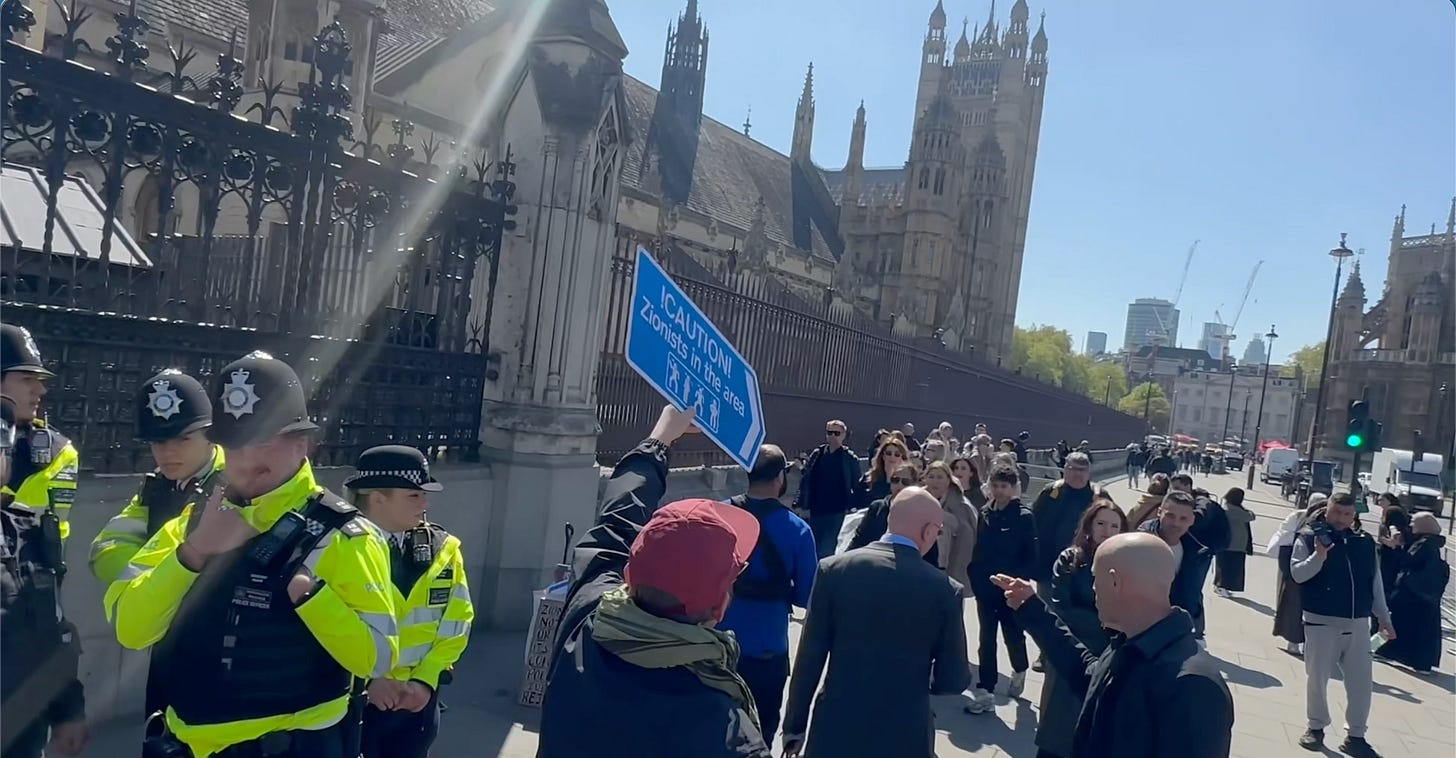
At the same time, Jews are hearing increasingly aggressive rhetoric on Britain’s streets. Week after week, demonstrators chant “Zionism is a crime” and “Zionists are not welcome here”, whilst celebrating “resistance” and endorsing “resistance by any means”. Defenders of such language often argue that resistance can include lawful protest, civil disobedience and political activism. Yet many Jews hear something altogether different with the declarations that exclude them from civil life.
The difficulty is that the organizations most commonly described as the Palestinian “resistance” include Hamas, Palestinian Islamic Jihad and other armed groups whose methods have included suicide bombings, kidnappings, rocket attacks and the deliberate murder of civilians. When activists speak of supporting resistance “by any means”, many Jews hear a phrase that appears deliberately ambiguous about whether violence against Israelis is included within those means.
Even where speakers insist they do not personally support terrorism, the slogan blurs the distinction between peaceful activism and violence. It suggests that violence may be understandable, justified or historically necessary. It normalizes rhetoric that many Jews experience not as a call for liberation, but as a threat. That perception is strengthened by groups that openly talk about and endorse the “Palestinian Thawabet”, which promotes armed resistance specifically as a non-negotiable means to achieve Palestinian liberation.
Jews do not hear this rhetoric in isolation. It is heard in the aftermath of 7 October. It is heard against a backdrop of attacks on Jewish schools, synagogues, businesses and individuals across the Western world. It is heard alongside chants calling for intifada, revolution and the dismantling of the world’s only Jewish state.
This dynamic is reinforced by a broader ideological framework that has become increasingly influential in activist circles. The source may be ‘neo-Marxism’ or ‘woke ideology’, but society is divided into categories of oppressor and oppressed. Once Israel is placed firmly within the category of oppressor, those associated with Israel can themselves become associated with oppression. And with it, the complexity of Jewish and Israeli history disappears in a puff of ‘progressive’ smoke.
Centuries of discrimination, expulsion and persecution are pushed aside. The Holocaust becomes a historical footnote. The reality that Jews remain a tiny minority population, something that was always a focus of antiracist protection, becomes irrelevant. The Zionist ceases to be a person with a legitimate national identity and instead becomes a representative of power. And once that transformation occurs, hostility towards Zionists has been reframed as virtue.
That is why calls to exclude Zionists from public spaces, professional organizations and social movements are increasingly tolerated. It is why slogans directed at Zionists are defended in ways that would be unimaginable if directed towards almost any other ethnic, religious or national group.
For many Jews, however, the distinction between Jews and Zionists is largely artificial. The overwhelming majority of British Jews identify in some way with Israel’s continued existence as a Jewish state. They may disagree passionately about governments, leaders, borders and policies. They may argue fiercely amongst themselves. But they do not regard the existence of a Jewish homeland as a crime.
When opposition to Zionism becomes the test of whether a Jew is acceptable, what is being scrutinized is not merely a political opinion. It is a central component of how most Jews understand their collective identity.
That is the Jewish exception.
It is the expectation that Jews alone must separate themselves from a core element of their people’s history, identity and aspirations in order to qualify for acceptance within parts of public life. The Holocaust taught Jews that the greatest threat to a minority community does not start with physical violence. Rather, it is the gradual normalization of suspicion, the transformation of institutions that exist to protect citizens into bodies increasingly willing to view one minority community through a lens that is not applied to others, the application of a test that others are never forced to endure which heralds more concerning times.
For generations, British Jews believed they had found a permanent home in a liberal democracy that accepted them as equal citizens. Many still believe that. Yet an increasing number are beginning to wonder whether a society that judges Jews by standards not applied to anyone else can truly claim to treat them as equals. The question facing Britain is therefore not whether Jews should be worried. It is whether the rest of society has noticed that Jews are increasingly being asked a question that nobody else is expected to answer.
It is this othering that has become the Jewish exception.