The Jewish Ghetto Redux
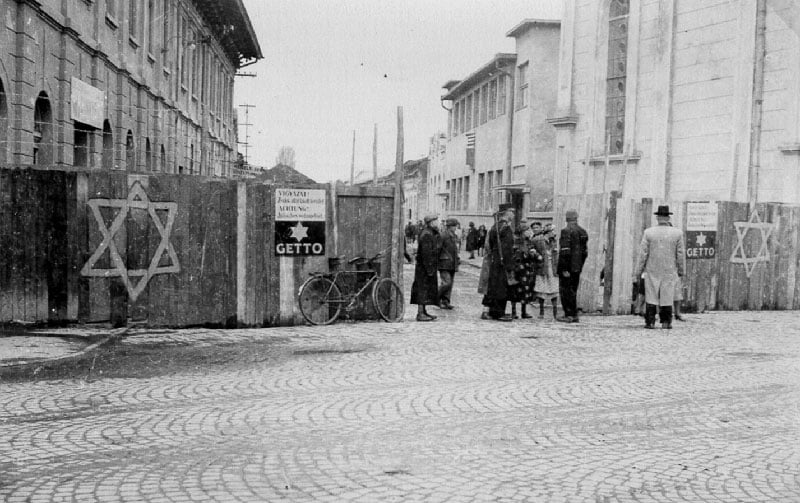
For much of the Medieval period, Jews in the West were subject to compulsory segregation, confined to urban ghettos in order to isolate, control, and monitor them. This segregation was justified as a form of moral protection for the surrounding Christian population from a people long portrayed as spiritually corrupting, alien, and irredeemably unclean.
In contemporary Canadian higher education, the Jewish community increasingly finds itself confined to a different kind of ghetto — an intellectual one that serves many of the same functions as the old: isolating Jewish perspectives, containing them within narrowly prescribed spaces, and treating them as sources of moral and political contamination requiring management rather than engagement.
What has happened on my campus in Montreal over the past several years reflects a broader transformation in our informational and institutional culture.
Social media has fragmented public discourse into ideological echo chambers in which people are rewarded less for intellectual seriousness than for emotional conformity. The algorithms governing online attention are designed to maximize engagement, and outrage is among the most effective ways to achieve it. Content that provokes anger, fear, or moral exhilaration spreads farther and faster than content that encourages complexity, restraint, or ambiguity. Attention has become currency, and increasingly, extremism outcompetes moderation in the marketplace of ideas.
Our academic institutions are not immune to these pressures. In many cases, they are beginning to mirror them.
There was a time when public-facing programming at my college — symposiums, conferences, and educational events advertised to the wider community — approached sensitive political issues with an ethic of balance and intellectual pluralism. During the 2008 International Women’s Week symposium, for example, the college hosted a panel titled “Women and Peacebuilding in the Middle East” featuring Palestinian, Jordanian, and Israeli speakers. The participants differed politically, sometimes sharply, but they shared a commitment to dialogue and coexistence. The purpose of the event was not ideological mobilization. It was understanding.
That institutional culture has changed considerably.
In 2023, the same symposium featured a speaker aligned with the Boycott, Divestment, and Sanctions (BDS) movement, without any meaningful countervailing perspective. The issue here is not that pro-Palestinian perspectives were included. Universities should expose students to competing moral and political arguments, including forceful criticism of Israeli policy. The problem arises when institutional programming ceases to value pluralism altogether, and activism begins replacing inquiry as the governing educational ideal.
This concern becomes more acute when activist movements are presented without context or critical scrutiny. My efforts to engage my colleagues about this event were thwarted. The invited speaker appeared under the banner of feminism through her association with the “Palestinian Feminist Collective.” Yet within months of appearing on campus, she made public statements widely interpreted as celebrating the October 7 Hamas attacks and later published material disputing or minimizing reports of sexual violence committed during the atrocities. She subsequently appeared as a featured speaker at the 2024 McGill encampment, where organizers promoted a “Summer Youth Program” depicting masked keffiyeh-clad youth carrying AK-47s.
What was once fringe activist rhetoric is increasingly being normalized through institutional platforms.
The shift became even more difficult to ignore during the college’s 2024 Social Science festival, titled “It’s Time for Change.” The symposium featured four separate events on the Middle East conflict involving five speakers in total. Not one represented the perspective of the mainstream Jewish community. Two explicitly advocated for BDS and were openly hostile toward that community.
This did not occur in a vacuum. It unfolded amid a broader surge in antisemitic rhetoric and intimidation across Canada and the West more generally: calls to “globalize the Intifada,” synagogue vandalism and shootings, masked demonstrations outside Jewish institutions, and escalating hostility on university campuses, including here in Montreal.
And yet the institutional response has often been characterized more by avoidance than by principled leadership.
Administrators frequently point to the college’s annual Holocaust and Genocide symposium as evidence that Jewish perspectives still retain a place within campus discourse. But this defense becomes difficult to sustain upon closer inspection. Since October 7, 2023, the symposium has operated under what amounts to a de facto boycott by large segments of the college community. The 2026 symposium proceeded only under unprecedented security measures. The Holocaust commemoration ceremony itself was cancelled over security concerns. Unlike other college-wide symposiums, this event remained closed to the public.
The symbolism is difficult to ignore. The one institutional space in which mainstream Jewish perspectives are still nominally welcome has become isolated, securitized, and treated as uniquely volatile.
Increasingly, Jewish concerns within post-secondary institutions are being confined to narrowly circumscribed intellectual spaces: Holocaust education, antisemitism panels, security discussions. Outside these designated zones, Jewish perspectives on contemporary political issues are often treated not as legitimate contributions to debate, but as obstacles to activism or expressions of institutional power. The result is what might be called the ghettoization of knowledge: intellectual spaces that are not merely specialized, but self-sealed — protected from opposing viewpoints under the language of safety, solidarity, or decolonization.
The irony is difficult to miss. Those who speak most passionately about inclusion and equity are increasingly excluding entire categories of dissenting voices, particularly mainstream Jewish ones, thereby reproducing the very dynamics of ideological exclusion and moral hierarchy they claim to oppose.
There is also a broader structural problem. Symposium coordinators are elected through anonymous college-wide voting processes, making these positions vulnerable to organized ideological capture by activist factions. Under such conditions, institutional neutrality becomes increasingly difficult to maintain.
The activist views I have described remain numerically marginal. But once they are repeatedly platformed under the authority and branding of respected academic institutions, they acquire the appearance of moral legitimacy and cultural consensus. Public-facing institutional programming does not merely reflect opinion; it shapes perceptions of what opinions are socially acceptable. When only one ideological current is amplified, moderates begin to internalize the social and professional risks of dissent.
People often do not fall silent because they have been persuaded. They fall silent because they conclude that speaking openly carries consequences.
This is the deeper danger of abandoning balance in institutional life. Universities and colleges cannot preserve intellectual pluralism by retreating from it. Once institutions stop defending the legitimacy of dissent, they begin reinforcing the very forms of ideological intimidation they were meant to resist.
A university or college should not function as an ideological echo chamber. Its role is not to ratify political orthodoxies, but to cultivate the habits of critical inquiry, moral seriousness, and democratic disagreement on which a pluralistic society depends. And that obligation must include Jewish voices not merely in isolated commemorative spaces, but within the mainstream of institutional and intellectual life itself.