The Jewish-Muslim Religious Fraternity Project
The three Abrahamic religions were not created to be tolerant of one another out of some unavoidable fate or out of courtesy to one another. The reason they exist is to open up to one another and to know one another, so as to do one another good. (King Muhammad VI of Morocco)
The key question facing Jewish-Muslim relations, especially in the Middle East, is this: Will our core identities set us against one another, or can they bring us together to build a shared future—one in which each of us has a vital role in a great unfolding story? Can our religious identities move from being part of the problem to becoming part of the solution?
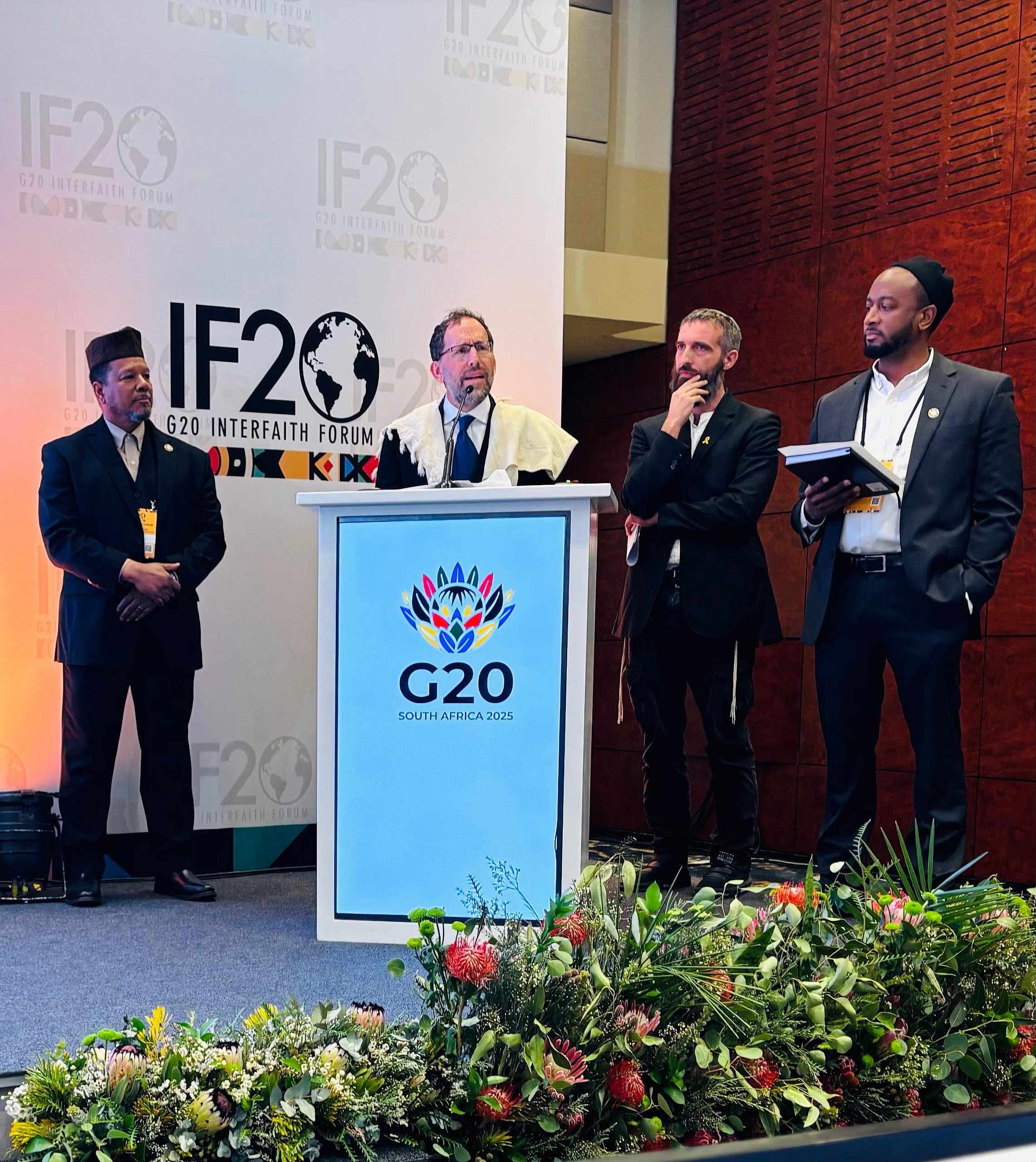
Recently, Rabbis from my organization—the Ohr Torah Blickle Institute for Interfaith Dialogue—together with a number of our partner Imams, presented a vision for the future at the G20 Interfaith Forum in South Africa. In what follows, I will share a portion of my address at the event and conclude with the declaration and call to action that we have been spreading throughout the world:
Faith as a Bridge, Not a Weapon
We have a dream: that our deep religious identities will serve not as a source of conflict, but as a bond of connection. That our friendships and sense of brotherhood will not exist despite our differences, but will be deepened and blessed by them.
We firmly believe this to be the will of our Creator—that this is the authentic truth that emerges from our sacred texts. We stand together against those who weaponize religion, who use God’s name to divide and destroy. That is a betrayal—not only of each other, but of the very books and the very God who guide us.
The Torah tells of tensions between brothers: Isaac and Ishmael, Jacob and Esau, Joseph and his brothers. These stories reflect the deep emotional complexity of family. And yet, again and again, the Bible teaches how, ultimately, brotherly love can prevail. So it is today with the relationship between Jews and Muslims.
Let me be clear: our focus today on Jews and Muslims is not to exclude our brothers and sisters of other faiths. It is to recognize that, just as every relationship is unique, so too is the blessing—and the challenge—of each.
Ultimately, our guiding vision is the one we declare at the end of every Jewish prayer: Aleinu—a world in which all humanity calls together in God’s name. In the words of the Prophet Zephaniah: “They will all call upon the name of God, and serve Him with one shoulder.”
This vision became personal for me exactly three years ago. After a major brain hemorrhage, I found myself hovering between life and death. But the prayers of brothers and sisters from all faiths called me back to life. It was, for me, a fulfillment of the first part of that prophetic verse: “They will all call upon the name of God.”
The second part“And serve Him with one shoulder”, I understood for the first time shortly after that, when I met my dear brother, Imam Talib Sharif. When he embraced me with a massive hug—face to face, heart to heart—our shoulders touched and became one.
When we forge the vertical line to God, and the horizontal line to one another, this is when faith and religion can heal our broken world.
The Joint Declaration
As part of a long-term effort to promote Jewish-Muslim reconciliation, a delegation of Jewish and Muslim faith leaders convened in Cape Town, South Africa, at the G20 Interfaith Forum Summit, to issue the following declaration:
With a shared commitment to fostering genuine understanding and respectful dialogue between our Jewish and Muslim communities, we acknowledge the deep-rooted historical complexities that have shaped their relations.
Rooted in our shared humanity as descendants of Adam, we view the deepening of religious fraternity between Jews and Muslims not merely as a means to ease tensions but as a revival of our common Abrahamic heritage and a fulfillment of God’s will. This delegation is part of a long-term process of dialogue, joint study, and cooperation. Its purpose is to make our religious identities a source of connection rather than conflict.
We draw inspiration from the al-Madina Constitution of the 7th century, which brought our communities together, as well as from the historic Nostra Aetate declaration of 1965, which marked a pivotal shift in Jewish-Christian relations. As we commemorate its 60th anniversary in 2025, we seek to build upon its legacy by embarking on a parallel journey for Jewish-Muslim relations.
This endeavor will critically examine both the convergences and distinctions between our traditions, with the overarching aim of equipping our communities with the wisdom and perspective necessary to address illnesses in the world that plague our ability to coexist in lasting peace.
The road ahead is long and fraught with complexities. Our efforts will require strategic planning, scholarly engagement, participation in global forums, dedicated women-led interfaith dialogue, and the dissemination of our shared vision through educational and media channels, and more.
We do not presume to predict the timeline or ultimate success of this undertaking. However, we recognize that it holds the potential to be one of the most significant interfaith initiatives of our time. We, the undersigned, guided by hope and faith, commit to taking the first step on this journey.
We invite all of you to join this endeavor.