The Judenplatz: Vienna Waits for You
There is a Vienna seen and celebrated, where tourists line up for a sense of majesty and the nostalgia of empire. They pass through the splendid halls of Schönbrunn Palace, beneath the chandeliers of the Opera House, and through the Belvedere gardens. This is the Vienna of painted ceilings, Bohemian crystal, silk-covered walls, and preserved Habsburg splendor.
Another story lies beneath these familiar images – one of deep Jewish roots, achievement, and repeated destruction. Centered on Judenplatz – Vienna’s medieval Jewish quarter – this Jewish story of another Vienna emerges through architecture, memorials, museums, and the remains of the synagogue beneath the street.
Across these centuries, the same pattern returns: Jewish life built and destroyed; protection granted and withdrawn; dignity, memory, and home defended.
The Jewish Museum Vienna has two locations in the old city. This walk begins at its Judenplatz branch, in the Misrachi House at the square’s edge. From the street-level museum, stairs descend to archaeological remains below. Moving from imperial Vienna to the medieval Jewish quarter requires an actual descent.
At the bottom, a narrow passage carries the visitor toward the synagogue ruins. The Latin limen means threshold; from it comes liminal – a space not quite of this world. The corridor, for me, recalled Yad Vashem, Israel’s Holocaust remembrance center, and the Jewish Museum Berlin, where architecture prepares visitors to leave the ordinary world behind. The city’s sounds recede as the passage leads beneath the square and toward another Vienna.
The Submerged Synagogue
The passage opens onto the remains of Vienna’s medieval synagogue. We do not know the name its congregation gave it. A Jewish presence in Vienna is documented by the late twelfth century. The quarter at Judenplatz and its synagogue took shape in the thirteenth century. By the fourteenth century, the synagogue was among the largest in the German-speaking world.
Among the foundations, one shape stands out: the hexagonal base of the bimah, the raised platform from which the Torah was read. Archaeologists identify the principal hall as the men’s prayer and study space. A smaller adjoining room may have served as the women’s section.
At first, the ruins appear modest: rooms reduced to outlines and walls that no longer rise above the knee. Yet each outline and broken wall marks a sacred space where community lived and breathed.
A digital reconstruction beside the stones restores the synagogue’s full height and proportions. Walls rise upon the surviving foundations. Columns divide the principal hall and support its vaulted ceiling. Narrow windows admit light; suspended lamps illuminate the bimah. Color and movement return. The synagogue ceases to be a collection of fragments and becomes an inhabited room.
Imagine standing here on a Friday evening. The familiar Friday-evening hymn Lecha Dodi would not have been sung here. Shlomo Alkabetz wrote it more than two centuries later, in sixteenth-century Safed. Even prayers and melodies that appear timeless entered Jewish life in particular places and periods. They were carried and adapted by different communities.
The authorship and date of Adon Olam are uncertain. Yet the hymn appears in the Rothschild Vienna Mahzor, a festival prayer book completed in 1415. It was known in the city before the synagogue’s destruction:
He is my God, my living redeemer,
the rock I grasp in time of distress.
After prayers, worshippers returned through the surrounding lanes to their homes. Around the Sabbath table, families might sing piyyutim, or liturgical poems, such as Baruch El Elyon or Yom Zeh Mechubad.
The reconstruction cannot tell us their names, melodies, or conversations. The stones belonged to people who prayed, studied, argued, celebrated Shabbat, and expected to return home safely. The synagogue was not built as a memorial. It was built for life.
Ascent and Descent: Returning to the Square
I climbed the stairs, but I was not necessarily ascending. At the top, I returned to daylight and to Judenplatz. Below lay the foundations of a community. Above ground stood buildings, inscriptions, and monuments revealing what later Vienna had chosen to honor, conceal, contest, and remember. Ascending toward the light does not ensure moral clarity.
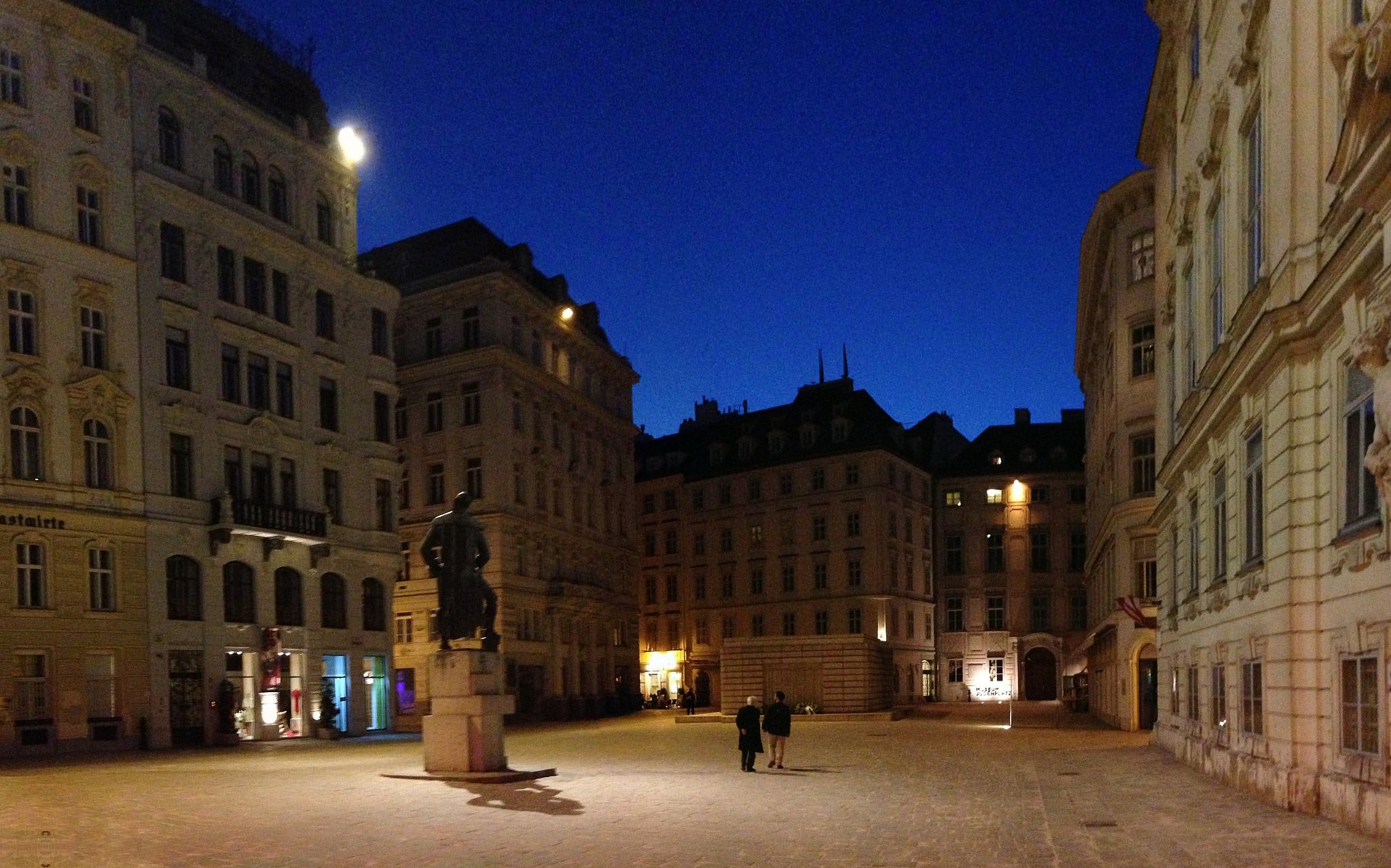
I paused and scanned the square. Judenplatz is about eighty-three meters long-slightly shorter than an American football field from goal line to goal line – and can be crossed in less than a minute.
Across the paving stones stands one of Vienna’s oldest houses, decorated with a medieval religious scene. Nearby, Gotthold Ephraim Lessing-the German Enlightenment writer and advocate of religious tolerance-stands in bronze beneath the windows of a former imperial chancellery. At the center stands the Memorial to the Austrian Jewish Victims of the Shoah.
Ageless hatred, Enlightenment hope, twentieth-century catastrophe, and present-day remembrance remain visible all at once.
The House of the Great Jordan
I turned toward Zum Großen Jordan – the “House of the Great Jordan” – at Judenplatz 2. It was the larger of two nearby houses once owned by the Christian goldsmith and civic official Georg Jordan. Narrow and several stories high, its pale façade reaches back in part to the Middle Ages.
High on that façade is a late-Gothic relief depicting the scene Christians know as the Baptism of Jesus. Two Jews stand in the Jordan River during ritual immersion. John – Yohanan is the teacher; Jesus – Yeshua comes to him for immersion. Above them, Saint George drives his spear into a dragon. The images play upon Jordan’s name. The river evokes his surname; the saint, his first name. A craned neck reveals a Latin inscription directly beneath the relief. It celebrates the massacre of Vienna’s Jewish community in 1421, declaring that the burning of Jews purified the city of the crimes of the “Hebrew dogs.”
“Hebrew dogs.” The words are more than a crude insult. They remove the victims from the human family. Hatred depends upon that removal. It is difficult to hate someone who reminds us of ourselves, our children, or our parents. The other must first be made alien, dangerous, and inhuman.
The remaining lines equate ritual cleansing by water with the mass murder of Vienna’s Jewish community. Fire and blood are celebrated as a brutal cleansing.
The date marks the violent end of a community rooted in Vienna for three centuries. During the Vienna Gesera – the name given to the persecutions of 1420–21 – Jews endured arrests, torture, forced conversion, and expulsion.
Duke Albrecht V ordered the surviving 212 Jews – 92 men and 120 women – to be burned alive at Erdberg, in what is now Vienna’s third district, on March 12, 1421. The executions took place during Lent, less than a week before Passover and eleven days before Easter, a season often marked in Christian Europe by anti-Jewish preaching and violence.
The destruction continued after the fires. Jewish property was confiscated. Stones from the demolished synagogue were looted. They were reused for the Nova Structura – the “New School”- of the University of Vienna, near today’s Bäckerstraße 13. The Nova Structura no longer stands.
Religious accusation and financial interest worked together. Jews were falsely charged with desecrating the consecrated wafer of the Eucharist – the body of Jesus in Catholic teaching. Across medieval Europe, Jews were imagined as both unbelievers and secret witnesses: publicly rejecting Christianity while allegedly recognizing and attacking the body of Jesus. Albrecht, deeply in debt and financing war against the Hussites, could seize Jewish wealth and erase debts by destroying the community.
Before 1421, the house had belonged to a Jewish man named Hocz. It passed through several owners before Georg Jordan acquired it seventy years later. The relief and inscription recast as a sacred dedication the destruction that had made Jordan’s ownership possible, presenting the massacre not as a cause for shame or apology, but as an act worthy of celebration.
The contradiction stains the square. Beneath the pavement lie the synagogue’s remains. Above ground, within the former Jewish neighborhood, the façade venerates Jesus and John in the Jordan River. Directly beneath them, the inscription glorifies the murder of Vienna’s Jews, who belonged, like Jesus and John, to Am Yisrael – the People of Israel.
Lessing’s Lesson: Tolerance and a New Age?
A few steps from the Jordan House inscription, Gotthold Ephraim Lessing looks across Judenplatz. Clad in a long coat, his head tilted in reflection, the German Enlightenment writer never lived in Vienna. His statue confronts the inscription and stands for reason, tolerance, and human equality.
What would Lessing say about the path of Europe’s Jews – from restricted tolerance through civic equality to the growth of Jewish Vienna and its destruction in the Shoah? His 1779 play Nathan the Wise may suggest an answer.
Set in Crusader Jerusalem, the play brings together a Jewish merchant, the Muslim ruler Saladin, and a Christian Templar. When Saladin asks which faith is true, Nathan responds with the “Ring Parable.” A father gives each of his three sons an identical ring. After his death, they quarrel over who possesses the original. The judge refuses to decide and declares:
Let each believe his own is the real ring.
Each son must prove his ring’s worth by how he lives. The sons need not abandon their inheritance or pretend that their traditions are indistinguishable. They must live in ways that make their claims worthy. Difference remains. No faith can claim a position of universal truth.
Nathan was shaped by Lessing’s friendship with Moses Mendelssohn, a leading voice of the Haskalah – the Jewish Enlightenment. Mendelssohn argued that Jews could participate fully in European civic life without abandoning Judaism. Their friendship challenged the boundaries separating Jews and Christians.
Standing before Lessing, I looked back toward the Jordan House. Lessing’s appeal to a new openness and civility rebuked an inscription that had turned murder into virtue. Yet the statue also warned against easy confidence. Reason and tolerance alone proved insufficient to protect Europe’s Jews.
Jewish life returned to Vienna on limited terms after another expulsion in 1670. Emperor Joseph II’s Edict of Toleration of 1782 opened educational and economic opportunities without granting equal citizenship. The revolutions of 1848 began to overturn that arrangement; the Basic Law of 1867 established civic equality.
Emancipation brought enormous change, but also a demand. Liberal Europe increasingly recognized Jews as individual citizens “of the Mosaic faith,” not as Am Yisrael, a people bound across borders by history and responsibility. Civic participation pressed Jews to define Judaism as a religion and push wider bonds of belonging into the private sphere. Zionism would later challenge that bargain.
By the Anschluss – the German annexation of Austria in March 1938 – Vienna’s Jewish population numbered approximately 185,000. Jews were essential to the city’s intellectual, artistic, economic, and political life.
Modern antisemitism grew alongside emancipation as older Christian hatred was recast in nationalist and racial terms. Karl Lueger, Vienna’s mayor from 1897 to 1910, made hostility toward Jews an instrument of popular politics. Hitler praised Lueger in Mein Kampf and advanced an antisemitic program that culminated in continent-wide mass murder.
German troops entered Austria on March 12, 1938, without armed resistance. Three days later, an enormous crowd filled Heldenplatz to hear Hitler proclaim the Anschluss. Photographs and film footage presented the annexation as Austria’s “liberation.” That was the message of Nazi propaganda. Beyond the propaganda, the size and enthusiasm of the crowds were frighteningly real. Vienna had opened its doors to Jews while nurturing movements determined to drive them out.
The statue’s history followed this arc. Unveiled in 1935, it was removed by the Nazis four years later and melted down. A second casting of the Lessing statue was unveiled in 1968 and moved to Judenplatz in 1981.
Postwar Austria often presented itself as Nazi Germany’s “first victim,” emphasizing the Anschluss while minimizing Austrian support for Hitler and participation in Nazi persecution and murder. The restored Lessing allowed Austria to honor the Enlightenment values it wished to claim without confronting that collaboration.
A more honest reckoning came slowly. During Austria’s 1986 presidential campaign, it emerged that Kurt Waldheim – a former secretary-general of the United Nations – had concealed the extent of his wartime service as a German army officer in the Balkans. He won the election nevertheless, but the controversy forced Austria’s Nazi past into public view.
In 1998, the Archdiocese of Vienna unveiled a street-level plaque on its building at Judenplatz 6. It remembers the Jews who chose death rather than forced baptism in 1421 and acknowledges that Christian preachers spread hatred while Vienna’s Christians accepted the crime, approved it, and became perpetrators.
Placement matters. High on the Jordan House, the older inscription celebrates destruction as ritual purification. On street level, the modern Church answers it. The first inscription has not been erased. After five centuries, it is challenged.
Between the two inscriptions stands Lessing, directing the square away from hatred and self-exoneration and toward responsibility. Behind him, four sculpted female figures above the gates of the former Bohemian Court Chancellery – now Austria’s Supreme Administrative Court – personify temperance, wisdom, justice, and courage.
Mendelssohn and Lessing championed those qualities. Nonetheless, neither law nor Enlightenment ideals protected Europe’s Jews. A few steps beyond Lessing’s statue, the Memorial to the Austrian Jewish Victims of the Shoah confronts the consequences of Europe’s failure to reject Jew-hatred and prevent the murder of the Jewish people.
The Sealed Library and Reckoning
British artist Rachel Whiteread’s memorial is a low, windowless block of pale concrete. Unveiled in 2000, it commemorates more than 65,000 Austrian Jews murdered by the Nazis.
Rows of cast books form the walls. Their pages face outward; their titles are turned inward. Double doors are visible, but they have no handles and cannot open. From a distance, the structure resembles an ordinary building. Up close, it reveals itself sealed and tomb-like. No reader can enter this library. No book can be opened.
The image reverses the familiar description of Jews as the People of the Book. For Jews exiled from our land and repeatedly forced to move, our books became portable pages of home. A tradition sustained through reading, interpretation, and near-boundless creativity is represented here by an impenetrable library.
The books appear almost identical, their titles hidden. The memorial names no individual victims. Countless lives risk being reduced to a single, incomprehensible number. Each volume asks us to imagine a particular life – a family, a home, and a story – that the memorial is incapable of restoring.
Around the base are the names of the concentration camps and murder sites where Austrian Jews were imprisoned and slain. At the information center in Museum Judenplatz, visitors can search for individual names and biographies. Outside, the memorial confronts us with the scale of the crime and the places where it happened. Inside the museum, individual lives become discernible.
The sealed library refuses the comforting idea that the Shoah can be fully entered or mastered. It can be approached, studied, and described. Even after decades of documentation and research, the question remains: How was this humanly possible?
The relationship between the memorial and the synagogue below was unplanned. During preparations, archaeologists uncovered the synagogue’s foundation walls. The discovery delayed the memorial project. Whiteread’s structure was shifted about a meter so that it would not stand over the bimah.
A hexagon marked in the pavement marks the bimah’s position. When I first saw it, I did not see only an architectural diagram. I thought of a body outlined at a crime scene. It gave physical shape to an absence created not by time, but by violence.
Judenplatz holds two destructions of Jewish life in proximity, separated by just a few steps and five centuries. The hexagon marks the synagogue below, where Torah was once read aloud. Above it, the concrete library holds books that will never open.
The memorial was also shaped by disagreement over how Vienna should remember. Simon Wiesenthal, a Holocaust survivor who devoted his postwar life to documenting Nazi crimes and pursuing their perpetrators, pressed Vienna to build a memorial specifically to Austria’s murdered Jews.
Some believed that the synagogue ruins already offered testimony no abstract monument could equal. Residents objected to the memorial’s scale and the transformation of the square. Remembering the past did not enter Judenplatz without disturbing the residents of the present.
At the unveiling, Wiesenthal declared the purpose of the memorial:
“This monument should not be beautiful. It must hurt.”
I can read the dedication and the names of the places where Austrian Jews were murdered. I can enter the museum, descend to the synagogue ruins, and search for individual victims. All this brings me closer, but only so far. Knowledge can deepen responsibility, but it cannot open the memorial’s sealed books or restore the lives they represent.
Building a memorial or affixing a plaque is paradoxical. It encourages remembrance but can also imply that memory’s work is complete: the names inscribed, responsibility acknowledged, the visitor free to walk away. When remembrance ends there, memorialization becomes catharsis without commitment.
This is also a challenge of Jewish educational travel – and Jewish education more generally. If an encounter remains only moving or informative, the past becomes scenery through a train window, briefly visible and soon left behind. Such travel matters when remembrance enters our lives and shapes what we do after returning home.
The memorial’s claim leads beyond the square, to Vienna’s living Jewish community. Jewish life in Vienna did not end with those memorialized here. About 12,000 Jews live in the city today.
The presence of the contemporary Jewish community provides no redemptive ending and does not soften all that was destroyed. The Jews of Vienna are not remnants of a vanished world or passive recipients of protection. They build institutions, educate their children, defend their rights, and determine the shape of Jewish life.
Their neighbors and governments also carry responsibility. Jew-hatred cannot be left for Jews alone to confront. In 2024, the far-right Freedom Party of Austria (FPÖ) won more votes than any other party in the national election. Its polished surface cannot erase its origins. Its first leader, Anton Reinthaller, was a former SS officer and Nazi cabinet minister.
Jean Améry, a Viennese-born Jewish survivor of Auschwitz, confronted Auschwitz, torture, and forgetting in At the Mind’s Limits: Contemplations by a Survivor on Auschwitz and Its Realities.
In the 1977 preface, he wrote:
“I rebel: against my past, against history, and against a present that places the incomprehensible in the cold storage of history and thus falsifies it …”
Améry committed suicide in 1978.
Améry’s refusal to let the past be sealed away remains with me even after I leave Judenplatz.
The past cannot be safely contained in ruins and memorials. Resisting Jew-hatred requires confronting those who spread it and the societies that tolerate it. For Jews, remembrance obligates us to sustain our communities and build Jewish lives. Judenplatz also points to an additional responsibility: hatred directed at some must become the concern of all.
_
Hit Follow at the top of the page to keep up-to-date with my blog and with this ongoing series on Jewish experiential travel. Stay tuned.