


The Keffiyeh Chronicles
In my role as communications director of the Policy Working Group* (PWG), I have made an annual trip to Berlin, where we partner with members of Pax Christi and Damour, a Palestinian NGO, to advocate for a resolution of the Israel-Palestine conflict based on the two-state solution. This trilateral venture began almost 10 years ago, and many of us have become not only colleagues but friends.
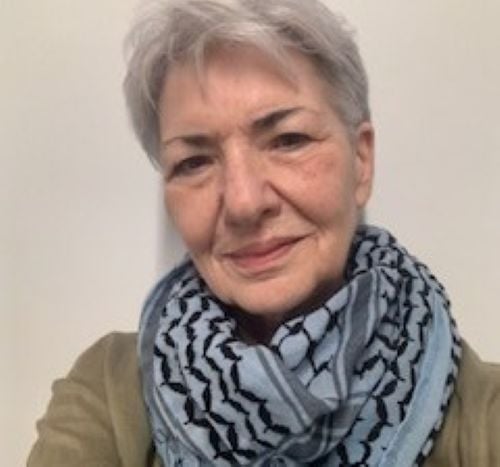
That is the background to my keffiyeh** story. On our visit to Berlin at the beginning of May, one of the Germans who has been to Palestine often, most recently to engage in protective presence in the West Bank, was wearing a sky-blue keffiyeh around his neck as a scarf to shield him from the cold. The black embroidery against the sky-blue background was absolutely stunning. I was unable to hide how much I fancied the keffiyeh, and my dear friend said he had several others at home and would gift this one to me at the end of our trip. And so I became the proud owner of a beautiful, stylish, and totally nontraditional headscarf that is a perfect match to my usual outfit of blue jeans and a black or white top.
Questioning by Israeli Security
A few days after returning from Berlin, I flew to Dublin for an event sponsored by the Candid Foundation at which Israeli and Palestinian civil society representatives engaged in a dialogue with European stakeholders to promote an end to the conflict. In the spirit of the meeting I was going to attend and conscious of the fashionable look of my sky-blue scarf against the neckline of my denim jacket, I happily wrapped my new keffiyeh around my neck and headed to Ben-Gurion Airport to catch my El Al flight to Dublin. And so it began.
With only a half-empty backpack and a trolley in hand, I expected to blitz through security after answering the usual “where are you coming from?” (home) and “did anyone give you anything to take with you?” (no) questions. It was quite early and I was already dreaming of my second cup of coffee in the rotunda. Instead, I barely made it to the plane.
Security guard: Where did you get the keffiyeh?
Me: From a friend in Berlin.
Security guard: Why?
Me: Because I thought it was pretty.
Security guard: What were you doing in Berlin.
Me: I’m a peace activist, and I met with people to talk about how to achieve peace.
Security guard: Who did you meet with?
Me: Parliamentarians and other political officials.
Security Guard: What did you say in those meetings?
Me: That’s a political question. Why do I have to answer it?
Security guard: It’s not political. It’s a security issue.
At this point the guard walked off with my passport to consult with her supervisor, and I did some quick calculations. With my Israeli passport, my Jewish nationality, and nothing subversive or illegal about my activities, I felt quite confident that no matter what happened along the way, I would ultimately find myself a free person. On the other hand, I really didn’t want to miss my flight to Dublin and the meetings we had scheduled in the Irish capital. With the security guard now walking back toward me, I chose the path of least resistance and decided to continue to answer her questions.
Security guard: Are you politically active here in Israel?
Me: Yes.
Security guard: In what way?
Me: I’m a member of the All Its Citizens party, I write articles, and I go to demonstrations against the war.
Security guard: You’re against the war?
Me: Yes.
Security guard: Why?
Me: Because I believe security can be attained only through agreements, not military operations and the seizure of territory.
“Wait here,” she said, and off she went with my passport for another powwow with her supervisor. Suddenly I had a flashback to attending a particularly contentious joint memorial ceremony several years ago and passing by a right-wing mob shouting “Death to the traitors.” I remembered walking up to a policeman and saying that they were threatening my life, to which he replied: “Why? Are you a traitor?” With that memory fresh in mind, I saw the security guard make her way back to me. “You can go,” she said. I took my passport and headed straight to the gate.
That evening at dinner, I shared my story with the other conference delegates, and they all reacted by warning me that today a keffiyeh is considered a red flag and that I should think very carefully about whether it’s wise to wear it on an El Al flight. I confess that these conversations only triggered the rebel in me and bolstered my determination to wear the keffiyeh on my flight home.
Dubliners Split on the Keffiyeh
My return flight was Saturday evening, leaving me several hours to wander the streets of Dublin before catching my flight. Coincidentally, it was Nakba Day, and one Irish woman who passed me on the street and spotted my keffiyeh shot me a big smile and called out “Free Palestine!” As I smiled back, all the complexities of the conflict began to swirl around in my head. Of course I support a free Palestine, if the reference is to a viable, contiguous, independent, sovereign State of Palestine alongside the State of Israel; however, I certainly don’t support freeing historical Palestine from the river to the sea by annihilating the State of Israel. By the time I decided that this could be an opportunity to broaden the woman’s understanding of the conflict if her intention was the latter, she had been swallowed up by the crowd.
Emerging from Christ Church Cathedral an hour later, I got stopped by an Irish man who shouted at me: “Take off that symbol of hatred!” This time I was quick to react. “Why do you think it’s a symbol of hatred?” I asked very calmly. That only made him yell at me even louder. Again, without raising my voice, I told him that I am a Jewish Israeli and a peace activist, to which he screamed: “You’re going to hell!” At that point I realized there was nothing more to say, and so I turned on my heels and flagged a taxi to begin my journey home.
En route to the airport, I considered what to do about the keffiyeh wrapped around my neck. My Palestinian counterparts in Dublin had been pretty clear about the risks, but I expected that as a Jew I would not be subjected to the same harassment, humiliation, and worse that they face at Israeli border checkpoints. I figured that the worst that could happen to me if I didn’t cooperate by answering all the intrusive questions would be a night in detention. I thought that would be a small price to pay for the furor I knew I could raise over my keffiyeh arrest, so instead of putting the keffiyeh in my trolley I adjusted it and headed toward security, primed for a confrontation.
‘You Should Be Ashamed!’
Alas, the security check passed without incident. The guard was friendly, asked me a couple of standard questions, and wished me bon voyage. But I wasn’t quite out of the woods. As I slowly made my way down the aisle of the aircraft, I heard a couple whispering to each other in what sounded like a debate about my nationality. When I reached them, I stopped and asked if there’s a problem. “Are you Israeli?” she asked. “Yes,” I replied. “You should be ashamed!” she shouted at me. “Why?” I asked. “You’re Israeli and you dare wear that thing! You should be ashamed,” she repeated. “And I think you should be ashamed of your ignorance and prejudice,” I replied and moved on.
Once seated, I began to mull over the entire keffiyeh saga, from the generosity of my German colleague who gave it to me as an act of friendship and appreciation for our joint work toward a common cause, the emotions – whether positive or negative – that this piece of cloth sparked in people, and the questions I had about my rights as a citizen of the State of Israel when being asked to name political affiliates and to defend my views on war and peace because I was sporting an accessory that belongs to Arab culture.
Badge of Courage
There are many photographs of Jews in keffiyehs during the early days of the state, Prime Minister David Ben-Gurion among them. In fact, many Jews who came to Palestine adopted the keffiyeh as a symbol of their integration into Middle Eastern culture. Over the years, however, the traditional black-and-white Palestinian keffiyeh has taken on political connotations. I am old enough to remember Yasser Arafat arranging his keffiyeh to resemble the map of pre-1948 Palestine, and I also remember the scandal around Saeb Erekat keffiyeh at the Madrid Peace Conference. Erekat’s intention was to draw attention to the Palestinian cause in defiance of attempts to blur the Palestinian presence by making them part of the Jordanian delegation. Today some see the keffiyeh as a symbol of Palestinian resilience, national identity, and struggle for freedom, and for many non-Palestinians it constitutes a demonstration of solidarity.
I must admit that I was first attracted to my sky-blue keffiyeh as a fashion statement. As for any political significance, its motif disqualifies it as a true Palestinian artifact, but if it conveys the message that I support the Palestinians’ right to be freed from occupation and live in a sovereign state of their own, that’s a bonus as far as I am concerned. Truth be told, the hostility I encountered from the couple on the plane made me see my keffiyeh as a badge of courage to be worn not despite but because of the discomfort it awakens in the majority of Israelis.
Peace Means Never Having To Defend Your Keffiyeh
I have thought of consulting a human rights lawyer to ascertain whether there are limits to the invasive questioning to which I can be subjected in the name of security if there is nothing illegal on my person. But then it struck me how naïve I was being. After all, the rules of engagement today basically set any perceived threat as the threshold for opening fire. In other words, were I to reach into my pocket for a tissue while refusing to tell the security guard what I say to interlocutors abroad, the guard could put a bullet through my head on the grounds that they feared that I was reaching for a weapon, and the incident would be ruled a justifiable shooting.
The bottom line is that I have lost my innocence about casually draping my keffiyeh around my neck simply because it adds a dash of color to my outfit. Before I put it on, I will have to think about where I am going, how I will be received, and whether I’ll be ready to stand my ground. And to my many thoughts about what peace between Israelis and Palestinians will look like, I can now add the day when the sight of a Jew wearing a Palestinian keffiyeh will generate no more admiration or repulsion, no more camaraderie or antagonism than the sight of a Jew in a French beret or a Stetson hat.
*The PWG is made up of senior Israeli academics, former diplomats, political analysts, and human rights defenders who advocate for international engagement to achieve implementation of the two-state solution. It is chaired by former Ambassador Ilan Baruch.
**A keffiyeh is a traditional square scarf worn in the Middle East. Originally a practical garment to protect farmers from the harsh sun and sand, the black-and-white keffiyeh has evolved into an international symbol of Middle Eastern heritage and Palestinian nationalism.