
Jewish historian
Featured Post
The Western Wall brouhaha can be solved easily
The court cases, to which I am a signatory, established the Kotel's legal status: It's a national holy site, regardless of who prays there or how
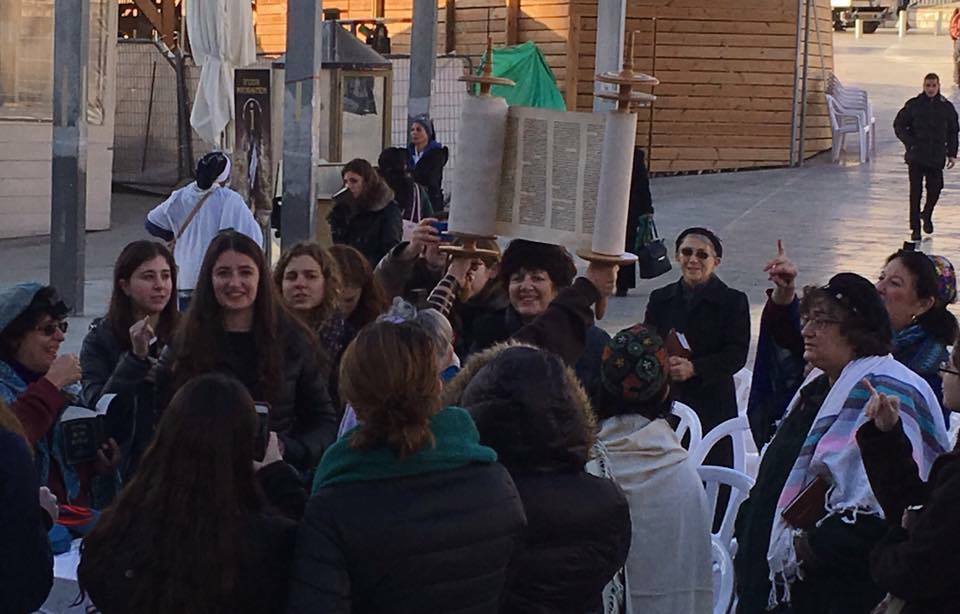
(Credit: A. Solovy)
Much has been said in the past few days, a rehash of what has been said, round after round, for years, about the Kotel (the Western Wall of what was the Second Temple compound), and denominational rights there. It truly reminds me of the classic discussion in the Talmud (Bava Metzia 2a), about two who take hold of (ohazin), a tallit, each claiming, it is all mine… zeh omer, kula sheli, ve’zeh omer, kula sheli…
I am one of the founders of women’s group prayer at the Kotel, having read Torah there in December, 1988, at the first women’s group prayer there, in the company of about 70 other women of all countries and Jewish backgrounds.
I am the first-named plaintiff in a suit before Israel’s Supreme Court asking the Court to enforce its own ruling — issued in 2003 — that women’s group prayer is to be accommodated at the Kotel.
A further ruling in 2013 (Sobel, 2013), stated that such prayer — at the Kotel — is a “custom of the place,” minhag ha-makom, having been taking place there regularly for, by then, 25 years, especially considering that Jewish group prayer at the Kotel altogether only began to be possible in 1967.
I will not rehearse here the many arguments I have made over the years in print and before groups, including the Israel Bar Association, about all this, not least, revealing sordid politics and money interests behind various actions to claim the site in exclusionary and divisive ways.
Just this following point — which I find nowhere in the current brouhaha, in which each side benefits from the claims and noise the other makes about the latest about disposition of claims to, or at, the Wall, or an alternate site — nothing riles the respective bases like this issue, also a very old, tired, and unworthy dynamic:
The legal status of the Kotel is an “אתר לאומי קדוש” — a national holy site, and not a synagogue or a “beit knesset” — and it needs to be administered as such. It tops a list of other holy sites that includes Ma’arat HaMachpelah — the burial cave of the Matriarchs and Patriarchs in Hebron and Kever Rashbi — the grave of Rabbi Shimon Bar Yochai in Meron, none of which is a synagogue either.
Administration of the site as its legal status mandates means administration in ways that accommodate all Jews, including secular Jews — anyone who relates to it as a place of sacred Jewish memory.
That is how the vast majority of Jews related to it, as seen in the overwhelming Jewish response to its retaking in 1967 for the first time since its destruction, 2,000 years ago, before its appropriation by various religious establishments and remaking as a Haredi synagogue, with Haredi coercion of the “accepted” practice there, and as a Haredi power bastion and cash cow.
To cede, explicitly or implicitly, that the site is a synagogue rather than the supreme national holy site of the Jewish people, pre-eminent site of Jewish memory and connection — is to cede the main principle, from which mistake the others necessarily follow, piling one upon the other, as is now occurring, yet again.
Administration of the Kotel as its legal status warrants would mean that anyone would be free to pray or not to pray; singly or in a group; gender-mixed, or gender-separate; silently or aloud, but that no one could force practice or lack of it on anyone else there.
This has been made not just a religious issue, but a narrow, combative, denominational-political issue and battle — and fundraiser par excellence.
That is a fundamental perversion of the site’s immeasurable historical importance, its legal status, and the best interests of the Jewish people as a whole. And it is that whole and not warring parts of it that must take precedence — in that place, in particular, whose wholeness, we are taught, was destroyed precisely by wanton divisions and divisiveness.
The solution — for all of us, not some of us, not more, better, or differently than others — is already available, right before us. Just as we already have a law for military service and no need for a new, separate, different one for some, we have the site’s legal status already fixed, just awaiting visionary, determined, and coherent translation into practice.
Related Topics
Related Posts