
NAnews - Nikk.Agency Israel News
“The Kyiv Period of Golda Meir”: Kyiv Archive Presents Her Birth Record
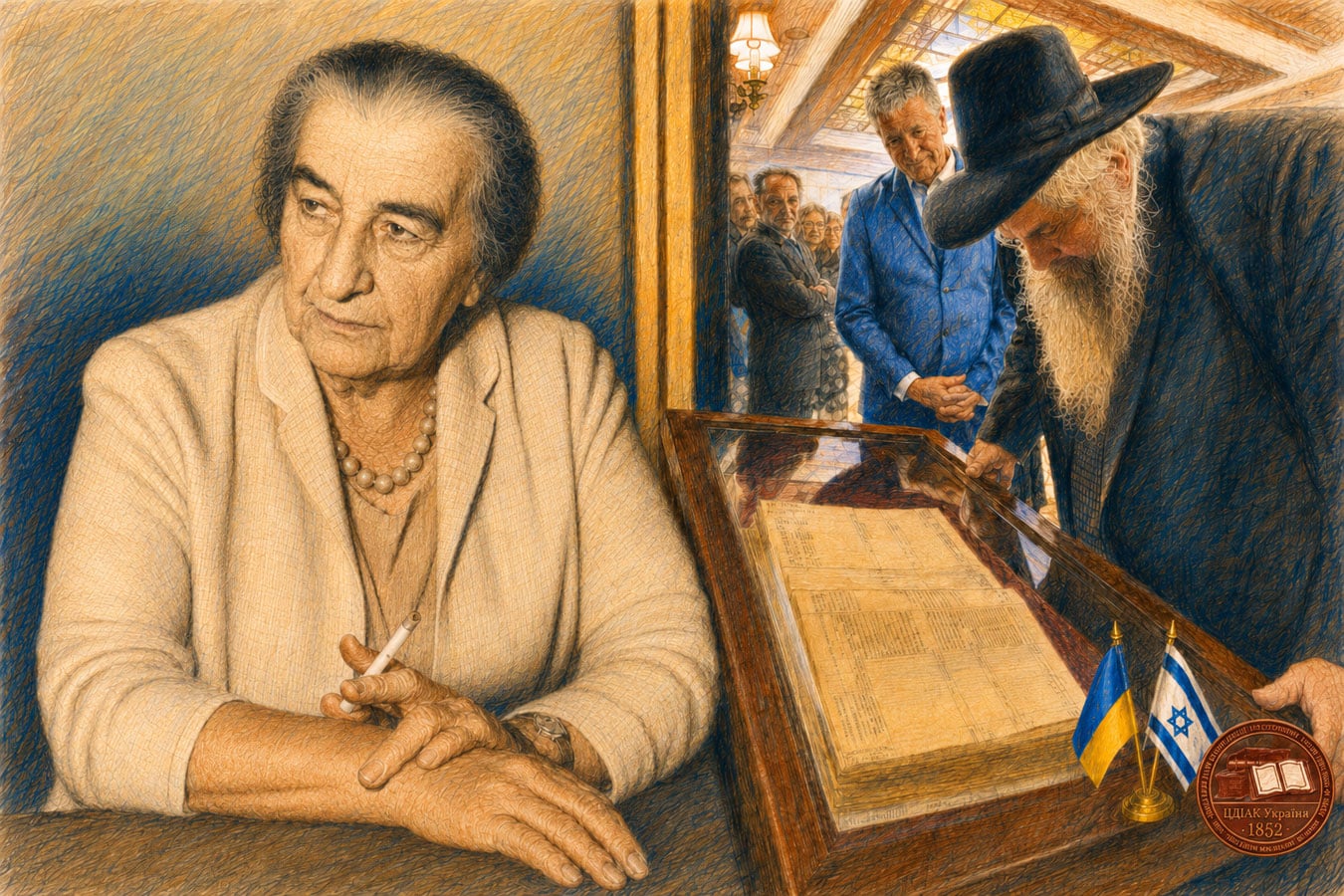
“The Kyiv Period of Golda Meir”: Kyiv Archive Presents Her Birth Record at Israel Independence Day Reception. The illustration was created using AI.
Sometimes a country’s history returns not through a monument, a speech, or a political anniversary, but through a single old page.
In Kyiv, the Central State Historical Archive of Ukraine presented a metric book containing the birth record of Golda Meir, the future prime minister of Israel and one of the two women who signed Israel’s Declaration of Independence in 1948.
The metric book was presented on May 11, 2026, during the Israel Independence Day reception organized by the Embassy of Israel in Ukraine in Kyiv. The Central State Historical Archive of Ukraine reported on the event the next day, May 12.
At first glance, this may sound like a small archival story.
A name. A date. A city. A family record.
But anyone who looks at this page carefully understands that it is not only about the birth of one famous person. It is about the long and complicated road from Jewish life in Kyiv to the founding of the State of Israel. It is about memory, exile, statehood, and the roots of a nation that was built by people whose biographies began in many different places.
Golda Meir was born in Kyiv on April 21, 1898, as Golda Mabovitch. Before Jerusalem, before the Israeli cabinet, before the Yom Kippur War, before the image of the tough, cigarette-holding leader became part of Israeli political memory, there was a child born into a Jewish family in Kyiv.
That is what makes this record powerful.
The archive did not only present Golda Meir’s own birth record. It also published scanned copies of metric records connected to her brother and sister — Aaron-Zelik Itskovich Mabovitch and Tsipa Movsha-Itskovna Mabovitch. That detail changes the scale of the story. We are no longer looking only at a biographical footnote about a future Israeli leader. We are looking at a family, a community, and a fragment of Jewish life in Kyiv at the end of the nineteenth century.
The inter-archival project was titled “The Kyiv Period of Golda Meir.” It was carried out on the initiative of Anatolii Khromov, head of the State Archival Service of Ukraine. According to the Ukrainian archival context, the purpose was not simply to display one rare document under glass, but to open a wider conversation about the Kyiv chapter in the life of the woman who would later become one of Israel’s most important political figures.
That is exactly the right way to approach this story.
Golda Meir is often remembered in Israel as a symbol of determination, responsibility, and the generation that built the state. Her image remains complex, especially because of the continuing debates around the Yom Kippur War. But complexity does not make her smaller. It makes her more human.
And this Kyiv record does the same.
It brings Golda Meir back from the level of national mythology to the beginning of an actual life. She was not born as a statue, a slogan, or a symbol. She was born into a family, in a city, in a Jewish world that existed long before the State of Israel was declared.
For Israelis, this matters deeply.
The State of Israel was created by people whose roots were scattered across the world: Eastern Europe, the Middle East, North Africa, the Americas, and beyond. Some came from Kyiv, some from Warsaw, some from Odesa, Baghdad, Sana’a, Casablanca, Vilnius, or Tehran. Israel was not built from one biography. It was built from thousands of journeys.
Golda Meir’s birth record in Kyiv reminds us of that.
For Ukraine, the document also carries meaning. Jewish history in Ukraine is not an outside story, not a decorative chapter added later, and not merely a tragic appendix to the twentieth century. It lived in cities, families, synagogues, schools, cemeteries, workshops, marketplaces, and archives. It was part of the daily fabric of Ukrainian towns and cities.
Kyiv is one of those places.
The fact that this record was presented during the Israel Independence Day reception in Kyiv gives the story another layer. Israel is marking 78 years of independence. Ukraine, meanwhile, continues to resist Russian aggression and defend its own sovereignty. The wars are different, the regions are different, the political circumstances are different — but both societies understand that independence is not an abstract word.
It is something that must be defended.
It is defended by soldiers, diplomats, families, teachers, volunteers, archivists, and communities that refuse to allow their history to be erased.
This is why an archive page can suddenly feel so current.
NAnews – Nikk.Agency Israel News recently wrote about the Kyiv presentation of Golda Meir’s birth record not as a routine cultural item, but as a sign of shared memory between Israel and Ukraine. That framing is important. The relationship between the two countries is not only built on diplomacy, security debates, humanitarian aid, official visits, and political disagreements. It is also built on biographies. On families. On cities. On the Jewish memory of Ukraine and the Ukrainian traces inside Israeli history.
There is something almost quiet about this kind of evidence.
A document does not shout. It does not argue. It simply exists.
But sometimes a page in an archive can say more than a long official speech. It says that history is not clean and separate. It crosses borders. It survives migrations. It reappears in names, handwriting, family records, and dates that once seemed ordinary.
Golda Meir’s Kyiv birth record is one of those pages.
It reminds Israelis that the story of Israel did not begin only in Tel Aviv in 1948, or in Jerusalem, or in the battles of independence. It also began in the Jewish homes of Kyiv, in the streets of Eastern Europe, in families that could not yet know where history would carry their children.
It reminds Ukrainians that Jewish memory is not foreign to Ukraine. It is part of the country’s own historical depth. To preserve it is not only to honor Jewish history. It is also to protect Ukraine’s fuller and more honest memory of itself.
And it reminds both peoples that freedom depends not only on weapons and borders, but also on the ability to remember who we are and where we came from.
Today, when Ukraine stands against Russian aggression and Israel continues to live under the threat of war and terror, this old Kyiv page does not feel distant.
It feels alive.
Because one entry in a metric book can connect a child born in Kyiv in 1898 with a state declared in 1948, with a prime minister facing war in 1973, and with two nations in 2026 still fighting to preserve independence, memory, and the right to define their own future.
That is why the page matters.
Not because it changes history, but because it makes history visible again.
Related Topics
Related Posts