
Urban Sociologist and Global Affairs Commentator
The Lamp and the Furnace
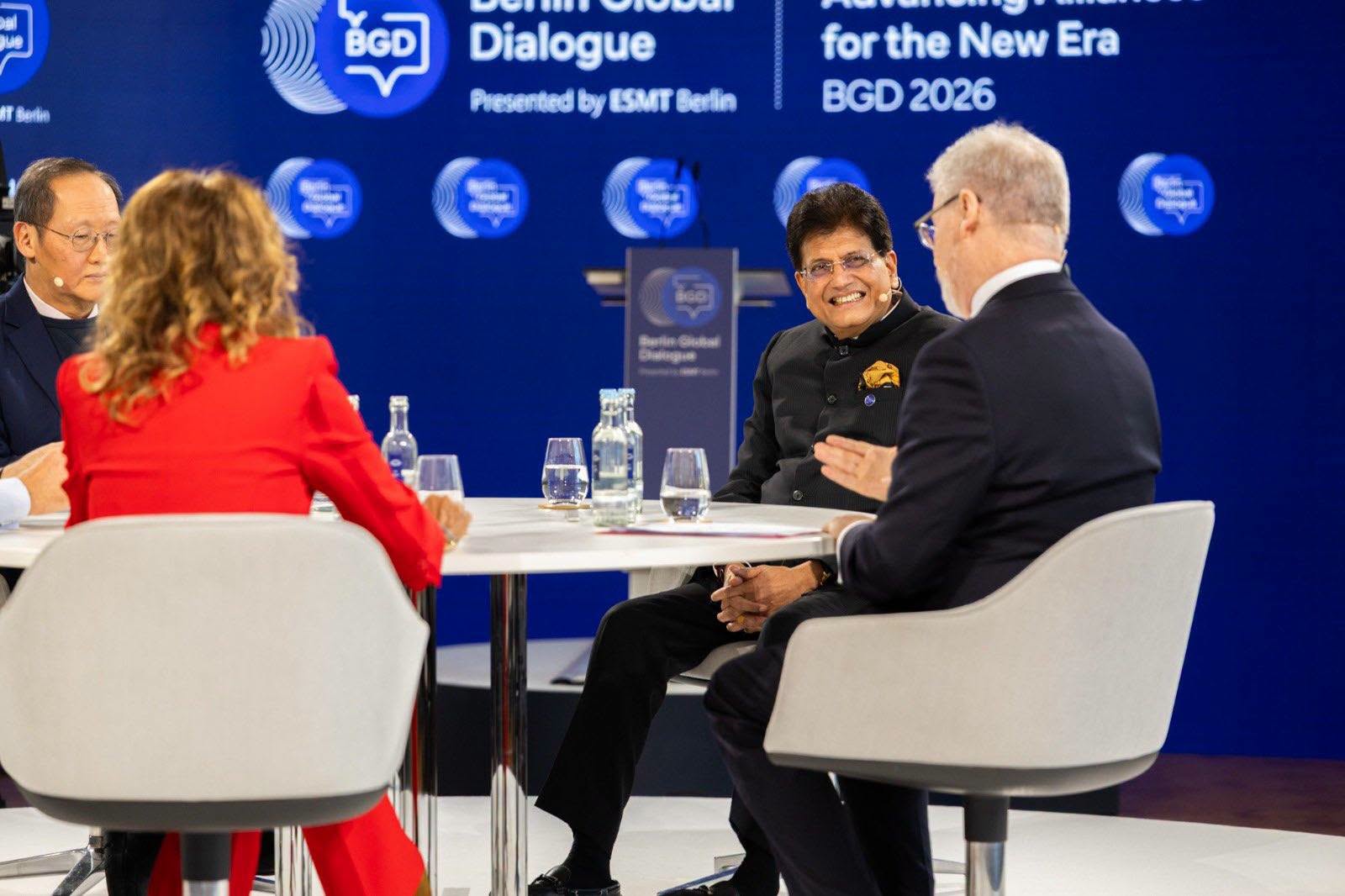
India's Commerce Minister Piyush Goyal at the Berlin Global Dialogue during the panel discussion on "New Era, New Alliances: The Third Path?" October 22, 2026. (Source: Piyush Goyal/Facebook)
Will electricity power inclusive prosperity and a cleaner future – or deepen inequality and the climate crisis? What does India’s experience reveal?
That gap, between the statistic and the lived experience, is the best entry point into India’s energy dilemma. It is also a warning for how we think about development everywhere.
A similar contradiction played out on a far larger scale in July 2012, when India suffered the world’s largest power-grid collapse, plunging an estimated 660 million people into darkness. The blackout disrupted railways, businesses and essential services, exposing weaknesses in grid management and transmission infrastructure. While the village illustrated the failure to connect households, the 2012 crisis revealed that even an extensive electricity network could not guarantee reliable power.
Both cases demonstrate that development must be measured not merely by infrastructure or official statistics, but by whether essential services actually reach people when they need them.
Power as a quiet form of freedom
We rarely notice electricity until it fails. In a developing economy, though, it is less a utility than a lever on nearly everything else. It lets a child read after sunset, a clinic refrigerate vaccines, a farmer run an irrigation pump, a tailor keep her machine running past dusk. Take it away, or make it unreliable, and growth at the national level never quite reaches the kitchen table.
When Bloomberg reported in January 2017 that some 240 million Indians lacked electricity, with roughly 50 million rural homes in the dark, the numbers were staggering. They were also a snapshot of a particular moment, not a verdict on the present. But a subtler point ran through both that investigation and MIT Technology Review’s 2015 account, unambiguously titled India’s Energy Crisis: a connection is not the same as power. A household wired to the grid but supplied for only a few hours a day, at inconvenient times, has been counted but not served.
The same unreliability burdened industry. Factories that cannot trust the grid buy diesel generators, absorb the costs, and hesitate to invest. A country dreaming of becoming the world’s workshop was building its ambition on a foundation that flickered.
The furnace problem
Here the story turns from a development problem into a planetary one. The fastest, cheapest and most proven way to power an industrialising India was coal. The country had it in abundance, and coal plants deliver electricity at scale whether or not the wind blows. A 2014 World Bank review reported that approximately 76% of coal consumed in India was utilized by the power sector, while coal accounted for 67% of the country’s total electricity generation. Burning it, however, releases carbon dioxide, the long-lived gas driving the warming of the planet.
The question MIT Technology Review put at the center of its reporting was blunt: could India power its manufacturing rise and its growing population without leaning heavily on coal?
It is easy to lecture from a distance. Wealthy nations built their prosperity over generations on fossil fuels and hold most of the historical responsibility for the carbon already in the atmosphere. To ask a country with millions still lacking basic amenities to forgo the same path, without offering affordable alternatives, is to ask its poorest citizens to pay for a problem they barely created. That is not climate policy. It is a moral sleight of hand, also sharply articulated by India’s Commerce Minister Piyush Goyal last week, at the Berlin Global Dialogue, where he questioned European countries over climate finance commitments.
Yet arithmetic is indifferent to fairness. With a population of well over a billion, even modest growth in each person’s energy use adds up to enormous growth in total demand. The International Energy Agency’s 2015 outlook named India as a leading driver of global energy-demand growth through 2040. The lamp in one village and the furnace in a distant power plant are connected to the same atmosphere.
The paradox of the idle plant
One of Bloomberg’s most striking findings cut against intuition. India could have spare generating capacity while millions of homes sat unconnected. Scarcity of electricity was not the whole story.
The deeper obstacles were financial and institutional. State distribution companies were burdened by losses, both technical and commercial. Poor rural households were unprofitable customers, so there was little incentive to reach them. Wires cost money; the people at the end of them often could not afford the bills. Power existed, but the last mile between plant and household had not been built or sustained.
This is a lesson that technologists sometimes resist: innovation is not just invention. A brilliant solar panel in a laboratory changes nothing for a family three hours from the nearest road. What matters is whether the technology can be financed, regulated, installed, maintained and paid for. India has never lacked engineers or ambition. What it had to build was the connective tissue that carries ideas out of institutes and into homes.
Two kinds of answers
The reporting pointed toward a pragmatic pluralism. Large renewable projects could feed grids with serious quantities of clean power, which is what factories and cities require. Decentralised solar installations and microgrids could serve villages where stringing conventional lines would be slow or prohibitively costly. Neither approach alone suffices. A country of such geographic and social variety needs a toolkit, not a single tool.
Narendra Modi’s government, in office from May 2014, committed to both ends of the spectrum. Rural electrification programmes such as the Deen Dayal Upadhyaya Gram Jyoti Yojana launched in 2014 strengthened village infrastructure, and the Saubhagya scheme, launched in 2017, targeted household connections directly. Alongside these, the government pushed renewable energy, solar in particular, with ambitious capacity goals.
Ambition, however, is not delivery. Renewable power needs transmission lines to carry it, storage to smooth its fluctuations, and flexible systems to keep supply steady as the mix changes. And while targets can be announced in a day, coal plants run for decades.
What counts as progress
The village with 15 connected homes reminds us that what we measure shapes what we achieve. If success means a pole and a transformer, officials will deliver poles and transformers. If it means a mother cooking by electric light and a workshop running through the evening, the effort must look very different.
The later record is encouraging, and it should be stated plainly. The IEA’s India Energy Outlook 2021 reported that near-universal household access was achieved in 2019, with more than 900 million people gaining a connection in under two decades. It is one of the largest expansions of access in history. The same assessment, however, cautioned that affordability, reliability and wide regional differences in consumption remained live concerns. Reaching the finish line of access reveals a second race: quality.
And neither race is the climate race. A nation can wire every home and still be shackled to coal. Conversely, a rush toward clean energy that leaves vulnerable families with costly or intermittent power would simply shift the burden onto those least able to bear it, along with workers whose livelihoods depend on the old energy industries. A just transition has to protect them too.
The question behind the question
India’s experience punctures a comfortable assumption: that developing countries must retrace the carbon-heavy path of earlier industrial powers. The alternative is possible, but it is neither automatic nor cheap. It demands patient investment, institutions capable of delivering on their promises, technology adapted to local conditions, and a willingness to treat sustainability as part of development rather than its enemy.
The deepest insight may be this: energy is never merely about energy. Every decision about generation, grid and tariff is really a decision about what kind of society the electricity will serve. Will it illuminate growth that is constrained by weak infrastructure? Growth that deepens the climate crisis? Or growth in which access, prosperity and cleaner technology advance together?
That choice belongs to India, but its consequences belong to everyone. A country of this size cannot decide its energy future privately. When a child in a once-dark village finally opens a book under an electric bulb, the question is not only whether the light stays on. It is what, across the whole warming world, the generating of that light will cost, and who will pay.
Related Topics
Related Posts