

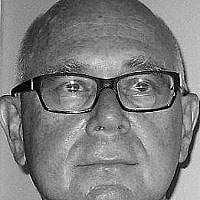
The Last Twins
Erno “Zvi” Spiegel is an unsung hero of the Holocaust – a nearly forgotten Hungarian Jew who saved young Jewish twins in the Auschwitz-Birkenau extermination camp in Poland from looming death.
An inmate in the camp since May 1944, he worked for Josef Mengele, the German physician who conducted gruesome medical experiments on twins he had personally selected upon their arrival in the camp. Spiegel, then 29, lived with the boys in a special barrack and related to them as a father figure.
Spiegel’s daughter, Dr. Judith Richter, researched his story to bring his legacy as a righteous person to the public. The Last Twins, a PBS documentary to be broadcast on June 15 at 10 p.m. (check local listings), fills in the blanks.
Narrated by the American movie actor Liev Schreiber, it focuses on several of the twins – Tom Simon, Mordechai Alon, Laszlo Kiss, Ephraim Reichenberg and Peter Somogyi – whom Spiegel rescued.
Spiegel recounts his rescue mission in an old recording integrated into the body of the film.
As Simon says, he and the other boys had never heard of Auschwitz when they got there by train from Nazi-occupied Hungary in the spring of 1944. They were among more than 400,000 Jews who had been consigned to Auschwitz by the pro-German antisemitic Hungarian government.
Mengele, a Nazi Party member, chose hundreds of twins for his pseudo experiments, immediately separating them from their parents. Only a few survived.
Known as the Angel of Death, Mengele employed Spiegel as a special assistant. His job was to accompany the male twins to Mengele’s office on the grounds of the camp, where 1.1 million Jews, political dissidents and Red Army prisoners of war perished. Mengele never addressed the boys directly, leaving that task to Spiegel, who watched over them benevolently.
Forty to 50 boys were under his supervision. According to one of the survivors, female twins were kept in another barrack and did not have a guardian like Spiegel.
Mengele was cruel and ruthless, judging by the comments of the surviving twins. Twins who survived experiments were often left maimed and blind. When a twin succumbed to the effects of an experiment, his sibling would be killed so that Mengele could compare their bodies in autopsies.
Spiegel, whose mother was murdered in Auschwitz, was subjected to an experiment as well, but details are not divulged.
The testimonies of the boys in this often touching film are stark and disheartening. They seem to hold back nothing.
They were due to be sent to the gas chamber in September or October of 1944, but Spiegel assured them they were safe. In a last ditch attempt to save his charges, he spoke to Mengele, who cancelled their executions. No reason is given for his decision.
With the Red Army closing in on the camp in January 1945, a particularly harsh winter, Auschwitz was evacuated by the Germans. Older twins joined what would be a death march toward Nazi Germany. Younger twins stayed behind with Spiegel, who kept a detailed list of the boys he had protected.
A Red Army officer arranged for them to be housed in a hotel in Krakow, Poland. From there, they embarked on a gruelling two-month journey back to Hungary, battling inclement weather and hunger. By that juncture, he and the boys had parted ways.
Spiegel was reunited with his sister, Magda, in Prague, where he met a woman who would be his wife. After their marriage, they immigrated to Israel and raised a family. For 30 years, he earned a living as the chief financial officer of a theater company.
Until his death, Spiegel never told his children about his ordeal in Auschwitz or about his role in saving twins. Judith, his daughter, learned about his past in a Life article. Thanks to this magazine piece, Spiegel met some of the boys whose lives intersected with his.
The Last Twins relates this poignant footnote in the Holocaust in sober fashion and preserves the memory of a noble man who rose above adversity.