
Carrie Bradshaw of the Middle East
The Leading Men of My World Cup
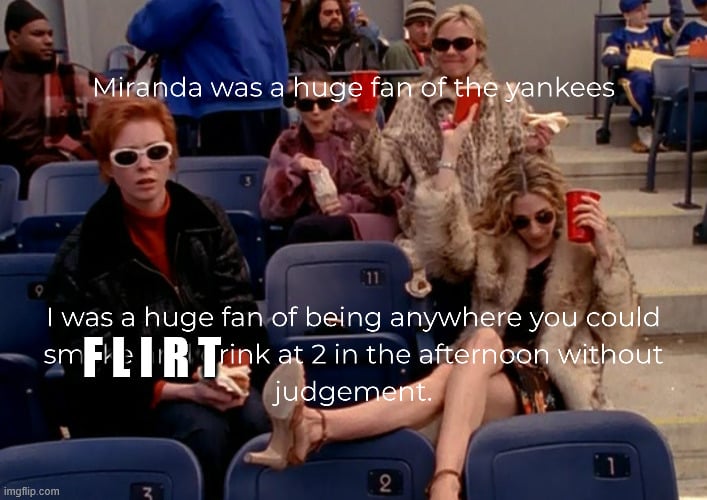
Adapted meme based on a scene from Sex and the City (HBO), included here for cultural commentary, gotten from the show's IMdB.
Effortlessly, Astronaut put his arm around me as he spoke to my friends. It occurred to me he was getting to know them. We had just watched Colombia advance to Round of 16 against Ghana and were wearing matching jerseys, subconsciously making us feel like part of the same team. I was trying to convince one of his friends to find a proper physical therapist for her swollen ankle. He laughed at the conversation as if he already knew me so well before turning back to me as his friends asked how we met.
Colombia came into this World Cup with the strongest team we could have hoped for, though we’d cheer for our tricolor even if they didn’t stand a chance. My dad remembers exactly where he was when, at nine years old, he watched the Moon Landing. He also remembers exactly where he was when Colombia beat Argentina 5-0 in a World Cup qualifier in 1993.
The night was not what I had expected. Just two weeks ago, this whole scenario was set to happen with a different leading man, someone I thought wanted to be on my team. Yet there I was with a guy I hadn’t even kissed yet who seemed completely at ease letting our friends– who were just meeting each other– know he was interested.
We met on a ski trip and immediately gravitated toward each other. He made me feel feminine and playful, which I had come to understand was a green flag. Astronaut, an aerospace engineer and not an astronaut, flirted like a gentleman and danced like the country we were born in. I was surprised when, after the ski trip, he didn’t immediately ask me out. I was even more surprised when my phone lit up with a message from him. Men always seem to know two things:
1. When you’ve starting seeing someone else.
2. When you’ve stopped.
This was, of course, the latter.
There’s a common belief that we shouldn’t talk about three things: religion, politics, and fútbol. I say, fuck it. Let’s talk about all three. They get tangled up anyway.
“When does the World Cup end?”, the last man I dated asked me, apparently surprised (and amused) that I cared this much about soccer. Long enough, it turns out, to convince myself he wanted to be with me, be accepted into two more Middle East fellowships, and watch Colombia elect a new president. Every four years, those elections collide with the World Cup, tying politics and national identity a little tighter to the jersey we wear.
The World Cup has overshadowed much in the news cycle and is happening at a time when US foreign relations are being redefined and reshaped. While millions of people have been watching nations compete on the field, another meeting of nations has received remarkably little attention. As we debated whether Colombia could make it another round, world leaders gathered at the NATO summit to debate Europe’s security, military spending, and the future of the alliance. One meeting decides which team wins. The other determines which team will fight beside you.
The screams of GOOOOL from my television set and at the various watch parties I’ve attended all month have overshadowed plenty for me, and I’ve let them. It’s not just about embracing escapism, but embracing a reality where countries must cooperate to be able to compete against each other. It takes coordination across the globe for these matches to take place, matches that unite communities under one flag– regardless of who you voted for. Competition, paradoxically, becomes another language of cooperation. Fútbol– or sure, soccer– doesn’t happen without agreements.
NATO (North Atlantic Treaty Organization) is an agreement, a political and military agreement between 32 countries, making it even more like the World Cup, which allowed 32 teams under its previous format (raised to 48 this year). It– NATO, not the World Cup– was meant to strengthen US presence in Europe and– this is big– deter Soviet expansion. Israel, in a state of persistent conflict but not in Europe, is not in NATO.
Trump’s view on NATO has largely been that we do more for the team than the team does for us, though plenty of wars have been fought to keep Russia from expanding its borders. Ukraine has been fighting that war for over four years and isn’t even considered to warm the bench. Meanwhile, Trump’s already skeptical stance on NATO has turned sour as the world sees the war with Iran as distasteful at best.
When someone on your team drops the ball, others must step up. This happens in relationships, too, the ultimate team of two people. Ideally, things balance each other out. That’s why we have partners, teams, and NATO.
I allowed myself to be swept off my feet by FIFA this past month, the way I’d allow myself to be swept off my feet by a man. It’s been a welcome distraction from a breakup I still don’t understand and a news cycle I’m pretending to understand. On Tuesday, July 7th, on the first day of the NATO summit, non-NATO member Switzerland eliminated Colombia, shattering the hopes of my proud country and bringing me back from my distractions.
Astronaut and I first bonded over a jersey and hugged each other as Colombia advanced to what would be its final round. I probably won’t remember where I was when I read the highlights from this year’s NATO summit, but I’ll remember that, just like my dad remembers where he was when Colombia scored five goals against Argentina. Maybe that’s the thing about alliances– whether they’re between countries, teammates, or two people. We rarely remember the negotiations themselves. We remember who stood beside us while they held.
Related Topics
Related Posts