


Senior Research Fellow, S. Neaman Institute Technion
The Link Between Palestinian & Israeli Nobels
From Lab to Life: The Link Between the Israeli and Palestinian Nobel Prizes
By Shlomo Maital
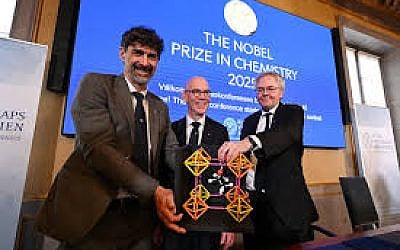 Omar Yaghi (center) and fellow Nobel Laureates. Source: Times of Israel
There is a powerful, poignant connection between the first Palestinian Nobel Prize for Science, awarded to Omar Yaghi, and the Nobel Prize for Economics, awarded to Yoel (Joel) Mokyr, Israeli who made his career in the U.S.
Yoel, who emigrated to Israel as a child in 1955 and did his B.A. degree at the Hebrew University, won the prize for his research and 2018 book (A Culture of Growth) showing that countries grow wealthy through their culture of innovation, creativity, entrepreneurship, and hence growth.
Yaghi, a Palestinian from Jordan, was sent by his father to study in a US high school, and remained, becoming a distinguished chemistry professor at UC Berkeley. He co-shared the Nobel with two scholars for developing metal-organic frameworks – advanced porous materials that can absorb water even from dry desert air, acting like microscopic spongers. His innovation can ultimately provide scarce water for arid regions, growing increasingly arid owing to climate change.
What is the connection? Hamas invested over $1 billion in tunnels, solely to attack Israel. That money could have gone for agriculture, science, education, health. It was fed by a culture of death. There is little evidence that a grass-roots culture of growth exists in Arab countries, even those drowning in petrodollars.
Yaghi absorbed and embraced the US culture of growth, which has made UC Berkeley one of the world’s great universities, with 63 Nobel Laureates (either faculty or alums)! Yaghi is the first Palestinian to win a science Nobel. Apparently, it was necessary for him to shed the culture of his birth, and embrace the culture of his adopted nation. The culture that has made Israel wealthy.
Israel is known, among others, for making the desert bloom. At my university, Technion, chemists are finding ways to draw water from the air, using metal-organic frameworks and other technologies. Technion researchers have developed innovative, energy-efficient technology, commercialized as H2OLL, that produces clean drinking water directly from the air, even in dry, desert conditions, “using a unique absorption/desorption process that’s more efficient than traditional cooling methods and also removes pollutants.” It doesn’t actually use MOF’s, but other Technion scholars are working on this technology, too.
Imagine, if those Hamas billion dollars were invested instead in schools and universities, building a culture of life rather than death, to enhance the lives of Gaza citizens. Instead — well, the images are terrible and disastrous. Those who supplied the billions – and yes, Israel, which acquiesced silently – are culpable, too.