Where history exposes power and moral failure
The Logical Fallacies That Erase Inconvenient Holocaust Prisoners
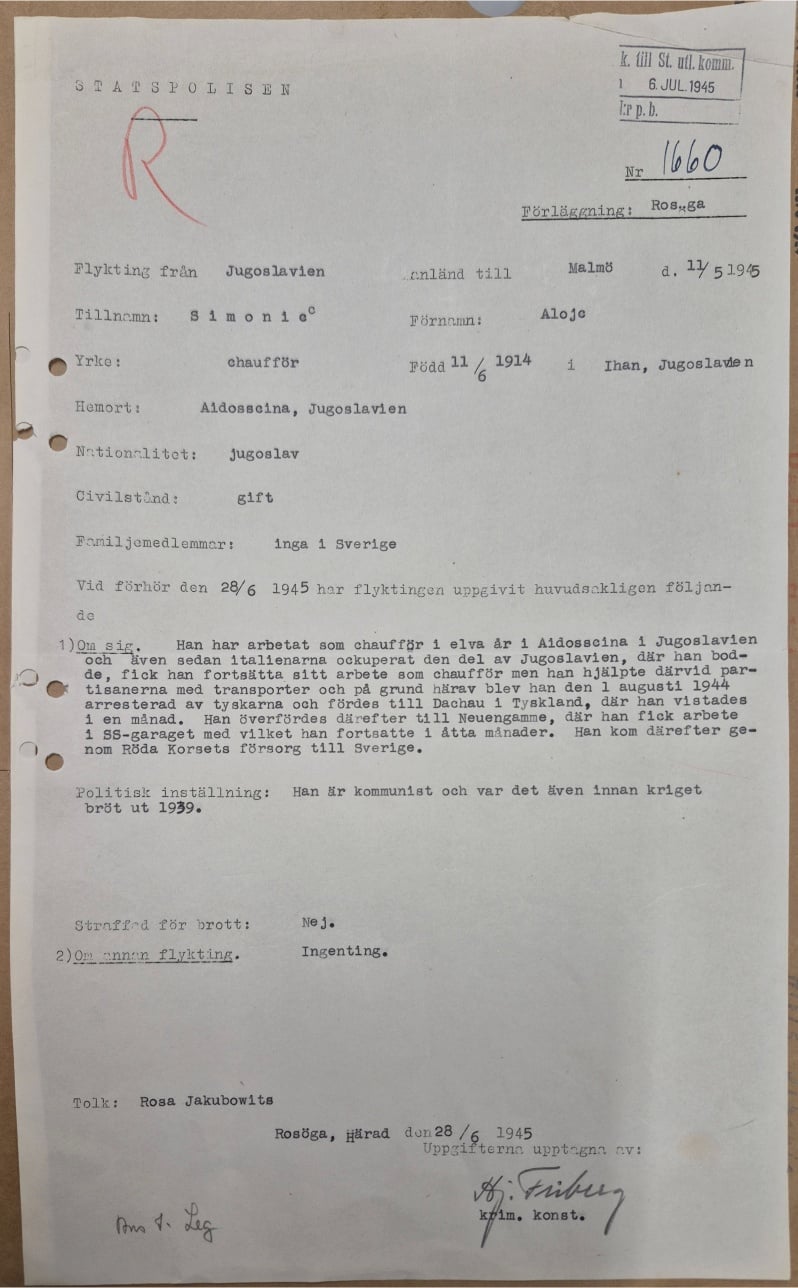
There is a document in the Swedish archives dated June 28, 1945. It records an interrogation of my husband’s grandfather, Alois Simonič, conducted only weeks after his liberation from the Nazi concentration camp system. He was thirty-one years old.
Alois had been born in 1914 in Ihan, in a part of Europe whose borders, governments, citizenship regimes, and occupying powers would change repeatedly during his lifetime. He made his living as a chauffeur and was married. During the occupation of Yugoslavia, he continued driving. He also used that work to help the Partisans with transportation.
The Swedish State Police recorded what followed with admirable economy. Alois said that he had assisted the Partisans with transports and that, because of this, the Germans arrested him on August 1, 1944. He was sent into the Nazi concentration camp system, first to Dachau and then to Neuengamme.
The form contains a separate entry for political orientation. Here the archive becomes wonderfully inconvenient.
“He is a communist and was one even before the war broke out in 1939.”
That is what the Swedish police recorded Alois telling them in June 1945.
No modern historian inferred his communism from fragmentary evidence. No political opponent applied the label to discredit him. No descendant reconstructed it from family gossip. Alois identified himself as a communist when the concentration camp system he had survived was still being dismantled.
The Nazi records independently establish his imprisonment within the political-prisoner system. Dachau documentation identifies him as a Schutzhäftling, records prisoner number 111385, his transfer from Trieste to Dachau in September 1944, and his subsequent transfer to Neuengamme. The surviving documentary trail continues through liberation and Red Cross evacuation to Sweden.
He survived, and so did the politics.
Communists belong to the history of Nazi persecution whether modern political movements enjoy remembering them or not. Political repression was foundational to the concentration camp system. Communists, Social Democrats, trade unionists, and other political opponents were among the earliest prisoners after the Nazi seizure of power. Dachau itself opened in March 1933 primarily as a camp for political prisoners.
None of this is obscure history. The discomfort begins when the prisoner is somebody’s grandfather.
Family memory has a remarkable ability to improve the politics of the dead. Political convictions become youthful indiscretions. Resistance becomes bad luck. Arrest becomes an inexplicable wartime tragedy. A person who made choices inside an occupied society is gradually converted into a harmless ancestor whom history simply happened to strike.
Several familiar logical fallacies make that conversion possible.
Presentism appears when current political loyalties become the test by which an historical victim is judged. If communism is morally repellent to me now, a communist persecuted by the Nazis becomes difficult to accommodate. His politics begin to shrink in the retelling until eventually they disappear.
Historical victimhood is not a character reference.
The Nazis did not persecute only people whose political opinions would be comfortable in contemporary America. Their concentration camps confined people whom the regime defined as political, ideological, racial, and social enemies. Political prisoners included Communists, Social Democrats, trade unionists, liberals, resistance members, and others considered dangerous to National Socialism. The red triangle marked political prisoners inside the camp system. Schutzhaft, or “protective custody,” supplied the bureaucratic language through which political detention could be administered.
The historical obligation is to describe why a person was persecuted, even when the answer produces someone we would not have invited to join our political party.
False equivalence arrives almost immediately after the word communist appears. Mention a communist imprisoned by the Nazis and somebody begins discussing Stalin or Mao.
Their crimes require no defense. They also do not alter the record of a man arrested by German authorities in occupied Yugoslavia.
Alois did not become less imprisoned at Dachau or Neuengamme because Stalin committed mass murder. Prisoner number 111385 does not disappear because the Soviet Gulag existed. Mao’s later crimes cannot travel backward through time and change the reason German authorities arrested a Yugoslav chauffeur in 1944.
The historical inquiry is narrower than the ideological argument people often substitute for it. Why was this man arrested?
Alois answered. He helped the Partisans with transportation. The Germans arrested him because of that activity. Asked separately about his political orientation, he identified himself as a communist and said that he had been one before the war.
Stalin is not an answer to any of those facts.
Then comes No True Victim, the demand that persecution become easier to condemn by making the persecuted person sufficiently passive, innocent, politically familiar, or morally congenial.
A communist who helped Partisans is awkward because he possessed agency. He believed something. He chose something. He used the ordinary skill by which he earned his living to assist people resisting occupation. His imprisonment cannot be reduced comfortably to the randomness of war because he gave an explanation for why he was arrested.
Perhaps Alois believed things his descendants later rejected. Perhaps he held convictions some of them would find abhorrent. Perhaps the man who spoke to Swedish police in 1945 would be unwelcome at their dinner tables today.
None of that makes his arrest by the Germans less historical.
He should not be remodeled in the opposite direction either, into a liberal-democratic hero whose communism was somehow incidental to an otherwise comfortable resistance story. Communist resistance to fascism emerged from actual political traditions, organizations, loyalties, and objectives. Yugoslav Partisan history cannot responsibly be rewritten as an American civics lesson populated entirely by people who would have agreed with us.
A person can resist one murderous political system without acquiring retrospective absolution for every doctrine associated with his own politics. Historical adults should be allowed to remain adults.
Political prisoners are especially vulnerable to sanitization because acknowledging their persecution requires acknowledging what made them political. Nazi repression of communism was present from the beginning of the regime. The language surrounding that repression was already an exercise in distortion. Schutzhaft means “protective custody,” a phrase of astonishing bureaucratic politeness for detention outside normal judicial protection.
The euphemism survives in the archive. So does the prisoner.
Appeal to consequences begins when an historical fact creates an uncomfortable implication in the present and somebody starts negotiating with the fact.
This becomes especially tempting when descendants embrace politics their persecuted ancestors might have despised. Grandpa was not really a communist. His communism had nothing to do with his arrest. Helping the Partisans was peripheral. Politics was beside the point. He was simply unlucky.
My husband grew up hearing that his grandfather had been in the “wrong place at the wrong time.”
The archive is less accommodating.
Alois was in a particular place at a particular time doing something. Swedish police recorded that he helped the Partisans with transportation, that he attributed his arrest to that activity, and that he identified himself as a communist.
“Wrong place at the wrong time” removes the verbs. It also removes the Germans.
Nobody arrests him. Nobody objects to his politics. Nobody punishes assistance to resistance. History becomes weather. Unfortunate conditions descended upon a passive man.
That grammatical disappearance appears frequently in family histories of political violence. People “ended up” in camps. They “were caught up” in events. They “had to leave.” Sometimes those constructions accurately describe lives over which victims possessed almost no control. Sometimes they conceal the perpetrator, the reason for persecution, and the choices a person made before the state seized control of everything that followed.
Alois’s account is harder to sterilize because it contains actions. He worked as a chauffeur. He drove. He helped the Partisans. The Germans arrested him.
The ordinariness of the first two actions is worth keeping. Resistance did not always begin with somebody dramatically picking up a rifle. Alois knew how to drive and had access to transportation. Under occupation, he used those circumstances to help Partisans.
That man is more historically legible than the grandfather who merely wandered into catastrophe.
There is also the genetic fallacy, dismissing evidence because of who found it or because the conclusion it supports is unwelcome. A Dachau register and a Swedish police report from 1945 do not become less reliable according to the politics of the modern reader. Their provenance, date, institutional origin, internal consistency, and corroboration determine their evidentiary value.
More inconveniently still, the communist in this case is speaking for himself. On June 28, 1945, a Swedish official asked about Alois’s political orientation. He answered. He was a communist and had been one before the war.
There is no modern ideological intermediary to remove from that sentence.
Anachronistic partisan sorting creates another distortion. American political categories are projected backward onto occupied Yugoslavia until “communist” becomes an all-purpose contemporary insult rather than an historical description.
Alois was Catholic. He was also a communist.
Those facts are perfectly capable of occupying the same human life. They also belong to a European political world that cannot be reduced to the vocabulary of twenty-first-century American elections.
Nazi anti-communism must likewise be understood inside its own ideological structure. National Socialism did not regard Bolshevism as an ordinary competing economic theory. Nazi propaganda fused communism with antisemitism through the fantasy of “Judeo-Bolshevism,” presenting Marxism and Bolshevism as instruments of an imagined Jewish conspiracy against Germany and Europe.
The fact that Alois was Catholic presents no difficulty whatsoever for understanding that ideology. Nazi propaganda did not require actual communists to be Jewish. Its antisemitic conspiracy theory treated communism itself as supposedly Jewish in origin and direction while the police state arrested real Communists of many religions and ethnicities.
That connection matters particularly when discussing Holocaust history. Jewish persecution and political persecution were not identical, and the distinctions between them must remain exact. The Nazi regime nevertheless constructed both inside a political universe in which racial antisemitism, anti-Bolshevism, antidemocratic repression, occupation, and the destruction of political opposition continually reinforced one another.
The Holocaust was the systematic persecution and murder of European Jewry, culminating in a project of continental annihilation. Jews were targeted as Jews under a racial ideology that ultimately denied them any legitimate place within the German sphere of power.
Acknowledging communist prisoners does not dilute that history. It allows us to describe the regime that perpetrated it with greater precision.
The same government could pursue the annihilation of Jews, imprison political opponents, murder disabled people, persecute Roma and Sinti, destroy resistance movements, exploit forced labor, and reorganize occupied populations according to racial and political hierarchies. Those histories intersect without becoming interchangeable.
Forgetting the communists does nothing to honor the Jews. It simply makes Nazism easier to misunderstand.
A related fallacy is moral contamination, in which crimes committed by a political movement elsewhere or later are used to contaminate retrospectively every person who had earlier identified with that tradition.
Chronology objects. The Alois preserved in the surviving documents was a chauffeur in occupied Yugoslavia, a communist before the war, a man who helped Partisans with transportation, a political prisoner taken into the German concentration camp system, and eventually a refugee brought to Sweden through the Red Cross. The historical record is open to further investigation. It does not require political protection from evidence, favorable or unfavorable.
It does require that the evidence belong to his life rather than to somebody else’s. His life now sits inside another uncomfortable historical problem.
More than eighty years after Alois’s imprisonment, I represent his grandson and great-grandson in proceedings under §58c of the Austrian Citizenship Act. My husband has formally authorized me to represent him and our son before Vienna’s MA35, including complaints, proceedings before the Vienna Administrative Court, access to files, and appellate proceedings.
Section 58c is a restitutionary provision intended to address the consequences of Nazi persecution. The difficulty in Alois’s case arises from precisely the sort of life persecution produced. Imperial collapse, shifting borders, political imprisonment, concentration camps, liberation, refugee movement, uncertain nationality, and eventual statelessness do not leave behind the administrative neatness modern citizenship systems prefer.
The paradox is ugly. A person’s legal identity can become unstable because European states collapse, borders move, fascist authorities imprison him, war displaces him, and postwar governments struggle to classify him. Decades later, that instability can become an obstacle inside a legal framework created to repair the consequences of Nazi persecution.
The historical sanitization of Alois and the administrative difficulty of §58c arise from different institutions and different purposes, but they share one dangerous appetite: the desire for a cleaner victim.
A politically neutral prisoner would be easier. A stable nationality would be easier. A continuous residence history would be easier. A passport trail uninterrupted by fascism and war would be easier.
Alois did not supply any of them. He supplied a life.
He was born in 1914 in Ihan. He was Catholic. He made his living as a chauffeur. He married. He was a communist before the Second World War. Under occupation, he helped Partisans with transportation. He told Swedish police that the Germans arrested him because of it. Nazi records placed him within the political-prisoner system. He became prisoner 111385 at Dachau and was transferred to Neuengamme. He survived. The Red Cross brought him to Sweden.
The questions historians should ask remain concrete. Why was this person arrested? What classification did the SS assign? What political activity preceded the arrest? What racial, religious, national, or ideological categories did the regime impose? Which state actions shattered the continuity later bureaucracies demand?
The answers will sometimes produce people whose politics we dislike. They should. The dead are entitled to something better than posthumous political grooming.
Alois’s communism does not need my endorsement, and his persecution does not require ideological rehabilitation. Calling him apolitical because his politics have become inconvenient strips the resistance from the resister and the cause from the persecution.
The Nazis gave him a number. The archive gave him back his verbs. His name was Alois Simonič.
Prisoner 111385 was a communist.
Related Topics
Related Posts