
Director of the Center for Law and Antisemitism, Striks Faculty of Law
The Long History of ‘It’s Just Anti-Zionism’
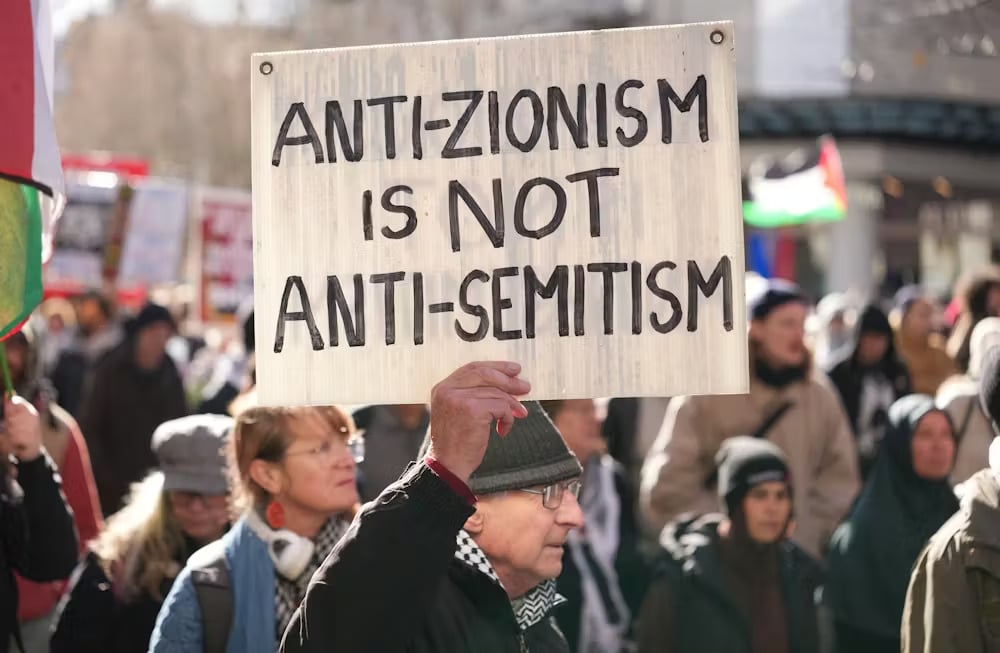
A demonstrator holding a sign stating “Anti-Zionism is not antisemitism,” reflecting a recurring argument in contemporary and historical debates. Photo: Scott Barbour/AAP
October 7, 2023 was the deadliest day for Jews since the Holocaust. In its aftermath, however, Jews were targeted not only in Israel. Almost immediately, a global surge in antisemitic incidents unfolded far beyond the Middle East. According to leading researchers, this period saw one of the most severe waves of antisemitism since the end of World War II, marked by a sharp rise in physical attacks, threats, vandalism, and intimidation against Jewish communities in numerous countries.
Alongside these acts, a familiar argument gained renewed prominence: that many of these incidents should be understood not as antisemitism, but “only” as opposition to Zionism or to Israel. As long as Jews were targeted as “Zionists,” and hostility was framed as political critique, it was said to fall outside the category of antisemitism. What looked to many Jews, and non-Jews as well, like a familiar pattern of hatred was thus explained away as politics. Not antisemitism, but “only” anti-Zionism.
To be clear, opposition to Zionism is not inherently antisemitic, and not every claim that hostility is “only” anti-Zionist is made in bad faith. The problem arises when this distinction is treated as self-evident or absolute – especially when it is used to explain away hostility that closely resembles older patterns of antisemitism. What is striking, however, is that this move is far from new. More than seventy years ago, the same argument was already being invoked to deflect attention from some of the most blatant antisemitic affairs of the postwar era.
The most notorious examples were the Slánský trial in Czechoslovakia and the Doctors’ Plot in the Soviet Union. In the former, fourteen senior Communist officials, eleven of them Jews, were accused of leading a “Zionist-imperialist conspiracy”; eleven were executed after forced confessions, while three were sentenced to life imprisonment. In the latter, nine doctors, six of them Jewish, were publicly accused in the Soviet press of plotting to assassinate Soviet leaders. The accusations were part of a fabricated campaign orchestrated by the Stalinist regime, which was abruptly halted after Stalin’s death and never led to a trial or formal charges. In both cases, the defendants were not formally targeted as Jews but as “Zionists”: alleged agents of Western imperialism and participants in a global conspiracy against the socialist state. As later scholarship has shown, notably in the work of Izabella Tabarovsky, this rhetorical move, which recast antisemitism as anti-Zionism, became a defining feature of Soviet and post-Soviet antisemitic discourse.
For many Jewish observers at the time, the antisemitic character of these campaigns was clear. Jewish organizations, Israeli newspapers, and Israeli leaders across the political spectrum identified them as such. Yet this recognition was far from obvious in its historical context. The events unfolded less than a decade after World War II, when the Soviet Union was widely regarded as the force that had defeated Nazism, and antisemitism, officially outlawed in the USSR, was commonly understood as synonymous with fascism. These campaigns therefore forced a troubling reassessment: antisemitism was not confined to the radical right, nor exclusively rooted in fascist ideology. It could also emerge from the political left, here in a Communist form, cloaked in the language of anti-imperialism and progress.
Israel responded with a broad public and diplomatic effort against Soviet antisemitism, appealing to Western public opinion and raising the issue in international forums. Then–foreign minister Moshe Sharett described the trials as imbued with a “malignant antisemitic spirit.” In doing so, Israel proved willing to risk its highly sensitive and strategically important relations with the Soviet Union – ties that were indeed strained, and temporarily severed, as a result of this stance.
More importantly for the purposes of this discussion, these affairs triggered a broader conceptual shift. In their wake, Jewish actors began, apparently for the first time in a sustained and systematic way, to articulate a link between anti-Zionism and antisemitism. As I argue in a recent article published in the Journal of Jewish Identities (Issue 19, Number 1, January 2026, pp. 41-58), this identification did not emerge from abstract theory, but from concrete observation: even when accusations were formally directed at “Zionists,” the persecution in practice targeted Jews as such, regardless of their actual connection to Zionism or to Israel.
Thus, for example, Moshe Baharav, an Israeli activist who headed a local organization combating antisemitism, wrote on November 28, 1952, following the trials, that “hatred towards Israel and towards Jewishness are one and the same, and Czechoslovakia and the rest of the countries belonging to the communist camp don’t hold the patent for this hatred.” Similar arguments appeared in Davar, the newspaper of Mapai, in two separate articles published on the same day in February 1953. The first one stated that “In our era, Judaism and Zionism, as well as the diaspora and the State of Israel, cannot be separated. This results in the new merging of antisemitism and anti-Zionism. Anti-Zionism is the clearest form of any struggle against Jews.” And the following article noted: “It would be futile to argue that the meaning of anti-Zionism and anti-cosmopolitanism is not antisemitism. The goal and purpose [of each] are the same, whatever the means may be.”
Soviet authorities across the Eastern Bloc, however, categorically denied that antisemitism played any role in these campaigns. Instead, they insisted, already then, that this was “just anti-Zionism.” The prosecutions were framed as legitimate political struggles against Zionism, portrayed as a hostile, imperialist ideology, rather than as persecution of Jews. From this perspective, the fact that most of the accused were Jewish was deemed irrelevant: they were targeted not as Jews, but as “Zionists.” Anti-Zionism was thus presented not merely as distinct from antisemitism, but as its very opposite.
This reasoning was articulated openly across the Eastern Bloc and echoed by Jewish Communist circles in Israel. Communist authorities in several countries, including East Germany, insisted that anti-Zionism and antisemitism were fundamentally different phenomena. Measures taken against “Jewish agents,” they argued, were legitimate security actions, while accusations of antisemitism were dismissed as Western propaganda designed to obscure the political nature of the struggle.
The same logic appeared explicitly in the Israeli Communist newspaper Kol HaAm (The Voice of the People). Its writers reproduced statements by Klement Gottwald, the founding leader of Communist Czechoslovakia, who argued that “antisemitism is the theory of racist fascism, while the war against Zionism is a defense against American spying.” In another issue, the paper echoed remarks by William Široký, then vice president of the Czechoslovak State Council, who dismissed allegations of “antisemitism in Czechoslovakia” as a “slanderous fabrication” and insisted that the struggle against Zionism had “nothing whatsoever to do with antisemitism.” In all these cases, the conclusion was presented as self-evident: anti-Zionism could not, by definition, be antisemitism.
History does not resolve contemporary debates, nor does it erase the need to distinguish between political criticism and racial hatred. But it does offer a cautionary reminder: the claim that something is “only anti-Zionism” has been made before – often precisely when acknowledging antisemitism carried significant political or ideological costs.
Related Topics
Related Posts