The Lost artwork of Ary Lochakov – 80+ Years later
Mystery By The Bay
Eighty years after disappearing from Paris, the life’s work of Jewish painter Ary Arcadie Lochakov mysteriously resurfaced on a San Francisco park bench.
How? Who was he? And who kept then abandoned his long-missing art?
The discovery reopened a window onto the shtetl of Montparnasse and the self-published Yiddish tome Undzere farpaynikte kinstler (Our Martyred Artists).
A serendipitous find by a San Francisco city worker — and his sensitivity to art — prevented the possible discard of nearly five dozen works and helped solve a decades-long mystery.
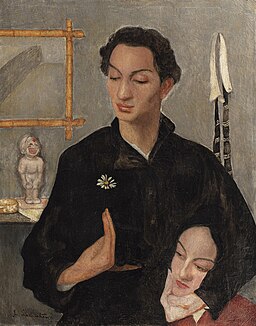
(Attribution: Ary Arcadie Lochakow, Public domain, via Wikimedia Commons)
On a May morning in 2022, Port of San Francisco maintenance worker Jermaine Joseph was on duty at Crane Cove Park when he noticed something unusual: nearly 50 pieces of artwork, arranged with care, some anchored with stones to prevent them from blowing away.
His find — an art-world equivalent of the Antikythera device discovery (the 2,000-year-old analog computer found in 1901) — set into motion a search for a Jewish painter that ultimately linked Bessarabia and Paris and the famed, if forgotten, École de Paris. Along the way, it also shed new light on the long-forgotten Yiddish book Undzere farpaynikte kinstler (Our Martyred Artists).
Joseph realized the artworks had only recently been placed there. But by whom? And why had they gone through such effort to attract attention?
Sensing something unusual, Joseph alerted colleagues Arianna Cunha, Projects Analyst at the Port, and Tim Felton, who happened to be on site for another task.
The team noticed the name “Lochakov” on many of the works, dated 1920–1941. Intrigued, they carefully collected the pieces and secured them in a conference room at their Pier 50 offices.
A Detective Story Unfolds
Cunha then took on a role worthy of Sherlock Holmes. Who was this Lochakov? How and why did his work miraculously appear along the shores of the Pacific? Who put the art there?
Her first step was the police: any reports of lost or stolen art? None. Next, she contacted museums, cultural centers, and art historians. Using online resources and museum networks, she eventually identified Lochakov by comparing the newly found trove with one of his works held at the Ghetto Fighters’ House Museum in Israel.
Ary Arcadie Lochakov: Life and Legacy
Cunha’s research uncovered the life of Ary Arcadie Lochakov: born in Orhei, Bessarabia (today, Moldova) in 1892, he studied painting at Odessa’s School of Fine Arts before joining the Russian Army in World War I — managing to survive the Eastern Front. After the war, he moved to Paris and became part of the École de Paris.
Paris was the art capital of the world, attracting artists from across Europe, many of them Jewish, fleeing poverty, pogroms, or political repression. Montparnasse was a hive of cafés, cheap studios, and intense cross-cultural interactions. Other artists of the Paris School included Marc Chagall, Amedeo Modigliani, Chaim Soutine, Jules Pascin, Moïse Kisling, and, of course, Ary Arcadie Lochakov.
From 1931 to 1938, Lochakov most probably lived at 38 rue du Vieux Port de Sèvres in Boulogne-Billancourt. He also worked in a photography studio to make ends meet. During his Paris years, he exhibited at the Salon d’Automne, Société des Artistes Indépendants, and the Salon des Tuileries.
Like many Jews trying to survive in Nazi-occupied Paris, Lochakov’s life was difficult. He died of malnutrition in October 1941 at Ambroise-Paré Hospital.
From The Paris Ghetto Across America to The Bay
The rediscovery of Lochakov’s paintings in San Francisco in 2022 occurred at a striking moment. Only a year earlier, in Paris, the Musée d’Art et d’Histoire du Judaïsme had mounted a major exhibition titled “Hersh Fenster et le shtetl perdu de Montparnasse”* — focusing on Jewish members of the École de Paris and based on Fenster’s research. *’The Lost shetetl of Montparnasse
Another serendipitous spinoff of finding Lochakov’s work was the light it cast on a long-forgotten and extraordinary book, Undzere farpaynikte kinstler (Our Martyred Artists). This self-published memorial/art book, in Yiddish, was published in 1951 in Paris by journalist and writer Hersh Fenster.
Fenster had lived in Paris since the early 1920s, but when he returned after WWII, he noticed that artist friends from the pre-war Paris art scene had vanished — deported, murdered, or lost to history. His book commemorates 84 Jewish artists — painters, sculptors, illustrators — who lived in Paris during the interwar period. Only a few hundred copies were printed.
The rediscovery of Lochakov’s paintings also highlighted Fenster’s book anew, allowing readers today to reconnect with artists who had been almost completely forgotten. A modern French translation, Nos artistes martyrs, was published by Éditions Hazan and the Musée d’Art et d’Histoire du Judaïsme in 2021.
From the San Francisco Mists to the Glow of Paris — A Treasure Returns Home
After a free public exhibition of Lochakov’s work at San Francisco’s Ferry Building, the artworks were sent to mahJ, the Museum of Jewish Art and History in Paris.
How did Lochakov’s art find its way from WWII Paris to San Francisco, more than 80 years after his death? And, once there, who took the trouble to carefully haul it to Crane Cove Park, arrange it just so, and then…….vanish?
What is known from online sources is that Lochakov’s collection was probably acquired by a family member or friend after his death. The best summary of what then followed comes from a this great report from KQED:
“That the art survived at all is its own miracle … the result of an unlikely line of stewardship, from artist, to nephew, to nephew’s ex-wife, to ex-wife’s sister, to ex-wife’s sister’s daughter. The artworks traveled from Paris to New York, to Providence, Rhode Island, to Huntsville, Alabama, and finally to San Francisco, where they were in the possession of Lochakov’s distant relative Diane Sammons. Sammons, a pediatric nurse at UCSF, died nearly a year before the pieces surfaced.”
But what then? How did the collection get from Sammons to the person or persons who meticulously transported all 48 works to the park that fine May morning, arranging them in a way almost certainly meant to attract attention, discovery and safeguarding? A curious chain of events — perhaps mini-miracles — ultimately led to their being transferred back to Paris many decades later.
Lochakov & the Parallels of the Jewish Experience
Today, after an eight-decade odyssey across borders, dusty attics, cold storage rooms, oceans, and near-forgetting, the once-lost works of Ary Arcadie Lochakov have returned home to Paris.
How they survived, whose hands protected them, and what stories accompanied them on their silent voyage — much of that may never be fully known. But in the quiet vault of the Musée d’Art et d’Histoire du Judaïsme in the Marais, the paintings endure, bearing witness to a life, a city, and a century that nearly let them slip away. They await their long-overdue moment back in the sun.
For those hoping to see and experience the collected Lochakov artworks in person, a public showing is unlikely until well after a planned museum renovation — which, knowing Paris, means possibly 2030 or later. This, according to the museum. So, sadly, a bit more of a wait.
The museum does offer a virtual visit of its regular permanent collection online, allowing visitors to explore galleries and view high-resolution images of works currently on display.
Resources
Digitized Yiddish edition of Undzere farpaynikte kinstler — read or download for free: Read Undzere farpaynikte kinstler
French translation — Nos artistes martyrs (Éditions Hazan / MAHJ, 2021)
MAHJ exhibition “Hersh Fenster and the Lost Shtetl of Montparnasse” (May–Oct 2021)
Exhibition details